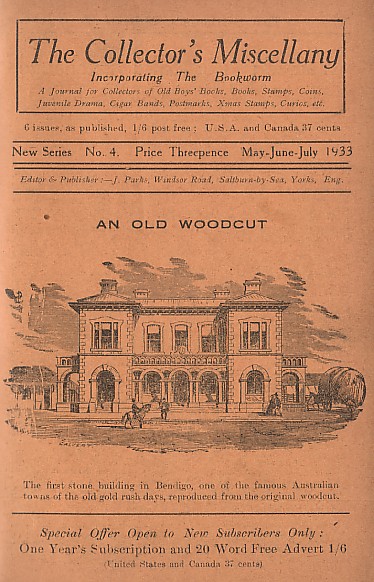
New Series No.
4. May-June-July 1933.
58
Wanted: Fox’s Boys Standard, Boys Leisure Hour, Boys Champion Journal, Halfpenny Standard, Vol 7 and 8 Boys Comic Journal, Vol 37 Boys of England. Also Young Ching-Ching, Green as Grass, That Rascal Jack, The School on the Sea, Cheeky Charlie. Robert Dodds, 3 Garngad Hill, Glasgow.
Wanted British
Bloods and Penny Dreadfuls, in volumes or runs, also old songsters, sheet
music, broadsides, playbills, etc. James
Madison, 465, So.
65
NEVER was there such an awkward commodity to trade as the rare penny dreadful or scarce old boys journal, simply because every man is a law unto himself, and there are no bookseller’s or auction room values, such as govern accepted literature, which according to the highbrows, even the beloved and revered works of E. Harcourt Burrage are not, and however we, his disciples, or the devotees of Geo. Emmett, Bracebridge Hemyng, Percy B. St. John, etc. may bristle at such a suggestion, it is none the less a cold commercial fact.
Enthusiasts from all over the world, in response to my well known invitation, call on me to inspect my collection, and from nearly everyone of them comes the question: “Mr. Ono, which do you regard as your most valuable possession?” I look at my immaculate copy of E. Lloyd’s “Gentleman Jack,” from that to my original Fox “Ching-Ching” series, to the “Wild Boys of London,” or to my runs of Fox and Emmett journals, and I have to confess myself stumped at the question. Simply because each and every one of them are worth just exactly what they will fetch, and I know these curious old books, more than any others, are governed by one immutable law, the reluctance of one man to part as against the eagerness of another man to possess. Granted both men happen to be in comfortable financial circumstances, a grotesque price can occur, which if it becomes known, is aggravatingly quoted as a ridiculous precedent, by those possessed of that little knowledge that becomes a dangerous thing.
Has it ever occurred to you that one man can create a value? If he informs all those who matter that he is willing to give £l0 for say a clean copy of “Moonlight Jack,” then until he is supplied, every copy of that book is a potential £10. Once supplied, try and get £5 for the next copy and you might try in vain. Has it also occurred to you that, if there were as many collectors of “bloods” as there are of foreign stamps, a clean copy of “Blueskin” would quite reasonably be worth £500, instead of the
66
humble fiver which is usually its limit. Just a few scores of “blood” collectors as against thousands of philatelists.
Three or four of the old collectors have died in the last three years, and their passing has caused a difference in values. Simply because they “paid the piper, and they called the tune.” Its a funny game all on its own.
If I had six copies of the “Wild Boys of London” I could place them because I happen to know where they are wanted. If I had nine, I should be stumped what to do with the other three, and that is how near it is. Can it be wondered that booksellers never understand these books and never will? Maybe it is as well for us that they do not. I have had the common Hogarth House “Charity Joe” quoted me as “rare old penny dreadful, 25/-” and from the same man bought a nice copy of “Gentleman Clifford” for 7/6.
One of the biggest causes of the confusion of booksellers as to values was the two enormous remainder stocks put on the market about twenty ago, of Edwin J. Brett’s 6d. re-issues, and the Hogarth House romances. But not only has this lot confused the ordinary secondhand bookseller, but also some of the little dealer collectors who have crept into the game this last few years, and who are prone to consider themselves oracles. One of these a few weeks ago asked me could I supply him with copies of “Crusoe Jack,” “Midshipman Tom” and “Frank Fearless.” But he reminded me “that as these were only common remainder titles, the figure must be low.” And this is a man who considers himself quite an authority on the subject, so when I told him to send me along as many copies of “Crusoe Jack” for 20/- a time as he could get hold of, it must have shaken
his “remainder” theory somewhat.
I know collectors who would get palpitation of the heart if they saw a good copy of “Sweeny Todd” but who would look coldly at a fine specimen of “The Skeleton Horseman” which should be worth four times as much. So how do we arrive at values?
Including myself, there are about half a dozen specialists the world over, who lay ourselves out to find copies for others as well as to augment our own collections, and on the whole, it is a very unthankful task. Eliminating the little border line collectors, with what I call “a seven and sixpenny outlook” there are not more than half a dozen collectors the world over who are satisfied or able to pay fair prices for really rare items. You buy say a small collection of about forty items. Five of the top notchers you place at once, but the other thirty-five remain on your duplicate shelves for years. No one wants them. So what is the value of a penny dreadful? I don’t know. Who does?
BARRY ONO
67
BY JOSEPH PARKS
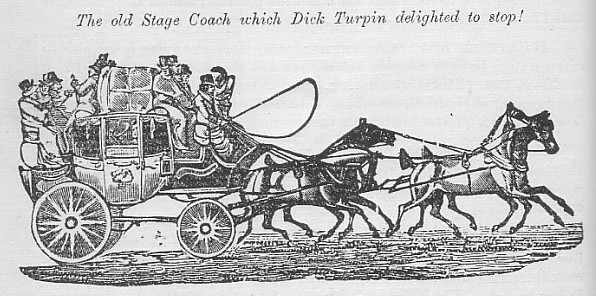
ONE of the most popular characters in British fiction from
the time of his execution down to the present day was Richard, or as he is more
popularly known, Dick Turpin. Turpin was
the son of an
He certainly never rode from London to York in twelve hours as is so often stated, but the ride was accomplished in this time; namely in 1676, by Neveson (or Nicks) who having plundered a traveller at four o’ clock in the morning at Gadshill, set off for York and was in the bowling green at York, before a quarter to eight in the evening, and thereby proved an alibi.
Turpin stopped Tom King upon the road and from thence onwards, they were inseparable companions, King being accidentally shot by Turpin whilst endeavouring to escape from some officers who were attempting his capture.
Shortly after this, Turpin went to Long Sutton in
The first definite record of the mention of Turpin in literature that I have been able to trace, is to be found in a chapbook of songs entitled “The Dunghill Cock; or Turpin’s Valiant Exploits,” circa 1796. Doubtless long before this time chapbooks and songsheets dealing with his daring deeds were published, but owing to their fugitive nature none appear to have survived. I have a songsheet entitled “O Rare Dick Turpin,” published
68
by the Catnach Press.
The famous Catnach Press was founded by James Catnach in Seven Dials,
In 1834 Ainsworth published his famous “Rookwood,” which so
graphically describes the fictitious ride to
Thomas White, of
Perhaps the most popular romance dealing with Turpin was
“Black Bess” published by
followed by the sequel “Black Highwayman” in 86 numbers. This item is scarce.
(To be continued)
69
“Moonlight Jack, the King of the Road,” 30 numbers. Newsagents’ Publishing Company, 1866.
“Dance of Death; or, the Hangman’s Plot,” 23 nos. Newsagents’ Pub.
“Wild Will; or, the Pirates of the
“Red Ralph; or, the Daughter of Night,” 52 nos. Newsagents’ Pub.
“Skeleton Horseman; or, the Shadow of Death,” 60 nos. Newsagents’ Pub.
“Skeleton Crew; or, Wildfire Ned,” 24 nos. Newsagents’ Pub.
“Tales of Highwaymen,” 62 nos. Newsagents’ Pub.
“The Boy Pirate,” 92 nos.
Newsagents’ Pub.
“The Boy Detective; or, the Crimes of
“Black Hawke, the Highwayman,” 19 nos. Newsagents’ Pub.
“Lightning Dick, the Devil of Whitefriars,” 21 nos. H. Lea, 1865.
“Gentleman Clifford; or, the Ladies’ Highwayman,” 35 nos. E. Harrison, 1864.
“Lion Limb, the Boy King of the
“Ivan the Terrible; or, Dark Deeds of Night,” 33 nos. Newsagents’ Pub.
“Wild Boys of
“Tom King and Jonathan Wild; or, the Days of Young Jack Sheppard,” 18 nos. A. Ritchie, 1868.
“Sixteen-String Jack, the Noble Hearted Highwayman,” 19 nos. A. Ritchie, 1868.
“Hounslow Heath, and its Moonlight Riders,” 18 nos. London Romance Co., 1866.
70
“Nan Darrell, the Highwayman’s Daughter,” 12 nos. H. Lea, 1862.
“Tyburn Tree; or, the Mysteries of the Past,” 31 nos. R. S. Swift, 1861.
“Varney the Vampire; or, the Feast of Blood,” 109 nos. E. Lloyd, 1847.
“Gentleman Jack; or, Life on the Road,” 205 nos. E. Lloyd, 1856.
“Claude Duval, the Dashing Highwayman,” 202 nos. E. Lloyd, 1856.
“Paul Clifford; or, Hurrah! for the Road,” 162 nos. E. Lloyd, 1853.
“The String of Pearls; or, the Barber of Fleet Street,” (the original “Sweeny Todd,”) 92 nos. E. Lloyd, 1850.
None of the above are for sale, they are inserted as being of interest to readers of the Collector’s Miscellany only.
(To be continued)
* * *
There exists a limited edition of G.W.M. Reynolds works in 10 vols. It contains “The Mysteries of the Court of London,” “Lady Saxondale’s Crimes” and “Fortunes of the Ashtons.” The edition is believed to be limited to 500 copies.
Newnes BLACK BESS LIBRARY, 2d nos. (small series). No. 16.
Newnes DICK TURPIN LIBRARY, 3d. nos. Nos. 1 to 24, 26 to 28, 30 to 36.
Aldine ROBIN HOOD LIBRARY, 2d. nos. Nos. 28, 32, 33, 34, 35, 36, 37, 38, 39 40,
41, 45, 46, 47, 49, 50, 51, 52, 53, 54, 55, 56, 58, 60, 63. Parks, Printer Saltburn-by-Sea,
76
Wanted “Penny Dreadfuls” and fierce Boys Journals 1840 to 1900. Large collection ditto for Sale or Exchange. 3d. for list, World’s Biggest Collector, Buyer, Exchanger, Barry Ono, 100, Ferndale Road, Clapham, London.
IF YOU COLLECT
American first editions, newspapers, magazines,