38
Wanted: Fox’s Boys Standard, Boys Leisure Hour, Boys Champion Journal, Halfpenny Standard, Vol 7 and 8 Boys Comic Journal, Vol 37 Boys of England. Also Young Ching-Ching, Green as Grass, That Rascal Jack, The School on the Sea, Cheeky Charlie. Robert Dodds, 3 Garngad Hill, Glasgow.
Wanted
Bullseye 4-9, 12, 13, Plucks, any Jack, Sam & Pete items, Aldines,
De Witt’s Claude Duval, etc. Have for
exchange Boys of England, vol. 13, Comrades, vol 3, Tom Tartar, etc. Parks, Printer,
42
Newnes BLACK BESS LIBRARY, 2d nos. (small series). No. 16.
Newnes DICK TURPIN LIBRARY, 4d & 3d. nos. Nos. 1 to 24, 26 to 28, 30 to 36, and any after No. 138.
Aldine ROBIN HOOD LIBRARY, 2d. nos. Nos. 28, 32, 33, 34, 35, 36, 37, 38, 39
40, 44, 45, 46, 47. 49, 50, 51, 52, 53, 54, 55, 56, 58, 60, 63. Parks, Printer
Saltburn-by-Sea,
44
45
BECAUSE he knew me vaguely as a writer for boys, a jovial doctor from the next village repeatedly stopped his car to chat with me about old-boy literature. He had happy memories of Jack Harkaway and Ralph Rollington, but his favourite tale was “Don Zalva the Brave,” by Alfred R. Phillips
“Write as you will, Goodyear, you will never write anything as good as ‘Don Zalva,’” he said. “No, of course not,” I laughingly agreed. We parted then for the last time, for within a week he was dead. It is good to recollect that he retained his boyish zest for the old penny-number yarns to the last.
“Don Zalva the Brave” appeared before my time, as also did
Roland Quiz’s “Giantland” and “Tim Pippin.”
I read reprints of Pippin stories in Young Folks’ Paper, wherein
R. Louis Stevenson’s first three serials, “
Two tales which stick in my mind were called “Caractacus the Unconquered” and “Poor Ben o’ the Barge.” Perhaps some of the readers of the Collector’s Miscellany can recall in which periodicals these serials appeared. I graduated from them to “The Master of the Sword” in the Boys of the Empire and to “Mat Marchmont’s Schooldays” in the Boy’s Popular Weekly, which awarded me my first prize for literary work when I was eight. Those yarns threw a glamour over my young life which glows in my veins yet.
My parents “took in” the Weekly Budget Novels, but I never could read them—they were too “adult” for me. My chief joy was to pore
46
over the titles of the novels—hundreds of them all in small print at the back of each novel. Buffalo Bill figured prominently in them, but the only one I recollect clearly was “Oriana, or The Castle of Gold,” which I have fondly rolled round my tongue many times since.
I catch myself wondering if the boys of to-day will retain the same deep affection for the stories written now as we old boys do for the stories of long ago. I fear not. The old yarns were more human and nearer to the common run of life. To-day’s stories are more mechanical—too much concerned with aeroplanes and speedboats and the like.
As a boy I never could finish a story by Jules Verne or G. A. Henty. I turned with relief to “The Slapcrash Boys,” “Handsome Harry,” “Tom Tartar at School” because they were merry and bright and tinged with natural humour throughout. Now and then I come across books which dear old E. Harcourt Burrage (what did the E. stand for?) wrote for publishers like Partridge and Sampson Low: they read tamely by comparison with his robust Ching Ching series, than which nothing livelier was ever produced for boys.
Last year I completed a cycle of forty big books for boys, mainly stories of school life, but alas! I have no feeling that they will be as affectionately regarded 30 years hence as Burrage’s yarns are now. His style was sometimes slipshod—he wrote a tremendous lot and often in haste, with the printer’s imp at his elbow—but always his stuff pulsed with animation and vivid incident, conceived by one of the most fertile imaginations that ever devoted itself to the entertainment of boyhood.
I notice that publications like the Weekly Budget Novels and the magazines issued by Hendersons—Young Folk’s Paper, The Garland, Nuggets, Scraps, etc.,—are not sought much by ardent collectors like, Barry Ono, Joseph Parks, and Henry Steele, who seem to prefer the brighter looking penny bloods. I don’t blame them. As a playwright in a modest way I yearn to put upon the stage my own version of “Dick Turpin” and “Sweeney Todd,” but such melodrama requires too much staging and too many period costumes, which my amateur companies, touring all over North and East Yorkshire, cannot carry with them.
R. A. H. GOODYEAR
* * *
A Newport, (Mon.) collector of old boys’ books is the proud possessor of the following:—Young Folks, Vol. 1 - 49; Boy’s World, Vol. 1 -9 ; Young Englishman, Vol 1 - 10; Boy’s Comic Journal, Vol. 1 - 50. All clean and complete, and many of them bound.
47
I HAVE been asked by our esteemed Editor to contribute a few
words relative to this well known and prolific Publisher, and his Celebrated
Publishing Office at Red Lion House,
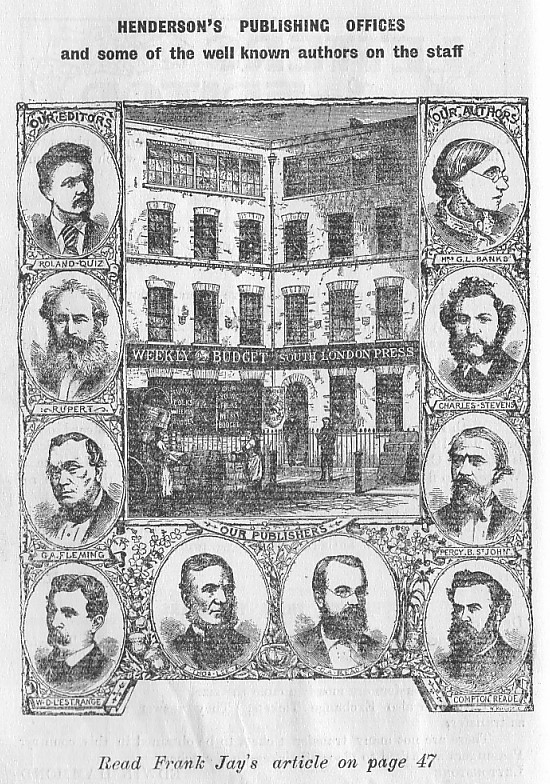
Many collectors will remember the various publications from this office, the most notable being beyond a doubt the Young Folks Weekly Budget made famous by its first publishing Stevenson’s “Treasure Island” and “Kidnapped,” and not the least by the celebrated Tim Pippin stories by Roland Quiz, the classical stories by Charles A. Read, the thrilling romances by Alfred R. Phillips, and other well known revered authors and writers, not forgetting the inimitable illustrations by John Proctor under the pen name of “Puck.”
They will also recall the hundreds of the 3d. People’s
Pocket Story Books of stories, tales and romances, that first appeared in
the Weekly Budget, and other publications of
Mr. Henderson first published the South London Press in January 1865, and it is still being published, this newspaper, the Weekly Budget and Young Folks Weekly Budget was the backbone of his business. His other publications were the Comic Pictorial Nuggets, Nuggets, Varieties, The Garland, Story Nuggets, The Key, a weekly journal of instruction
and amusing literature, 1863 to 1865, in which several of the stories from the Weekly Budget were continued, and other publications and periodicals.
48
Mr. Henderson did not however confine himself to what may be termed sensational publications, for in 1868 he published the Orb, a Churchman’s Newspaper and Literary Journal for the People, having for its motto “the Altar, the Throne and the Cottage.” I don’t suppose many collectors will hunt for this particular newspaper.
Of the portraits shown in the picture of Red Lion House, the
best known is Roland Quiz, (Mr. Richard Quittenton,) who was first Editor of
the Weekly Budget and afterwards for 42 years, Editor of Young Folk’s
Weekly Budget. He died at the age of
80, at
W. W. L’Estrange contributed many stories to
Mr. James Henderson died at
I am greatly indebted to a member of
FRANK JAY
* * *
The Boys of England first appeared in
56
Juvenile Drama. Wanted plays published by Brett, and other
publishers. Also plays in packets, loose
sheets, books of words, etc. Parks, Printer, Saltburn-by-Sea,
Wanted British Bloods and Penny Dreadfuls, in
volumes or runs, also old songsters, sheet music, broadsides, playbills,
etc. James Madison,
465, So.