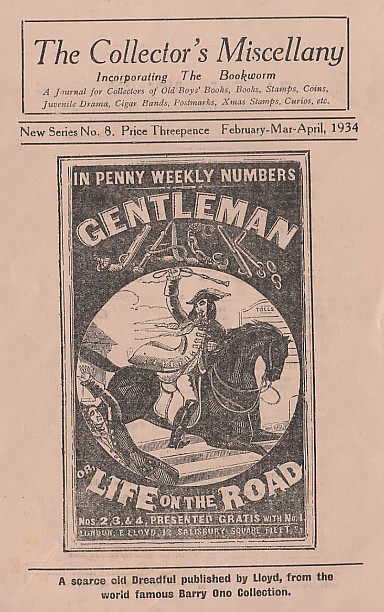
New Series No. 8. February-Mar-April,
1934.
22
Wanted: For Sale
Wanted British
Bloods and Penny Dreadfuls, in volumes or runs, also old songsters, sheet
music, broadsides, playbills, etc. James
Madison, 465, So.
Wanted: Bravos of Alsatia, The Wandering Apprentices, Karl the Uhlan, boys periodicals 1880-1900. Hunter, North Lodge, Sweethope, Musselburgh.
IF YOU COLLECT
American first editions, newspapers, magazines,
Wanted “Penny Dreadfuls” and fierce Boys Journals 1840 to 1900. Large collection ditto for Sale or Exchange. 3d. for list, World’s Biggest Collector, Buyer, Exchanger, Barry Ono, 100, Ferndale Road, Clapham, London.
24
Wanted—Vols of Boys of England, Young Men of Gt. Britain and similar old boys journals and romances. A large number of duplicates for disposal—state wants. C. Ransom, 26 Paternoster Row, E.C.
25
NOTES ON THE JUVENILE DRAMA
W. WEST, 1811-1831
W. WEST was one of the earliest of the various publishers of the Juvenile Drama—if not the earliest of them all—on which point there is difference of opinion. (J. K. Greene claims to have been the “inventor” of the Juvenile Drama). But all authorities are at least agreed that West produced some of the best sheets that were ever done, and there is very little doubt that the only other publisher whose work will compare with West is Hodgson who started soon after West in 1811.
According to John Ashton (Varia) West published at least 107 different plays between 1811 and 1831 and in addition a very large number of Theatrical Portraits. I have several sheets of plays which are not included in the list of 107 given by Ashton in his delightful essay on the Juvenile Drama, so no one can say how many plays were actually put out by this most prolific publisher.
In addition to the small size, West published at least two other larger size sheets, usually containing one “wing” on the same sheet as a scene.
West carried on his business originally at 13, Exeter Street, Strand, but later moved to Wych Street, opposite the Olympic Theatre (long since demolished). Several famous artists worked for him, including Blake and George Cruikshank, but the initials “G.C.” appearing on many of his sheets are those of George Childs who appears to have done a lot of work over a number of years. West’s own signature appears many times, but I am told he never drew a line in his life.
All this does not really matter. Whoever did the work it was beautifully done, both in outline and vigour of design. What a contrast to the wooden clumsy work of a much later period of the Juvenile Drama
26
For twenty years West reproduced in miniature form many of the most successful plays that were produced at the principal London Theatres. “As originally produced at Covent Garden Theatre,” figures on the title sheet of many of his plays.
West’s colouring too is splendid, and I have sheets in my possession, well over 100 years old, which still retain the rich bold colours as if they were done yesterday.
If any reader of this article should come across any of West’s early sheets I advise him to secure them while he has the chance. A reasonable price for the small size sheets is 1/- to 2 /- each. For the larger sizes 3/- or more would probably be asked. After all they are etchings, and generally quite beautiful work, and one must forget that about a hundred years ago they were priced a penny or twopence per sheet
I wonder how many people are fortunate enough to own a complete play of West’s? I should very much like to see one. And to think that at one time these splendid sheets were so little prized that thousands were used to wrap up fish in parcels!
M. W. STONE
29
BARRY ONO OF “PENNY DREADFUL” FAME
INTERVIEWED BY “THE COLLECTOR’S MISCELLANY”
|
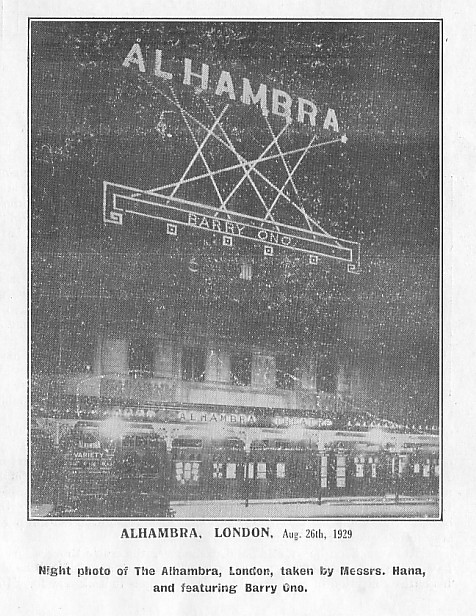
AS Mr. Ono’s articles have so frequently appeared in this journal of late, and as most of our readers only know him by repute as probably the world’s largest collector of “bloods” and old boys’ journals, and a profound authority on that subject, we thought perhaps in lieu of yet another article by himself, a few facts about him might be interesting. As “The Life of Barry Ono” could easily run to a few thick volumes, restricted space makes it a very formidable task. Just as the world would not have known the late Marie Lloyd as Matilda Wood, or Dan Leno as Geo. FitzPatrick, neither would the Music Hall public know Barry Ono as Ex-Councillor Fred Harrison of Camberwell, London, one time proprietor of six book shops at one time in London. Long before another “Old Boys Book Club” was ever contemplated, Barry, at the age of twelve, founded “The Boys’ Lending Library,” and |
used to bind his Boys’ Standards and “Sweeny Todds” in brown paper volumes of 12 numbers. Admission sixpence, and a penny for 12 numbers for a week. Living in apartments with his mother, and having nowhere to take the boys, the queue on the pavement got so long that police intervention put a stop to the youthful librarian.
Always a keen buyer, seller and exchanger, the whole thing seems to have collapsed about 1903, and Barry tells us with anguish, how he sold his entire collection of that period for £4. To get it back now for £150
30
he would reckon a fine stroke of business as it contained many rarities he has never been able to replace. So his present almost unbelievable collection has all been built up since 1912.
His “blood” correspondence now extends to the uttermost confines of the English speaking world, and there is hardly a collection of any importance, to which he has not been a big contributor, while he claims to have
31
created about a dozen little collector dealers, who now very often, when quoting him books, put in parenthesis (this is very scarce) which Barry regards as “teaching your grandmother how to suck eggs.”
“Why will they do it?” Barry wails, “When I have taught the bounders most of what they know.” We call him Barry, because to the Variety public of three continents he is “Good Old Barry” with his well known act “The Old Time Music Hall in 12 Minutes.” He was undoubtedly responsible for the wonderful revival of interest in the “Old Time Songs,” which he now bitterly complains has been stolen by everybody, so he seems doomed to have “Old Time Thunder” stolen from him in some shape or other. He is just as big an authority on “Old Time Songs” of the Music Halls, and can lecture on “The Evolution of the British Music Hall, from the Tap Room Free and Easy.”
In the serious politics of his profession he is known as “The Unofficial King’s Counsel of the Music Hall profession,” as the Variety Artiste’s Federation send him as advocate on all knotty problems to the Ministry of Labour, the Home Office, The House of Commons, etc., and he is now shoulder to shoulder with Mr. Arthur Denville, the actor M.P. and 16 other professional organisations, trying to bring about the abolition of the Entertainment Tax, where the human element predominates as against the mechanised entertainment. In short a busy man, and a popular one, which is why the Collector’s Miscellany thought his many comrades and admirers in the “Penny Dreadful World,” might like a further insight into the career of a man of so many parts.
The timid “new chum” among collectors, can always depend upon a kindly and courteous reply from Barry Ono on any knotty point, or a view of his big collection whenever they may so desire. Keen as he is on all antiques, we verily believe a tattered copy of “Three Fingered Jack” or a few numbers of The Rover’s Log would give him a bigger thrill than the discovery of a Ming vase.
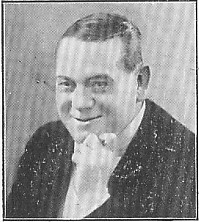
And thus we leave him, keener and more enthusiastic on the old “bloods” than ever he was. A photograph of the jovial Barry appears on page 29.
SCARCE “DREADFULS”
IN THE BARRY ONO COLLECTION.
5th. LIST.
(Continued from No. 7.)
“Paul’s Perils, or; the Days of Jonathan Wild,” 51 numbers. E Bennett, 1890.
“Marquis of Dalewood,” (by author of “Paul’s Peril’s,”) 12 nos. E. Bennett, 1890.
32
“Rankley Grange,”’ (by author of “Paul’s Perils”) 36 nos. E. Bennett, 1891.
“Dora the Duchess, a Mystery of the Highway,” 38 nos. H. Vickers, 1861.
“The Flying Dutchman, or; the Demon Ship,” 12 nos. Foster & Hextall, 1845.
“Mysteries of Old Father Thames,” 32 nos. W. Caffyn, 1847.
“The Mysterious Freebooter,” (signed E. Viles, author of “Black Bess”) 55 nos. M. White, 1844.
“Mysteries of Berlin,” (in 10 original monthly wrappers). W. Colyer, 1845.
“Under the Pirate Flag,” 60 nos. A Ritchie, 1872.
“New Newgate Calendar,” 80 nos. A. Ritchie, 1889.
“Captain Tom Drake, or; England’s Hearts of Oak,” and sequel
“Admiral Tom,” 77 nos. A. Ritchie, 1869.
“Lady Godiva, or; Peeping Tom of Coventry,” 7 nos. Newsagents’ Pub. Co., 1869.
“Lady Godiva, or; Peeping Tom of Coventry,” 31 nos. E. Lloyd, 1849.
“Nell Gwynne, or; Mysteries of the Court of Charles the Second,” (another “Claude Duval,”) 62 nos. H. Barton, 1860.
“The She Tiger, or; the Female Fiend of Paris,” 27 nos. H. Vickers, 1858.
“Bonnie Dundee,” 9 nos. Chas. Fox, 1870.
“Lambs of Littlecote,” 39 nos. Aldine Pub. Co., about 1894.
“The Island School,” 38 nos. Aldine Pub. Co., about 1895.
“Giant Jack,” 9 nos. Chas. Fox.
“Tom Torment,” 30 nos. Chas. Fox, 1890.
“School on the Sea,” 12 nos. Chas. Fox, 1888.
“Dick Strongbow, the Diamond King,” 22 nos. Best for Boys Pub. Co., 1891.
“Hardiboy James, or; Chums and Chappies,” 13 nos., and sequel
“The Bangwell Boys,” 5 nos. Best for Boys Pub. Co., 1891.
“Tom Terrybell, the Leader of Langton School,” 9 nos. Best for Boys Pub. Co, 1893.
“Tom Tartar,” 30 nos. Best for Boys Pub. Co., 1891.
(To be continued)
None of the above are for sale, only inserted to interest readers of “The Collector’s Miscellany.”
33
THE SENTINEL OF POMPEII
(This story appeared in The Young Briton in 1874, and in The Boys’ Standard in 1886 and 1891)
A story in a boys’ book old,
It told of ancient Romans bold,
Of Britons captured by their foe,
And to the slaughter made to go,
Of Gladiatorial combats grim,
Of a sentinel who at Pompeii’s Gate,
Remained until it was too late,
This yarn though it was meant for lads,
Still holds them now that they are dads,
This tale of old boys’ journal fame,
Was given alack! no authors’ name,
I think however, the story throughout,
Was by Charles Stevens, without doubt,
Years ago, a novel written,
Was by that classic writer, Lytton,
Stevens doubtless was inspired,
By this and his ambition fired,
So he wrote the “The Sentinel” there and then,
A noble story from an able pen.
HENRY STEELE
HENDERSON’S “ROB ROY LIBRARY”
THIS publication was popular with those boys who have to-day reached manhood, and those old boys who have been laid peacefully to mother earth. Messrs. James Henderson & Sons were the publishers, the stories being written by Angus Maclean. Four issues appeared monthly at the usual price of one penny each. The front cover was by Phil Ebbutt. The first four numbers were titled respectively, “Rob Roy’s Escape,” “The Outlawed Chief,” “The Black Captain,” and, “Broadsword and Musket.”
Rob Roy was known as the Scotch Robin Hood, but he never seemed to us Colonial boy readers, to have the same appeal as Robin Hood of Sherwood and his merry men.
The entire series were well produced in large readable type with the front cover illustrations in colour.
ERIC J. ROBSON
38
Wanted Roderick Dhu (published by Harrison), Varney the Vampyre, 1st half, or sell 2nd half. Taylor, 1 Kimberley Road, Stockwell, London.
39
Wanted For Sale Exchange
Wanted. Newnes
(3d) Dick Turpin Nos. 1, 2, 3, 5, 19, & 20, Newnes (2d) Black Bess Library (small
series) No. 16, Aldine Robin Hood (2d) Nos. 37, and 38 6d each offered. All old Aldine Libraries, Boys Friend
Library, (A.P.C.) Robin Hood Library, Henderson’s Rob Roy, Marvel, Pluck, Penny
Poplar, etc. Parks, Printer, Saltburn-by-Sea,
Yorks, England.
Wanted: Boys Leisure Hour, Boys Standard, Boys of England, vol. 37, Young Ching-Ching, Cheeky Charlie, That Rascal Jack. Robert Dodds, 3 Garngad Hill, Glasgow.
For
Tyburn Dick, Black Bess, etc. for sale. List 1½d.
Wanted Emmett, Brett, Fox, Ritchie, etc. publications. Strickland, 2,
40
Wanted For Sale
Wanted: by
Barry Ono, complete collections of “bloods” and fierce old boys journals. Report also single items. Top price for right stuff or good exchanges
offered. Want vol. 1 Tyburn Dick, vol. 9
Boys Comic. Offer 20/- for first 18 nos
Spring Heeled Jack. Collectors always
welcome to inspect my collection. Correspondence
invited.