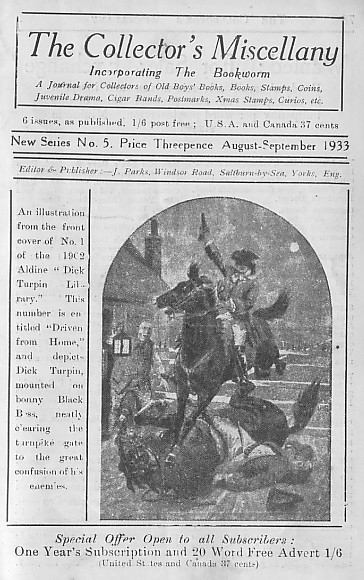
New Series No. 5.
August-September 1933.
78
Wanted: Fox’s Boys Standard, Boys Leisure Hour, Boys Champion Journal, Halfpenny Standard, Vol 7 and 8 Boys Comic Journal, Vol 37 Boys of England. Also Young Ching-Ching, Green as Grass, That Rascal Jack, The School on the Sea, Cheeky Charlie. Robert Dodds, 3 Garngad Hill, Glasgow.
Wanted British
Bloods and Penny Dreadfuls, in volumes or runs, also old songsters, sheet
music, broadsides, playbills, etc. James
Madison, 465, So.
85
“WHERE ARE THE
COLLECTORS, AND WHO ARE THEY?”
IF the “Old Boys Books” and the cult of the “Penny Dreadful” is not to die of inanition, it occurs to me, that its devotees must get a move on to stimulate the interest. I appeal not only to the camaraderie, but to self interest, as when the hobby wanes, so do values, and those with important collections, will see their hardly won treasures, for which they have paid fancy prices, gradually depreciate in value. What with match box labels, razor blade covers, tram tickets, and the various weird hobbies now invading the pages of the Collectors’ Miscellany, poor old “Blueskin,” and that imposing run of vols. of the “The Boys Standard,” the joy of some proud collector’s heart, looks like falling into the discard.
Why is this? There must always be cause for every effect, and I think the late J. J. Wilson was right, when he used to say that unless we kept on continually banging the big drum, and fanning the dying embers, the fire would go out. I think the main trouble is, that collectors are prone to be selfishly exclusive. If they meet a new collector chum, and do a bit of selling and exchanging with him, or manage to buy some small collection for a mere song from the widow or son of the late collector, the fact is sedulously preserved as a dark secret, the while other collectors in their hermit caves, get blase over looking at their own hoard, and hearing nothing of what is happening to other collectors.
Now I have no knowledge of any son who has followed in his father’s footsteps with this hobby, while the wife, during her husband’s life time, is prone to look on it as a kind of amiable lunacy on his part. Whether the wives of the future will look with more tolerance or even reverence on collections of tram tickets and razor blade labels, remains to be seen.
I do however know of tragic instances of treasured collections that have met with short shrift on the demise of their owner. The question is—Where do they go, and who gets them? Now it may be sheer vain
86
gloriousness on my part, but I certainly do tell the world when ever (seldom now) I find a new lot. I just love collectors to know I have got them, and to come along and see them. Which is why, in another column I am giving a series of lists of some of my rare items. To stimulate interest and to get others to do the same thing.
I always welcome a new collector, as a veritable pilgrim to
Newnes BLACK BESS LIBRARY, 2d nos. (small series).
No. 16.
Newnes DICK TURPIN LIBRARY, 3d. nos. Nos. 1 to 24, 26
to 28, 30 to 36.
Aldine ROBIN HOOD LIBRARY, 2d. nos Nos. 28, 32, 33, 34, 35, 36, 37, 38, 39 40,
41, 45, 46, 47, 49, 50, 51, 52, 53, 54, 55, 56, 58, 60, 63. Parks, Printer Saltburn-by-Sea,
You all know him, Mr. R. T. Herring, of Norbury, and I am proud to have started such a genial comrade on the road. Another big collector is Mr. H. A. Hall of Newport, to whom I once introduced a £100 collection, which he bought, generously allowing me to buy many eagerly desired
87
items out of it. I supplied my friend Du Calion with practically the whole of his collection which he recently sold for £175. Just three instances of many in which I have pleased others and profited myself, and only by making myself inter-communal, and avoiding silly secrecy.
I was at Hodgson’s Sale Rooms,
A bit more of that sort of thing, and Mr. Parks would have to enlarge this fine little journal, he’d get so many articles and adverts. Well, I still like my “Ching-Ching,” and “Charley Wag” better than tram tickets, and if a few of the real old brigade will only rally to these columns, as of yore, maybe we’ll start a few circulating, and once again revive full interest in the Old Boys Journals, and Penny Number Romances.
BARRY ONO
* * *
SCARCE “DREADFULS”
IN THE BARRY ONO COLLECTION.
2nd LIST.
(Continued from No. 4.)
“Sweeny Todd, the Demon Barber of Fleet Street,” 48 numbers. Chas. Fox, 1883.
“Jonathan Wild; or, the Thieftaker’s Daughter,” 13 nos. W. Winn,
“Charles Peace, the Burglar,” 100 nos. G. Purkess, 1888.
“Colonel Jack; or, the Life of a Highwayman,” 104 nos. H. Lea, 1864.
“The Boy Rover; or, the Smuggler of the
“The Boy Brigand; or, the Dark King of the Mountains,” 32 nos. H. Lea, 1864.
“Charley Wag, the New Jack Sheppard,” 72 nos. W. Grant. 1861.
88
“Fanny White, the Young Lady Thief,” 21 nos. George Vickers. 1862.
“Woman with the Yellow Hair,” by author of Charley Wag, 24
nos.
“Outsiders of Society; or, the Wild Beauties of
“Cartouche, the French Jack Sheppard,” 14 nos. Chas. Fox, 1887.
“The Gipsy Gentleman,” 9 nos. Chas. Fox. 1888.
“Merry Wives of
“The Poor Boys of
“Women of
“Work Girls of
“Night Hawks of London; or, the Noble Highwayman, and the
Miser’s Daughter,” 12 nos. Newsagents’
Pub.
“The Mendicants of
“Life in
“The
“The Mystery of
“Calcraft the Hangman,” 30 nos. G. Purkess, 1871.
“Mother Shipton,” 12 nos. G. Purkess, 1874.
“Black Bess; or, the Knight of the Road,” 254 nos. E. Harrison. 1868.
“Black Highwayman,” 2nd series of “Black Bess,” 86 nos. E. Harrison. 1874.
“Blueskin,” 158 nos. E. Harrison. No date, about 1870.
(To be continued)
None of the above are for sale, only inserted to interest readers of “The Collector’s Miscellany.”
89
BY JOSEPH PARKS
(Conclusion)
PERHAPS one of the most fantastical stories of Turpin that was ever conceived was “The Blue Dwarf” which was published in three volumes by Hogarth House. The author was the celebrated Percy B. St. John, and it must certainly be the most wretched composition that he ever concocted. In fact to anyone with an acquaintance of his work it is really difficult to believe that he was the author. “The Blue Dwarf” is a typical “blood” and numerous coloured plates were given away with it during the course of publication. It is often described as scarce, but this is far from being the case.
A story featuring Dick Turpin as one of the leading characters was published in Comrades Vols. 2-3, 1894. This was titled “Wild Dick,” and was by the author of “Who Killed John Cameron?”
In 1890 the Aldine Publishing Co. issued their first “Dick Turpin Library” but I have been unable to trace a single copy, although I have it on good authority that it actually appeared. The second series commenced in 1902, the first number being entitled “Driven from Home.” It ran to 182 numbers. Charlton Lee wrote the first 111 numbers, and Stephen H. Agnew most of the others. Charlton Lee also wrote many of the stories for “Claude Duval,” “Spring Heeled Jack,” “Jack Sheppard” and other Aldine publications. He is credited as being the author of “Mysteries of Newgate,” and “Chronicles of Old London Bridge,” but I have been unable to trace either of these publications. Shortly towards the end the publishers commenced to reprint the earlier stories, but under different titles. Richard Prowse illustrated many of the covers which are really works of art.
This library was followed in 1908 by the “Black Bess Library,” which ran to 18 numbers. Each alternative number was a story of Claude Duval and his comrades. Many of the stories were also abbreviated and reprinted in the “Boy’s Own Library.”
A series of complete stories dealing with the gallant highwayman appeared for some considerable period in the early penny numbers of Pluck, and there were also some in Lot-o-Fun round about 1909. Twelve stories of Dick Turpin appeared in the Jester a little previous to this date.
Between 1908-10, David Goodwin wrote two or three Dick Turpin stories which were published as serials in the Boy’s Herald. One was entitled “The Black Mask,” and another, “On Turpin’s Highway.” Both
90
of these were reprinted in Pluck and in the “Boy’s Friend Library” and of recent years in the Nelson Lee Library. Not so many years ago one of the “Boy’s Friend Library” contained a story of Turpin entitled “Dick Turpin’s Double.”
In 1920 Messrs. George Newnes commenced to publish a “Dick Turpin Library” in 3d. numbers, which ran to 138. nos. Nos. 1 - 48, were, with slight alterations, reprints of the early Aldine issue, but all published after No. 48 were new material, and the bulk of them poorly written and not a patch on the older authors’ conceptions of the same characters. The covers, however, are of a very high standard and were illustrated by various prominent artists.
In 1920 the same firm issued a “Black Bess Library” in 18 small 2d.nos. The most outstanding feature of this series is that the bulk of the plots and in many cases whole chapters, have been lifted from the pages of Viles’ “Black Bess.” This was followed in 1921-22 by the “New Black Bess Library” which ran to 38 numbers. These were all, with certain modifications, reprints of the Aldine series. A serial story dealing with Jack Sheppard runs through the earlier numbers.
“Dick Turpin’s Ride to
Skelt, Webb and, other publishers added “Dick Turpin” to
their lengthy list of the juvenile drama, and the play of “Dick Turpin’s Ride
to
“Dick Turpin,” was also a favourite drama on the stage, and Purkess, Dicks and other publishers of stage plays added this play to their stock.
And thus I draw to a conclusion, although probably there are hundreds of Dick Turpin stories of which I have never heard. Perhaps Mr. Barry Ono will overhaul his collection and tell us more? That the love of the old highwayman romances is not yet dead is shown by the fact that until only a few weeks ago an highwayman serial was appearing in the pages of Comic Cuts, and this even has been succeeded by a pirate yarn.
JOSEPH PARKS
“The Red Inn” which appeared in Chips nearly thirty years ago, was at that time an up-to-date version of “Sweeny Todd.” I remember it as a very exciting serial. A similar series appeared early this year under the title of “The Inn of a Thousand Secrets.” This was in the Bullseye. Both yarns omit the mutton pie part of the original story.
93
DEAR SIR,
Mr. Barry Ono in his masterful and interesting article under the above heading in your recent issue, agrees that he does not know the value of a penny dreadful and enquires “who does?”
This is a question that cannot rightly be answered because there is no intrinsic value attached to this class of literature. What value there is must be purely sentimental, and dealers and collectors, (who collect to sell again), place their own idea of value upon penny dreadfuls, according to the desire or financial position of those who wish to possess this literature.
If sold under the hammer at Messrs. Hodgson’s or Sotheby’s, half a ton weight of such literature would only realize waste paper price, even if it was accepted by the auctioneers which is rather doubtful. A collection might be accepted for public sale if it came from the library of some well known nobleman or gentleman collector, along with real literary gems. It might then be added as a kind of make weight.
I don’t think the real value has ever been put to the test
in a public sale room except in one or two isolated cases. I, myself, attended a sale at Messrs.
Hodgson’s,
I commenced to collect about thirty years ago, my first deal
being from a young fellow who was going to
When Messrs. Edwin J. Brett Ltd. closed down, the whole of their
94
stock was cleared at waste paper prices, so much per cwt., and it was a common thing to see copies of their well known literature for sale on costermonger’s barrows at 1d. and 1½d. each volume.
Round about 1912 I had the option of purchasing the entire stock of Hogarth House publications—approaching 4,000 vols. in pink condition at 1d., 1½d., and 2d. per volume, the conditions being that I must take the entire stock. Not having the necessary room to store them, and being unable to sell many, even at. 3d., 4d. and 5d. per volume during my three months option, I was obliged to let them pass.
I can trace the era of inflated prices for this class of literature since that date. I have bought up several fine collections since then at less than a fourth of the cost to the original collectors.
There is no royal road to collecting such literature, consequently there is no properly established data of prices to rule its sale and exchange. You obtain the best price you can, presuming the buyer does not know the true value of what you offer. It is all a case of the “spider and the fly,” and the latter has now practically “passed out.”
I venture to assert that in less than ten years from now the penny dreadful will be absolutely worthless. The rising generation will not tolerate such publications and it will only be in museums that you will be able to see copies, preserved not because of their value, but simply as curiosities.
S.W. 15. FRANK JAY.
Apparently Mr. Frank Jay was not aware of the recent sale at Messrs. Hodgson’s when he wrote the above.—Editor.
* * *
The Aldine “Robin Hood Library” came out about 1903, but I believe that there was an earlier edition. It was also reprinted in 1912 in a smaller form. It was reprinted again in 1923. There are two issues of this last set, one with the price “2d.” and the other without any price stated. All the above sets consisted of 88 numbers. The Amal. Press Co. commenced a “Robin Hood Library” in 1919 in 1½d. numbers. This ran to No. 57 when it was incorporated with the “Nugget Weekly” (1½d.). The “Detective Weekly” and the “Prairie Library” were also incorporated with the “Nugget Weekly” at the same time. The Amalgamated Press Co. issue of “Robin Hood” is entirely different to the Aldine series.
96
Wanted “Penny Dreadfuls” and fierce Boys Journals 1840 to 1900. Large collection ditto for Sale or Exchange. 3d. for list, World’s Biggest Collector, Buyer, Exchanger, Barry Ono, 100, Ferndale Road, Clapham, London.
IF YOU COLLECT
American first editions, newspapers, magazines,