Painting technique of Leonardo Da Vinic
Linear perspective
Linear perspective is a mathematical system for creating the illusion of space and
distance on a flat surface. The system originated in Florence, Italy in the early 1400s.
The artist and architect Brunelleschi demonstrated its principles, but another architect
and writer, Leon Battista Alberti was first to write down rules of linear perspective for
artists to follow. Leonardo da Vinci probably learned Alberti's system while serving as an
apprentice to the artist Verrocchio in Florence.
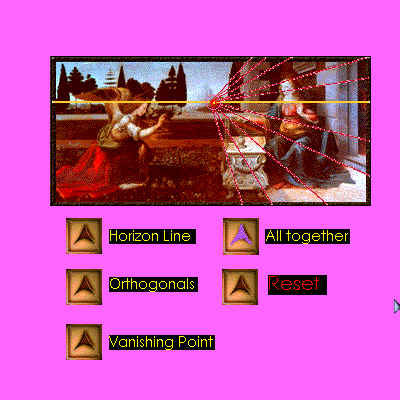
To use linear perspective an artist must first imagine the picture surface as an
"open window" through which to see the painted world. Straight lines are then
drawn on the canvas to represent the horizon and "visual rays" connecting the
viewer's eye to a point in the distance.
The horizon line runs across the canvas at the eye level of the viewer. The horizon line
is where the sky appears to meet the ground.
The vanishing point should be located near the center of the horizon line. The vanishing
point is where all parallel lines (orthogonals) that run towards the horizon line appear
to come together like train tracks in the distance.
Orthogonal lines are "visual rays" helping the viewer's eye to connect points
around the edges of the canvas to the vanishing point. An artist uses them to align the
edges of walls and paving stones.
Aerial perspective
Leonardo was fascinated by the atmosphere and by its effects on the colors and
distinctness of distant objects. Though other artists had already begun to create some of
these effects in their work, Leonardo was the first to make careful measurements and
suggest rules for applying them realistically in painting. He called the subject aerial
perspective.
In morning light Leonardo observed that distant objects such as mountains look bluer and
less distinct than nearby mountains. He also noted that the more distant the mountain, the
more its color approached that of the surrounding atmosphere.
His experiments suggested that to correctly color objects at different distances, artists
should do as follows: Paint the nearest one its true color. Paint the one behind
proportionately bluer, and the one behind that bluer still.
This firgue shows that how the technique are used in the paintings:
The firgue shows that the picture in Leonardo Da Vinci eyes:
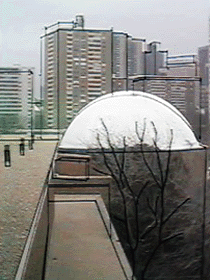
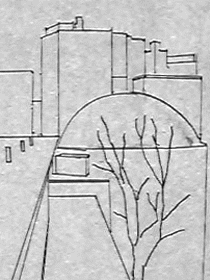
Real photo Leonardo's drawing