Mumia Abu-Jamal's Statement
Just Doesn't Add Up
By: Nikon
Nearly 20 years after the murder of Philadelphia Police Officer Daniel Faulkner the man convicted of the crime, Mumia Abu-Jamal told his story regarding the events that's took place in the early morning hours of December 9, 1981.
On May 4, 2001 attorneys for Jamal released several sworn affidavits regarding the case. One that most people familiar with the case awaited most anxiously was that of Mumia Abu-Jamal, who until this point had never given his side of the story. For the first time in almost twenty years Mumia said publicly that he did not shot Officer Faulkner.
|
|
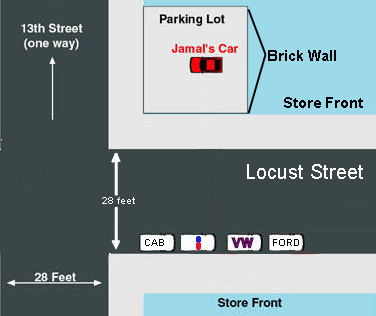
Jamal says in his affidavit that as a cab driver he often chose the 13th and Locust area becasue it was a popular club area with a lot of foot traffic. He claims that he was filling out his log when he heard shouting and glanced in his review mirror and saw a flashing dome light of a police car. However Jamal's cab was found in the parking lot across the street, and by the position of his cab all he would have seen through his rearview mirror would have been a brick wall. He then claimed that because a police car with it's lights on wasn't an unusual scene in that area that he continued to fill out his trip sheet until he heard what sounded like gun shots. At this point he claims that he again looked in his rearview mirror (brick wall) and saw people running up and down Locust Street. It was at this point that he saw his brother standing in the street "staggering and dizzy". He claims that he immediately exited the cab and ran to his scream. |
The odd thing about this is Billy claims in his affidavit that when he saw Mumia running across the street he was sitting in the front seat of his car. How could Billy be staggering in his front seat?
Mumia then say, "As I came across the street I saw a uniformed cop turn toward me gun in hand, saw a flash and went down to my knees." There is a lot that doesn't add up here. First, it was proven by balistics that Jamal was shot by Officer Faulkner's gun to the exclussion of all others.At the time Mumia claims to have run across the street Faulkner would have already been shot dead. Also, all of the prosecution witnesses testified that Mumia, or someone wearing the exact thing in one case, ran across the street BEFORE the shooting started. Lastly, Mumia claims that he was shot as he "came across the street", not after he crossed the street, yet balistics proved that the shot to his chest was fired from around 12 inches.
The bullet that hit Mumia entered his chest below his right nipple, and lodged in his back 4 to 5 inches lower. On a man Mumia's size that would correspond to roughly a 22 degree downward angle. Locust Street is 28 fet wide. If Mumia was shot when he was half-way across the street, or 14 feet from the officer, the bullet would have had to have been fired from 6 feet above the entrance would, or roughly a height of 10 feet. If Mumia was 8 feet away from the shooter the shot would have had to have come from a height of 7 feet 8 inches. This proves, as well as the ballistics evidence that Mumia would have had to have been across the street already when he was shot.
All of the witnesses to the murder, or even those who just heard the shots claimed to have heard the shots in a rapid sequence. (Some stated they thought they were firecrackers at first) If we are to believe Jamal's story, all of those witnesses would have to be wrong. According to his story he would have had to have gotten out of his cab, exited the parking lot, and crossed Locust Street before being shot. Which would leave a large gap in between the first shots, and the shot that hit Mumia. Not to mention that several of the witnesses claimed to approach the scene after Faulkner was shot. They would have certainly seen an officer shoot a man running across the street, or at least heard a stray shot.
As a matter of fact in Arnold Beverly's affidavit he claims that Mumia was shot by an Officer who arrived on the scene. We know that officers didn't begin to respond for 45 seconds, meaning that Mumia would have had to have been shot at least 45 seconds after the first shots were fired. This just doesn't add up with existing witness testimony. |
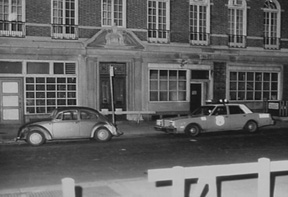
Jamal then explains his arrest and trip to the hospital which is peppered with allegations of being beaten and cursed at. During the trial we heard testimony from several police officers that Jamal was resisting arrest, and that it took several officers to restrain and handcuff Jamal . Jamal also claims that he was "rammed into a telephone pole", but a look at the photo of the overall crime scene shows no telephone pole in sight. Jamal goes on to say that he didn't confess at the hospital, or say that he shot the cop. Yet 19 years before he gave this statement he made a pre-trial motion to exclude his statements he made because he made tham only becasue they were coerced by police.
|
| On June 5, 1982 The Philadelphia Inquirer reported,
"Several witnesses testified that they subsequently
heard Abu-Jamal make a series of incriminating
statements, including statements admitting to the
shooting and saying where he had left the gun after the
shooting. Abu-Jamal argued that such statements came after police used coercive tactics, including picking him up and banging him into a no-parking sign, and failing to advice him if his right to remain silent." So, which are we to believe, that he made the statements after being coerced by police, or his account from almost 20 years later that he didn't make those statements at all? Either way, his present statement contradicts the earlier report. Jamal says in his affidavit that it was difficult to speak, let alone holler, yet 4 people claim to have heard him either say or yell, "I shot the MF'er, and I hope he dies". This is one of the statements Jamal attempted to get excluded in 1982. On June 7, 1982 the Inquire again reported on the motion made by Mumia. The article said, "Police officers and a security guard at the hospital to which Abu-Jamal was taken are to testify that they heard Abu-Jamal make incriminating statements. Abu-Jamal has unsuccessfully argued that much of the evidence gathered against him should be excluded. If he did make incriminating statements, he has argued, he was coerced into making them. Testimony showed that his face had been bruised and his lip and forehead cut while he was in police custody. Abu-Jamal said that he had been beaten; two police officers said that he had been accidentally carried into a pole, and had fallen, while being taken to a police van." Mumia Abu-Jamal had nearly 20 years to come up with this statement, as did his brother. You would think they would have at least insured that their statements matched not only the original evidence, but at least each others. |