A
Message from National Secretary Jerry Atnip
Dear Brothers and Sisters,
At the 54th Biennial Conference held in August in Mobile,
Alabama, the Grand Lodge was unanimous in its resolve to
inform our members and the rest of the nation about the
Danny Faulkner story. The members attending the
conference were equally adamant that we also inform them
of those persons and corporations that are attempting to
keep his killer from receiving the justice he deserves.
As your National Secretary, I am proud to take a leading
role in this effort. Danny's story is an important one to
tell and we will do everything in our power to see that
he is remembered.
We have posted the lists of supporters
of Danny Faulkner's killer which appeared in paid
advertisements in The New York Times in 1995 and
in 1998.
Brother Faulkner was murdered on December 9, 1981. His
killer was convicted in 1982. This has been and will
continue to be a dramatic and prolonged struggle. The
Fraternal Order of Police has been involved at every turn
demanding justice for Brother Faulkner. We have taken up
the issue once again with renewed energy and
determination. Allow us to do so in a way that will be
the most effective and in keeping with the spirit of our
departed brother.
 |
Danny, We
Hardly Knew You
Danny Faulkner was the kind of young
man every father and mother wants for a son,
every child wants for a brother and every person
wants for a friend. He was easygoing and
friendly, yet organized and focused. He was a
hard worker who always had time for his friends.
Danny was the youngest of seven children, born to
an Irish-Catholic family from the southwest side
of Philadelphia. His father, who was a railroad
worker, died of a sudden heart attack when Danny
was only five years old. Danny was raised by a
working mother and his older siblings. After
school, he would walk to the home of Tom and
Trish Faulkner. Tom was Danny's big brother.
There, Danny would play with neighborhood kids
and do his homework. He loved to run around the
corner to a neighborhood clothier and pretend he
worked there. He would dress up in a tie, then
pick up a broom and sweep their walks.
Danny left high school prior to graduation and
joined the U.S. Army. It wasnít that he didnít
like school, but this was a kid who had matured
beyond many of his classmates. He just needed to
get his life started. While serving in the armed
forces, Danny continued his studies, earning his
high school diploma as well as an Associates
Degree in Criminal Justice.
|
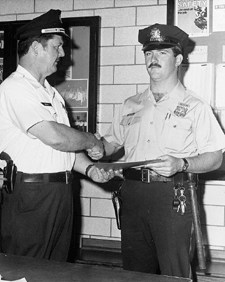
Upon fulfilling his military service, Danny went
home to Philadelphia to began his law enforcement
career. His first position was that of a
corrections officer. In 1975, he was able to make
the career move he hoped and worked for and
became an officer of the Philadelphia Police
Department.
Being the organized and focused young man he was,
it wasnít long before he had purchased a home of
his own in his old neighborhood in southwest
Philly. Not long after, he began dating the young
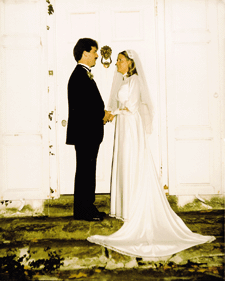
woman that would become his wife. Danny and
Maureen dated about a year, were engaged for
another six months and were married in the fall
of 1979.
Maureen remembers Danny as easygoing, while she
was the one who always worried. He was the
extrovert. Once a month, the couple would host a
get-together of all their friends and the group
would play cards in the Faulkner home until the
wee hours of the morning. Danny was the
neighborhood leader for the Muscular Dystrophy
Association and the organizer of the Annual
Softball Marathon to benefit that charity. One of
his childhood friends had suffered from the
disease and Danny felt strongly about helping in
the fight against it.
Danny loved the outdoors and when deer season
opened in Pennsylvania, you would find him
stalking the forests of the Pocono Mountains.
Maureen, too, loved beauty and the freshness of
the Poconos. The couple were saving their money
with dreams of purchasing a vacation home there.
Danny loved being a police officer and planned to
spend the rest of his working life advancing his
career in law enforcement. He had enrolled in
community college and was working toward his
Bachelorís Degree in Criminal Justice
Administration. He also had plans to go on to law
school, hoping to ultimately become a prosecutor
in the District Attorney's Office.
Danny Faulkner was a young man with clear goals
and dreams. He truly represents an American Story
and the best traditions of our nation. He was
raised in a loving family and was building his
own family with the same love and determination
with which he had grown up. He took time to serve
his country. He was bright and energetic--caring
and giving to his neighborhood, to his friends
and to his profession. Mumia Abu-Jamal did not
just kill a cop. He murdered a loving husband, a
caring son, a brother to all around him and a
friend to those he served. Mumia shot and killed
a piece of America, a piece of America we would
all like to see more of today. |
The Murder of
Officer Danny Faulkner
the real victims--a police officer and his wife
On December 9, 1981, at approximately 3:55 a.m., Officer
Danny Faulkner, a five year veteran of the Philadelphia
Police Department, made a traffic stop at Locust Street
near Twelfth Street. The car stopped by Officer Faulkner
was being driven by William Cook. After making the stop,
Danny called for assistance on his police radio and
requested a police wagon to transport a prisoner.
Unbeknownst to him, William Cook's brother, Wesley (aka
Mumia Abu-Jamal) was across the street. As Danny
attempted to handcuff William Cook, Mumia Abu-Jamal ran
from across the street and shot the officer in the back.
Danny turned and was able to fire one shot that struck
Abu-Jamal in the chest; the wounded officer then fell to
the pavement. Mumia Abu-Jamal stood over the downed
officer and fired four more times from close range, one bullet struck him
directly in the face. Mumia Abu-Jamal was found still at
the scene of the shooting by officers who arrived there
within seconds. The murderer was slumped against the curb
in front of his brotherís car. In his possession was a
.38 caliber revolver that records showed Mumia had
purchased months earlier. The chamber of the gun had five
spent cartridges. A cab driver, as well as other
pedestrians, had witnessed the brutal slaying and
identified Mumia Abu-Jamal as the killer both at the
scene and during his trial. On July 2, 1982, after being
tried before a jury of ten whites and two blacks, Mumia
Abu-Jamal was convicted of murdering Officer Danny
Faulkner. The next day, the jury sentenced him to death
after deliberating for less than 4 hours. The Supreme Court of
Pennsylvania heard the defendantís appeals and upheld
the conviction on March 6, 1989.
Officer Danny Faulkner joined the ranks of those
courageous officers who have given their lives to keep
our nation's streets safe and free. Danny and his wife,
Maureen, had been married only slightly more than a year.
Now, she was left a widow with only her memories of the
young officer to comfort her and dreams of the life they
could have shared together. Danny and Maureen Faulkner
are the real victims of that horrible night in December,
1981. It is for them that we seek justice.
Danny - A
Symbol for Many
An unfortunate truth is that law
enforcement officers lose their lives in the line
of duty almost daily. All across our country
their killers sit in prison--waiting out their
sentences, planning their death penalty appeals,
or pleading to be paroled. The friends, family
and co-workers of Danny Faulkner are among many
who must fight to see that justice is done and
that their fallen loved one is not forgotten. How
has the murder of Danny Faulkner taken on such
national prominence? Why is it important for
officers across our country to be heard on this
matter? Danny Faulkner has become a symbol for
all our fallen brothers and sisters and the
struggle of their loved ones to see that justice
prevails.
By all official accounts, the murder of Officer
Danny Faulkner was a clear cut case. The murderer
was caught at the scene and readily identified by
witnesses to the whole incident. Mumia Abu-Jamal
should have shared the same fate as that of other
cop killers--living out his life in prison in
anonymity, filing numerous appeals and waiting
for his sentence to be carried out. Dannyís
killer, however, is not your typical killer.
Mumia Abu-Jamal was raised in the projects of
Philadelphia. At 15, he helped found a local
chapter of the Black Panthers. He became an
ideologue, joining radical fringe groups like
MOVE. He saw himself as a soldier in the fight
against minority oppression. He became a local
radio personality doing stories on the
disadvantaged. He learned how to mold public
opinion and how to take full advantage of the
politics of race. Mumia, working with his lead
attorney, Leonard Weinglass (Weinglass is also
known for his work with attorney William Kunstler
and their controversial defense of the Chicago
Seven), has been able to bring together a diverse
coalition of anti-death penalty groups, left-wing
extremists, academics, fools and the misinformed.
They have made Mumia their cause célèbre.
|
|
Such high profile personalities as Spike Lee,
Susan Sarandon, Paul Newman, Maya Angelou and
Alec Baldwin, to name a few, have lent their
names to advertisements claiming Mumiaís trial
had been unfair and calling for a new trial.
Danny's killer has also become a symbol for
international organizations in places such as
France and Denmark that oppose the death penalty.
They have turned this murderer into a
"political prisoner." Alternative rock
bands like Rage Against the Machine and the
Beastie Boys have done benefit concerts to raise
money for Mumia's defense. Students at the
University of California wear "Free
Mumia" t-shirts. This culmination of
politicos and personalities, regardless of their
motivations, have turned Danny's murderer into a
mythic figure. Truth has been damned and fantasy
has become fact.
It is the weight of this coalition, built by the
supporters of this killer, that demands that
organizations such the Grand Lodge of the
Fraternal Order of Police also weigh into this
fight in an effective and substantial way. It is
our responsibility to Danny, and all the fallen
officers he represents, to assure that the public
knows the truth about this incident and that
substance will prevail over celebrity. Maureen
Faulkner, Danny's widow, cannot do it alone. The
Philadelphia and Pennsylvania FOP Lodges cannot
do it alone. The financial and public relations
resources that have come together to render aid
to this common killer with the uncommon knack for
propaganda, are too much for any one group to
face alone. It will take the effort of all the
members of the FOP from across our country. We
must all become aware of the facts of this case.
We must speak out so that the truth is heard.
Danny Faulkner was a good and decent man and an
honorable police officer. He was brutally
murdered and his killer is Mumia Abul-Jamal. This
is a time when justice demands that no honest man
sit silent.
|
|