Arnold Beverly's Confession
to Murder
Just Doesn't Add Up
By: Nikon
In May of 2001 the new defense team working for
Mumia Abu-Jamal released a number of affidavits concerning the
case. One of the most discussed was an affidavit by Arnold
Beverly who claims that he, not Mumia actually murdered Officer
Faulkner. The courts have refused to hear it because the defense
waited almost 2 years to release it and Pennsylvania law says
that any new evidence must be filed with the court with 60 days
unless it meets certain requirement, which Beverly's affidavit
did not meet. Neither the State nor Federal Courts have ruled on
the merits of the affidavit. If they had I think it would have
been dismissed anyway.
| Beverly claims in his affidavit that he and
"another guy" were hired by the mob and corrupt
policemen to kill Officer Faulkner because he interfered
with the graft and payoffs made to allow illegal activity
in the Center City area. Other affidavits release on or
about the same time implied that part of the corruption
included doing club checks at bars and demanding payment
from the owners for any after hours business. Beverly
claims that he was given a photograph of Officer Faulkner
and told that he was supposed to "check something
out" at Johnny D's at 13th and Locust. Apparently
the defense is trying to imply that Faulkner would be
doing one of the club checks. The problem with that is
that Johnny D's was a pizza place, not a bar, and would
have been closed at 4 o'clock in the morning.
|
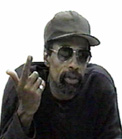
Arnold Beverly from a
video tape of him reading his June 8, 1999 affidavit.
|
Beverly goes on to say that he was carrying his own .22
caliber revolver and the "other guy" gave him a .38
caliber "policeman's special". Neither of these guns
were capable of firing the bullets that were found at the scene
or in Officer Faulkner. Ballistics test proved that the bullet
found at the scene were fire from a .38 caliber with rifling
characteristics of 8 lands and grooves with a right hand
direction of twist. Obviously this would rule out the much
smaller .22 caliber. A "policeman's special" in 1981
was a Smith & Wesson Model 10 six shot revolver. This gun
only has 5 lands and grooves etched into it's barrel, and is thus
not consistent with the bullets at the scene.
Beverly says that he was waiting across Locust St. for Officer
Faulkner to arrive, wearing a green camouflage jacket. Not one
witness mentioned seeing a camouflage jacket. While he was
waiting there he claimed that the "other guy" was
waiting near Camac St.
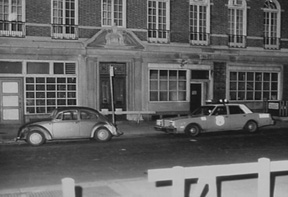
Actual crime scene
photo showing the VW owned by Mumia's brother, Billy
Cook, and the full size patrol car driven by Officer
Faulkner.
|
It's obvious from looking at the crime scene photos
that Officer Faulkner wasn't driving a small police car
that night. He was driving a full size 4 door Plymouth. Beverly
then claims to have heard a shot come from east on Locust
Street, or his left, and witnessed Officer Faulkner fall.
During the trial Criminalist Dr. Tumosa testified that
the shot to Officer Faulkner's back was fired from 8-12
inches away. Beverly should not only have heard the shot
coming from directly in front of him since he was
watching Officer Faulkner, but should have seen the
shooter because he would have had to have been
within a foot of Officer Faulkner, who Beverly was
supposedly watching.
|
Beverly then claims to have heard another shot which must have
grazed his right shoulder, but the fact that he was being shot at
didn't stop him from running towards the scene. He claims he ran
across the street and shot Officer Faulkner in the face at close
range, however not one witness saw him run across the street and
shoot Faulkner. One witness, Michael Scanlan testified that a man
ran across the street and shot Officer Faulkner, but he described
that man as wearing a red and blue jacket or sweater, not a
camouflage jacket. Two other witnesses, Cynthia White and Robert
Chobert, both positively identified Mumia as the shooter.
Beverly claims that Mumia was shot by another police officer
as he approached the scene, however ballistics tests on the
bullet removed from Jamal proved that it was fired from Officer
Faulkner's gun to the exclusion of all others. Also, another
witness, Albert Magilton, positively identified Mumia at the
scene as the man who ran across the street right before the
shooting.
For years Mumia's supporters have claimed that a mysterious
man shot Officer Faulkner then ran east on Locust Street to
escape before police arrived. However Beverly doesn't claim to
have run east on Locust. He claims to have run back across the
street and exited the area through the speedline. He claims that
as he was going down the steps he saw police officers arriving
from all directions.
This affidavit also raises some other good questions. The
defense claims that since Beverly gave his statement he has
feared for his life because of possible retaliation from the
Philadelphia Police Force. Yet ironically Beverly came forward as
a witness in the Thomas Jones arrest which was televised
nationally. Why would someone fearful of the Police Force come
forward as a witness against the same police force?
It must also be asked why the mob would find it necessary to
hire an outsider with a very limited criminal record to perform a
task that they obviously could have taken care of themselves. If
they did hire an outsider I think the chance of him living to
tell his story would be very slim.
As Pennsylvania Common Pleas Judge Pamela Dembe ruled when
refusing to hear the affidavit, it is common for people to come
forward and confess to high profile crimes.