The Seven Wonders of the Ancient World
Originally compiled sometime around 200BC, the idea of mentioning the best monuments of all time was first described by the Greek Herodotus around 500BC, but later officially compiled during the Middle Ages.
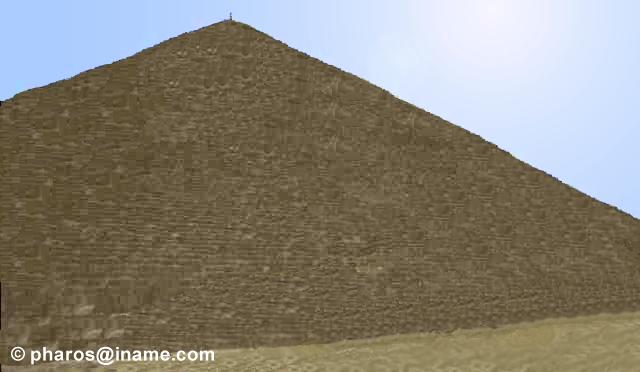
The Great Pyramid of Giza
Located at the city of Giza near ancient Memphis (outside Cairo) in present day Egypt. Built as a tomb somewhere around 2560BC for the Pharoah Khufu (Cheops). The only remaining monuments of the Seven Wonders of the Ancient World. The pyramids of the Pharoahs Khafre and Mankaure, beside the pyramid of Khufu, are not technically one of the Seven Wonders. At 145m (481ft) high, it was the tallest manmade structure on Earth until the nineteenth century AD. The four corners of the pyramid point to each of the directions on a compass.
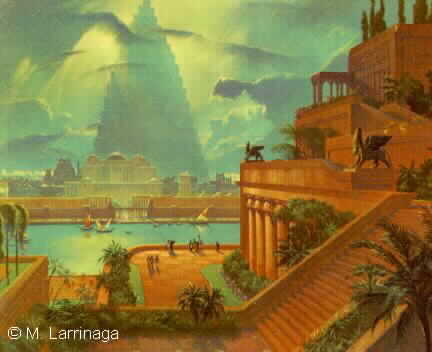
The Hanging Gardens of Babylon
Located on the banks of the Euphrates river in present day Iraq, about 50km south of Baghdad. Built as a gift by Nebuchadnezzer II for his wife Amyitits in 600BC. Amyitis was a Medean, native to the mountainous area of present day Iran. Legend has it she was homesick on the flat plains of Iraq. The Hanging Gardens were meant to remind her of the lush tree filled mountains of her homeland. Described as tiers on columns supporting volumes of earth with great trees and exotic animals, watered by machinery hidden from view. Their is speculation as to whether the Gardens even existed, as tablets from the time give description of the city of Babylon, it's palace, and the city walls, but no mention of the Gardens. The description comes from the Greek historians Berossus and Deodorus Siculus, possibly a result of exaggerations from soldiers under Alexander the Great's military expeditions through Mesopotamia.
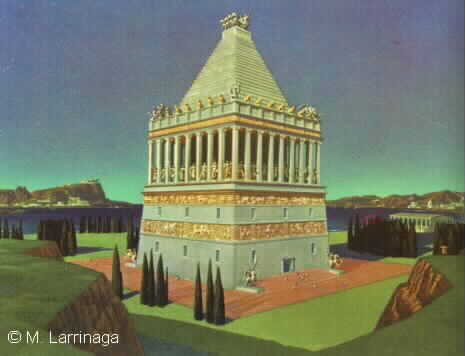
The Mausoleum of Halicarnassus
Located in present day Turkey in the city Bodrum, ancient Halicarnassus, on the Aegean sea. Built as a tomb by Artemisia around 500BC (350BC?) for her husband Mausolos, king of Caria, who was actually a satrap (govenor) of the Persian province of Caria in Anatolia. Built of polished stone and marble, 40m (120ft) by 30m (100ft) at the base and 45m (140ft) high. Each side was decorated with many statues by a different Greek sculptor: Bryaxis, Leochares, Scopas, and Timotheus. The top of the mausoleum contained a statue of a chariot pulled by four horses. In the fifteenth centruy AD, the Knights of St. John of Malta invaded the region and built a massive castle. They decided to fortify it in 1494AD using stones from the Mausoleum, using most all stones by 1522AD. The castle still stands at Bodrum today.
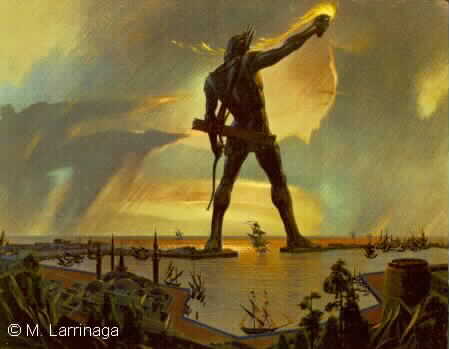
The Colossus of Rhodes
Located on the Greek island of Rhodes off the southwestern coast of present day Turkey. The statue was commissioned and built by the Rhodian sculptor Chares of Lindos from hammered sheets of bronze to honor the Greek god Helios, the Sun god in 282BC at the Mandracki harbor of Rhodes. It sat on a white marble base, and was 33m (110ft) high, paid for by the spoils of a war with Macedonian besiegers and Egyptian Ptolemaic allies. The statue fell when an earthquake hit Rhodes in 226BC, broken at the knee. Ptolemy III of Egypt offered to sponsor rebuilding it, but an oracle was consulted and forbade reerection, so the offer was declined. When the Arabs invaded Rhodes in 654AD, they disassembled the remains and sold it to a Jew from Syria. The Colossus of Rhodes was the inspiration for the French sculptor Auguste Bartholdi's Statue of Liberty.
The Statue of Zues at Olympia
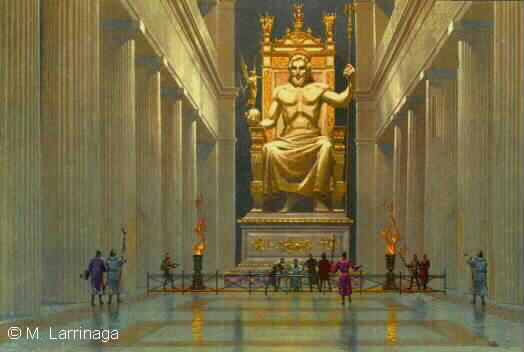
Built by the Greek sculptor Pheidias at Olympia in present day Greece, 150km west of Athens. Built around 450BC, the statue was made from shaped segments of ivory to honor the Greek god Zues, ruler of the gods. The height of the statue was 13m (40ft), depicting Zues seated on a throne. His robe and sandals were made of flattened sheets of gold. The statue was built inside a temple. The temple was eventually closed in 391AD when Theodosius declared the Olympics and Greek gods pagan beliefs and rituals. It was later moved to Constantinople where it was destroyed by fire in 462AD.
The Lighthouse of Alexandria
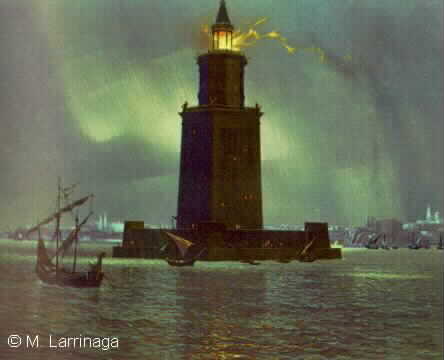
Built on the island of Pharos, now a promontory within the city of Alexandria in Egypt. It was conceived and initiated by Alexander the Great's general Ptolemy Soter, who became Pharoah of Egypt, around 290BC and designed by the architect Sostratus. The lighthouse was lit by a fire at night, and reflected sun rays from a great mirror during the day. It was said the light could be seen for 50km (35miles) off-shore. The Lighthouse was badly damaged by two earthquakes in 1303AD and 1323AD, and not rebuilt since the Arab rulers did not have the strong ties to the Mediterranean. It was finally destroyed in 1480AD when the Egyptian Mameluke sultan Qaitbay built a fort on the island using the stone and marble of the fallen lighthouse. A very accurate description is given of the Lighthouse by the Arab traveler Abou-Haggag Al-Andalousse in 1166AD. It had a square base, an octagonal tower, and a circular top portion, 117m (384ft) in total height. A statue of Poseidon adorned the lighthouse summit in ancient times.
The Temple of Artemis at Ephesus
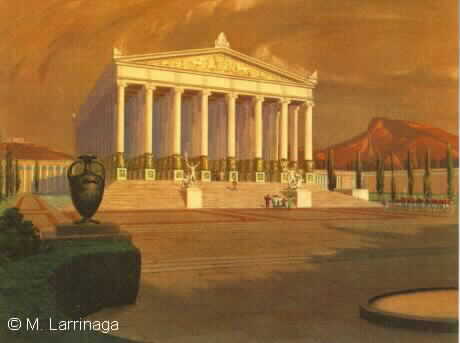
Built around 550BC in the town of Ephesus (near modern day Selcuk, 50km south of Smyrna) in present day Turkey. Built as a temple for the goddess Artemis of hunting, nature, and fertility. The temple was sponsored by the Lydian King Croesus and designed by the Greek architect Chersiphron. The temple was built of Marble and was at least 20m (60ft) high, and 80m (260ft) by 130m (430ft) in layout, decorated with bronze statues by the Greek sculptors Pheidias, Polycleitus, Kresilas, and Phradmon. The temple was burned down in 356BC by Herostratus in an attempt to immortalize his name (a common pyromaniac hoodlum by today's standards), the same night as Alexander the Great was born, hence the reason Artemis "allowed" her temple to be destroyed as she was too busy. The temple was rebuilt, but then destroyed by the Goths in 262AD. Rebuilt again, the temple was finally torn down by St. John Chrysostom in 401AD. By this time, most Ephesians had converted to Christianity and likely had no interest (or financial sponsor) to rebuild the temple.
- (1) http://ce.eng.usf.edu/pharos/wonders/

