 Family: Agamidae
Common Name: Australian Water Dragon
Scientific Name: Physignathus lesuerii
Food: Variety of vitamin/calcium dusted insects such as crickets, mealworms and waxworms, earthworms. They will also eat suitably sized mice, as well as canned cat food or canned dog food and some fruit.
Distribution: Australia
Habitat: Wooded or bushy areas with water
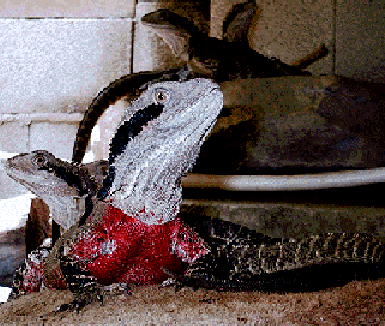
Color Discription: Males have a crested neck and blood red belly. Males have larger heads than females and the black/white design on the male's head is strongly expressed with white lips and a deep black band behind their eyes. Females have similar but duller coloration.
Physical Discription:
Size: Male Australian Water Dragons grow to an average two and a half feet. Females are generally smaller staying around 20 inches in length.
Temperatures: 75º - 92º Generally a temperature gradient is needed ranging from 92º Fahrenheit to 75º Fahrenheit.
Breeding/Reproduction: Breeding Australian Water Dragons begins with courtship behavior from the male. The male will bob his head, puff out his red chest and circle the female awhile. She will give in and breeding will then begin, She will lay from 6 - 20 eggs per clutch which take from 70 to 120 days to hatch.
Cage Setup: If you have to keep them in an indoor enclosure, a pair will do well in a terrarium that is 2 feet high, 3 feet wide, and 4 feet long.
Water: Australian Water Dragons need a water bath, as they enjoy bathing and swimming in the wild
Special Needs: A UVB light will do nicely in providing heat and light, UVB lighting is essential. If they are kept outdoors this is not an issue as they will get the proper lighting naturally, but if kept indoors it is essential for the proper UVB light. Hiding places should be provided (such as hide boxes), which are cooler than the rest of the cage, which should be kept at 80 degrees Fahrenheit during the daytime.
Special Note: These lizards are diurnal so it is important that you provide them with plenty of light. Water Dragons will stop eating if the day is too short or if they are too cold or stressed.
