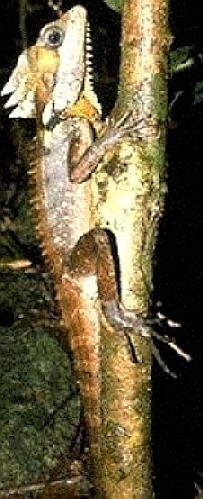
 Family: Agamidae
Common Name: Boyd's Angle-headed Dragon
Scientific Name: Hypsilurus boydii
Food: ants, beetles, grasshoppers and earthworms
Distribution: Australia (NE Queensland)
Habitat: Rainforest
Color Discription: Brown or grey above with some specimens having a green flush. There is a large yellow dewlap edged with enlarged spines.
Physical Discription: A moderately large, laterally compressed agamid with a large, wedge-shaped head. A dorsal crest, discontinuous with the nuchal crest, consisting of enlarged, hardened and pointed scales, runs down to the base of the tail.
Size:
Temperatures:
Breeding/Reproduction: Females lay their eggs in areas where the canopy is open - either in tree falls or beside roads. Nests consist of a shallow burrow covered in a few centimeters of soil and leaf litter. They will lay during the first few weeks of December produceing multiple clutches in a season Clutch sizes of 1 - 5 eggs.
Cage Setup:
Water:
Special Needs:
Special Note: Unlike most other agamids Boyd's forest dragons apparently do not thermoregulate - body temperatures are generally within a degree of ambient.
Forest dragons are arboreal and are usually observed perching on small trees at a height of approximately 3 - 6 ft. above the forest floor
