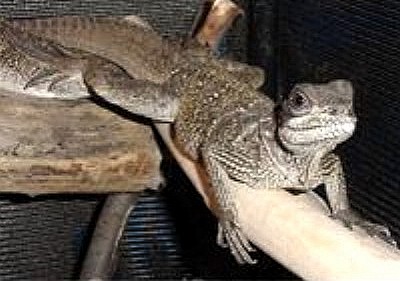
 Family: Agamidae
Common Name: Weber's Sailfin Dragon
Scientific Name: Hydrosaurus weberi
Food: Weber's Sailfin Dragons can be fed a diet of a variety of chopped or grated fruits and vegetables or larger insects, feeder fish, and pinkie mice may be accepted.
Distribution: Indonesia (Halmahera, Ternate)
Habitat: Forest
Color Discription: Weber's Sailfin Dragons are bright blue-green or yellowish, and have black markings that may appear in the form of speckling or even heavy rings on their body.
Physical Discription: Males may have very large crests over their tails and backs, giving them an almost prehistoric appearance!. These crests are what gaves the Sailfin Dragon its name. As well as is their nasal knobs.
Size: 24" - 36"
Temperatures/Humidity: high 70's - 88 degrees Fahrenheit during the day, and between 70 and 75 degrees at night. Humidity should be kept between 50 and 70 percent or shedding problems will occur.
Breeding/Reproduction: Males have larger pre-femoral and pre-anal pores than do females. Females should be allowed a dirt or soft substrate that they can dig into, they will bury their eight to eleven eggs. Eggs should be incubated between 82 and 85 degrees Fahrenheit. The eggs will take between 48 and 65 days to hatch. Usually, breeding occurs in early spring and eggs will be laid several months later.
Cage Setup: A single Weber's Sailfin Dragon can be housed in a tank large enough that includes as follows: A large land area, with a basking spot and a place to hide, and a sufficient water area to soak in. The top of the terrarium should be mesh.
Water: The water should be changed when it becomes dirty.
Special Needs: You should try to have highly visible sides and the dragon should be kept in a very calm area. Provide lots of hiding places and some hollow structure large enough for the entire Weber's Sailfin Dragon to fit into comfortably.
Special Note: Weber's Sailfin Dragons should be kept separated with the exception of breeding pairs.
They tend to be high-strung and can easily be stressed out, particularly if they have been wild caught.
Also, Weber's Sailfin Dragons may take the flight response to the extreme, by smashing repeatedly into the sides of their enclosure if they feel threatened.
They can break the enclosure or cause serious injury to their own bodies.
