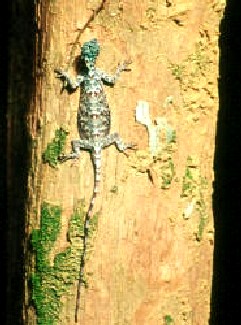
 Family: Agamidae
Common Name: Common Gliding Lizard
Scientific Name: Draco volans
Food: worms, flies, crickets, wax worms, or ants dusted with vitamin supplements.
Distribution: Indonesia (Borneo, Sumatra, Java, Timor), West Malaysia (incl. Pulau Tioman), Thailand (incl. Phuket), Philippine Islands (Palawan), Singapore
Habitat: Tropical Forest
Color Discription: There is great variation in colour, with various shades of grey or brown being found. For males the gular flag is bright yellow in colour, and for females it is blue flecked with black.
Physical Discription: They are able to glide because on each side of the body there is a wide flap of skin (the patagium) supported by movable elongated ribs. Males of the genus also have a throat fan or gular flag.
Size: 8.5"
Temperatures/Humidity: The daytime temperature should be between 80 - 85 degrees, and the night time temperature should be between 70 - 75 degrees. The basking area should be between 90 and 95 degrees. And a humidity level over 75 percent.
Breeding/Reproduction: A clutch that contains 4-6 eggs are laid in a nest that the female digs. The female will then pack the soil back over the nest.
Cage Setup: A minimum 25 gallon tall terrarium. A screen lid is essential for proper air exchange. The enclosure must include a basking area with several climbing branches, a suitable hiding area, and a "cool" area to allow for thermoregulation. If two or more lizards of the same species are desired, it is imperative that daily observations are made to avoid aggressive behavior.
Water: They should always have a bowl of fresh water available to them
Special Needs: Ultraviolet light is recommended for 12 hours per day. A timer will assist in maintaining an accurate schedule
Special Note: They need misting daily, Flying lizards are not for beginners. Contrary to their name, flying lizards cannot actually fly. Instead, when disturbed, flying lizards will only glide a short distances to safety.
Due to their shy nature, it is best not to handle these lizards frequently. Consider researching this unique animal before purchasing.
