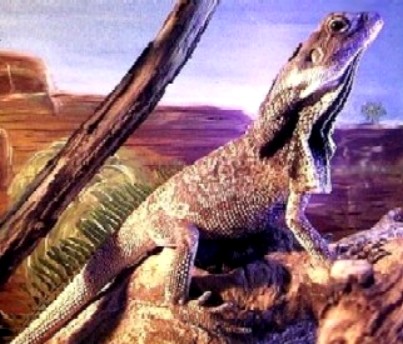
 Family: Agamidae
Common Name: Frilled Dragon
Scientific Name: Chlamydosaurus kingii
Food: Moths, crickets mealworms, earthworms etc, preferrably dusted or gut loaded with calcium or reptile suppliment. They also sometimes eat fruit, particularly banana, fish or shrimp, canned reptile food, small mammals and cooked eggs.
Distribution: New Guinea, Australia
Habitat:
Color Discription: olive through a greyish brown to a near black color.The frill has a great variety of color that can range from yellow to jet black. Patches of orange decorates the throat and in same cases the frill maybe spotted or drenched with spots of orange, red and white.
Physical Discription: Frilled Dragons got their name from their ability to extend huge flaps of skin on their neck as aggressive/defensive displays, or to show off for females.
Size: 30 inches (75 cm) with the frill extended 14 inches (36 cm).
Temperatures: between 84 and 88 degrees during the day and above 70 degrees at night and keep the basking temperature in between 90 and 95 degrees.
Breeding/Reproduction: They usually lay about a dozen eggs. Newborns are 5 inches long at birth and they will weigh approximately 3 to 5 grams. At birth, they are difficult to sex. They grow fairly quickly and may be as long as 16 to 18 inches within the first year.
Cage Setup: Frilled Dragons love to climb and are highly active lizards. They appear to feel more secure when given an arboreal arranged aquarium 55 to a 100 gallon glass tank or custom made wire cage. It must be 6 feet high by 3 feet wide, by 4 feet long (180cm by 90cm by 120). This cage is ideal for a 1 male to two female dragons.
Water: A large heavy water dish should be supplied.
Special Needs: A black light (must be suitable for reptiles) plus an incandescant (normal globe) for basking . If no black light is supplied the they should be put in the sun from time to time, but only on warm to hot days.
Special Note:
