
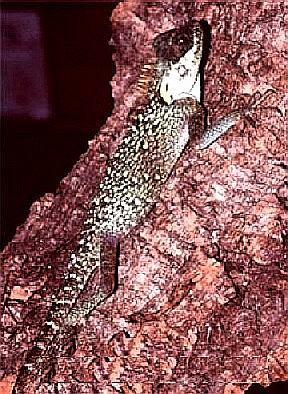
 Family: Agamidae
Common Name: Mountain Dragon
Scientific Name: Acanthosaura crucigera
Food: Worms, grubs, crickets, beetles, grasshoppers. May prefer to feed at night (Supply each meal with multivitamin and calcium supplements.)
Distribution: Burma, Thailand, C Vietnam, West Malaysia, Cambodia
Habitat: Densely foliaged mountain jungles. Usually found on the ground or only a short distance above the ground in low bushes. Fairly secretive. Rarely bask. Require a cool dense rainforest setup with access to water.
Color Discription: The colors vary considerably Generally gray-brown with dark spotting on sides; dewlap is black; belly dirty white. But they have a dark brown or black cross on their nape.
Physical Discription: All species are frog-like in appearance with moderately long tails. Some species have long spikes on their dorsal crest; others short spikes. All have a spike behind each eye. Extremely strong claws for digging. This genus used to be included with the Gonocephalus but sorted out. Lacks the gular fold/dewlap in males. Slight lateral compression. Strong orbital ridges. There are spines on the nape and Occiput. A wide gap separates the dorsal crest from the taller nape crest.
Size: Males reach 10" and the Females reach 8.5" - 9"
Temperatures: 70 - 82° F. days; drop to 68 - 70° F. at night
Breeding/Reproduction: lays eggs under rotting wood, bark; young 2-3".
Cage Setup: Forest setting
Water: Spraying regularly sufficient for drinking
Special Needs: Mountain Dragons require high humidity and large pans of water. Outfit tanks with drip or bubbler systems to maintain the high humidity that is needed. Sunlight/Ultraviolet B (UVB) Some is beneficial.They also require the proper temperature gradients more than a specific basking area.
Special Note: These lizards are all wild caught, and should be assumed to be highly stressed and heavily parasitized.
Get the lizard and a fecal sample to the reptile vet as soon as possible, to be tested for parasites, evaluated for
dehydration, etc.