
What is "wrong"
with Venezuela's Constitution?
6th February, 2003
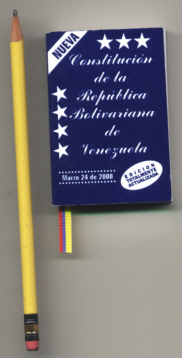
If we reflect about why the Venezuelan
constitution of 1999 poses such a threat for the established national
and international economic interests, that the representatives and former
political power-holders of the latter have not hesitated to do away with
it in one stroke of a pen when briefly and temporarily usurping political
power in Venezuela via last year's April 11th coup d´état, we certainly have
to understand the wider picture within which the Venezuelan "crisis"
is developing, framed by some kind of "master plan" for the Americas, which
is part and parcel of the New American Security Strategy of the current
Bush administration, intended to fully insert Middle and South America
and the Caribbean into the infamous globalization process under terms clearly
detrimental to the region and favourable to the interests of the USA.
The name of this master plan is FTAA
- Free Trade Area of the Americas (ALCA iin Spanish), lately sold to the
general public as a move to tackle the roots of terrorism and to "promote
global security" by "igniting a new era of economic growth through free
markets and free trade", with the USA "seizing the global initiative" and
"pressing regional initiatives"! (1)
Under the FTAA project, 34 countries
will have to subscribe to an international legal framework for at least
50 years, with obligatory modifications of the member countries'
constitutions regarding critical issues like firstly, the privatization
of remnants of collective property of land (especially in indigenous areas); secondly,
the acceptance of multilateral investment agreements allowing transnational
corporations to sue the host State in case the latter should hinder optimum
profit making in the form of environmental or social responsibility laws
denounced as "trade barriers"; thirdly, the privatization and appropriation
of natural, genetic and biological resources under the flag of corporate "intellectual
property rights"; and fourthly, the private appropriation of the existing
fossil energy resources of the Andean/Amazonia Belt by declaring them "global,
human patrimony" open to the highest bidder and not necessarily property
of a particular State under the soil of which these resources happen to
be located. All these issues come down to a rather crude expropriation
strategy better known as "neoliberalism".
A look into the new, Venezuelan
Constitution of 1999, approved by 80% of the Venezuelan population by a
national referendum, especially into articles 12, 119, 124, 127 and 129, will
make us understand what the problem with Chávez is all about, and why
the national economic elite in combination with foreign interests consider
it not enough that the president be forced to resign, but that the entire
constitution be trashed and for that end the country be lit up and burnt
to ashes on all fronts!
Regarding FTAA agenda point "privatization
of collective land", Article 119 of the Venezuelan constitution
would have to be done away with, as it states the following:
"The State
fully acknowledges the existence of the indigenous peoples and communities,
their social, political and economic forms of organization, their cultures,
customs and traditions, languages and religions, as well as their
habitat and original rights over the lands they and their ancestors have
traditionally occupied and which are necessary to develop and
guarantee their ways of life. It therefore is the responsibility of the
national government, with the participation of the indigenous peoples, to
delimit and guarantee the right to collective property of their lands,
which will be inalienable, inprescriptible, not confiscatable and not
transferable according to what is established in this constitution
and the law." (my translation / my emphasis)
Regarding FTAA agenda points "optimum
profit making" and "privatization of genetic and biological resources",
Articles 124, 127 and 129 of the Venezuelan constitution
would have to be shredded to pieces, which declare the following:
Article 124: "The intellectual,
collective property of knowledge, technologies and innovations of indigenous
peoples is guaranteed and protected. All activity related to genetic
resources and associated knowledge will pursue collective
benefits. The registering of patents on these resources and
ancestral knowledge is forbidden." (my translation / my
emphasis)
Article 127: "It is the right and the duty of each generation to protect and
maintain the environment for the benefit of itself and
of the future world. Each person has the right to individually and collectively
enjoy a sane, secure and ecologically balanced life and environment. The
State will protect the environment, the biological and genetical diversity,
the ecological processes, national parks and monuments and other areas
of special ecological importance. The genome of living creatures
cannot be patented and the corresponding law of bioethic principles will
regulate this matter. It is a fundamental obligation of the State,
together with the active participation of society, to guarantee that the
population develops within an environment free of contamination, where
the air, the water, the soils, the coasts, the climate, the ozone layer
and the living species shall be protected in a special way according to
the law."
Article 129, last
paragraph: " ... In the treaties subscribed by the Republic
with natural or juridical persons, national or international, or in permits
granted which involve natural resources, the obligation to conserve
the ecological equilibrium is considered to be an integral part of these,
even if not expressly formulated, as well as to permit the access to technology
and its transference in conditions of mutual agreement and to re-establish
the environment to its natural condition in case of alteration,
according to the law." (my translation /my emphasis).
Concerning FTAA agenda point
"appropriation of existing fossil energy resources", Article 12
of the Venezuelan constitution is certainly a stumbling block and would
have to be eliminated, as it declares all mine and hydrocarbon
deposits under the national continental, insular and maritime
territory exclusive property of the Republic and thus
inalienable and inprescriptible goods of national, public dominion.
This is just a glimpse into the
immediate problematic of what is "wrong" with Venezuela's Bolivarian
Constitution in the eyes of the national and international economic, financial
and energetic interest of the ruling elites and the big, transnational
corporations. The magnitude of their combined and sustained attack on the
democratically elected, legal and legitimate government presided by Hugo
Chávez reveals the magnitude of the basically nationalistic yet not isolationist,
humanistic project of the nation envisioned, outlined and enshrined in
the 1999 constitution.