
Calculating the Hubble Constant
Jurgen Shestani

Later in the 20th century, the constant hovered around 100km/s/Mpc and 50km/s/Mpc. In 2001, the Hubble Key Project determined the value of the Hubble Constnat to be 72+/- 8km/s/Mpc. Using the same data that was used for the Hubble key project, I have calculated the value of Hubble's constant. The data contains a group of Cepheid stars in a galaxy with their period and visible magnitude. For each galaxy I calculated the distance to it from earth in Mega Parsecs. The formulas are here
Absolue Magnitude = -1 - 2.8*log(Period(days))
Apparent Magnitude - Absolute Magnitude = 5*log(d(parsecs)) - 5
From these formulas, I calculated the distance to each Cepheid in 18 different galaxies, from there the average value of the distance is taken as the final value for the distance to the galaxies. After that has been calculted, I got data for the red shift(velocities) of the galxies. This data was provided by the NASA/IPAC Extragalatic Database
553
1831
1636
1510
921
548
-34
663
739
778
730
1571
716
1961
486
1206
241
816
9.7
15.81
18.48
20.83
11.57
12.06
3.48
13.35
13.11
10.56
8.34
15.15
16.91
15.43
15.41
13.68
6.69
16.17
925
1326A
1365
1425
2090
2541
3031
3198
3319
b3351
3621
4321
4414
4535
4548
4725
5457
7331
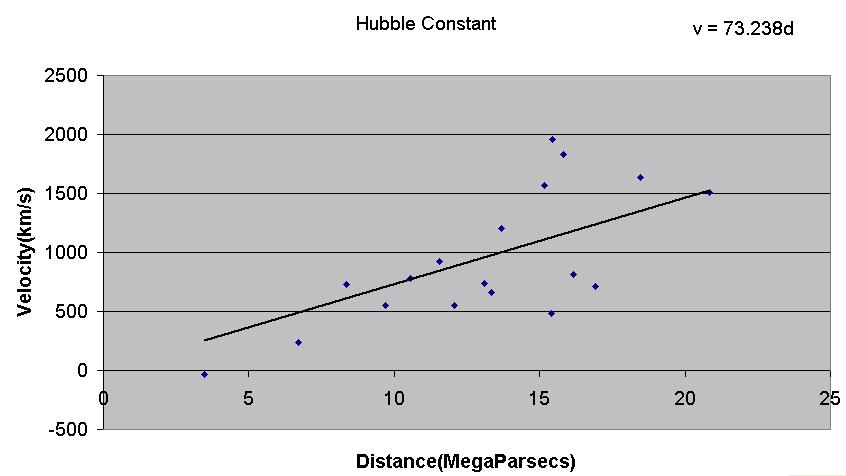
The Hubble Constant also allows us to approximately calculate the age of the universe. The age is approximately the inverse of the Hubble Constant. I found the value of the hubble constnat to be 73.238km/s/Mpc. The inverse of this is, .01365s/Mpc/km, converting from Mpc to km and cancelling the two out, gives you 409120663320968797 seconds, or 12.973billion years