
|
Met@box 2000 Functionality The met@box 2000 was made to be the multimedia centre of the living room. It supports a huge variety of common media formats. Whether you want to watch or record TV or Video, Listen to CD Audio or MP3 files, surf the net or read and write emails, the met@box 2000 will completely revolutionise the way we use our televisions. With new interactivity standards on the way the television will become a thoroughly new entertainment experience. In the past standards were not in place thus hindering the advance of interactive enhanced television. Direct marketing, games, electronic programme guides, surveys, ecommerce applications, and much more will accompany the media-rich content we receive through television networks giving the audience more choice, variety, and fun than ever before. What is the main purpose of the met@box 2000? Basically, television has stayed the same for a number of decades. Apart from changing from black and white to colour, and mono to stereo, the resolution and broadcast standards have been kept the way they were. However, the transmission technologies are moving from analogue to digital and bandwidth is becoming available for digital data services. A wide range of applications like games, interactive TV, internet-browsing, MP3 downloads, video conferencing, and voice over IP will make the TV exciting again. A combination of analogue and digital services would help audiences to take part in a new era of entertainment. To enable the new technology a platform is needed which is flexible and modular to accommodate both analogue and digital formats as well as different types of high-speed internet access devices. For this purpose the met@box 2000 was defined. Network connectivity The met@box 2000 is capable of handling standard modems as well as cable modems and other high-speed connections. In order to facilitate flexibility there is a slot dedicated to handling access to the internet which can handle both present and future networks. Video and audio Various MPEG standards have been adopted as current media formats. MPEG-II is without doubt the digital Video format for broadcasting. The newest form of audio compression is MPEG Audio layer III. This gives virtually no loss in recording quality but allows 10 songs to be recorded in the space of just one in PCM format. Video and audio Standards are moving very quickly so this feature is modular in order to keep pace with technology. TV Tuner There are several standards for TV tuners. Apart from different international broadcasting standards there are also various forms of transmission. Satellite offers both digital and analogue services. Cable networks also offer both types. Terrestrial transmission is also set to offer digital services. Even though this feature is not user-replaceable it is a part which can be specified by the purchaser in the shop. The tuner also acts as the BOT receiver The DVD Module Met@box AG placed a great deal of emphasis on the modularity of digital video to ensure supporting tomorrow's video standards. This may sound trivial but the logic on the board must be self-supporting in order to be fully replaceable in the event of a change of technology in future years. The module is a video socket-card which supports DVD through the ATA bus connection. The DVD processor is controlled by the host processor through a gateway interface. The module also allows various configurations of the met@box 2000 to be decided on in the production process. A device without a hard-disk, DVD ROM drive, and DVD module could act as an entry-level STB. Standards supported by the DVD module:
MPEG-4 Whilst today's digital video broadcasting uses MPEG-II because of its clarity of picture the MPEG-4 standard is coming of age. High quality video at lower bit-rates make MPEG-4 an ideal compression standard for networks and high density discs. MPEG-4 is also the first widely-accepted interactive video standard for multimedia applications with high quality video requirements. The DVD module will be able to exploit the MPEG-4 standard and still comply to MPEG-II and MPEG-I. The Met@box custom DVD format will also implement many of the advanced features of MPEG-4 to ensure an abundance of quality material which can either encrypted or not. Software There is no solution today which addresses all the needs of a versatile STB with home computer functionality. The met@box 2000 has a combination of operating systems to ensure that programs will be available for every conceivable television application. First of all, the met@box 2000 has a real-time pre-emptive operating system kernel to allow constant access to time-critical devices like BOT or Modem. Secondly, the met@box 2000 has a Linux operating environment to add file system functionality and device compatibility. Thirdly, the met@box 2000 has a JAVA virtual machine (JVM) to run highly portable applets from the internet. Fourthly, the met@box 2000 will have the latest JAVATV API which runs on the JVM to enhance the TV experience with interactive applications like electronic programme guide (EPG) and interactive television viewing. New standards in interactive television to be supported by the met@box 2000
ATVEF (Advanced Television Enhancement Forum)
ISO 7816 Smartcard systems
EPG (electronic programme guide)
PIP( Picture-in-Picture)
BOT (Broadcast Online TV)
Video Overlay
This concept is new and will help the elderly to get accustomed to a new generation of devices.
The smart card and on/off switch are easily accessible on the front of the device. A LED Display shows valuable information to the user like URL, Status, DVD or CD Audio title, or track number. The big @ Lamp is designed to let the user know when in standby mode |
|
Possible applications for the met@box 2000 The met@box 2000 is an allround device which alleviates the need for several boxes in the living room. If such a device was already on the market today it would revolutionise the way we purchase consumer electronic products. The advantages of such a system are first of all price reduction, secondly, space saving, and thirdly, ease of use. Only one remote control to operate more than 10 different devices.
|
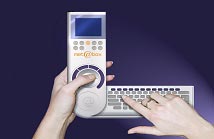 The remote Control is designed to let computer illiterates use very few buttons to achieve maximum results. To keep the typing of emails easy a keyboard is hidden within the remote control case.
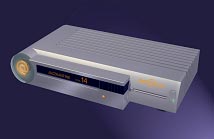 The case was developed to be able to integrate storage devices normally typical to PCs or similar devices. DVD and Hard-disks can be installed in this case without the ugliness of slots and bays.