
October 1998
North American Juntunen
Family History Project
History & Genealogy for the Fun of It
Juntunen Sukukirja Volume I Information
As a service to North American Juntunens, Margaret Smith has agreed to act as the distribution agent for the first volume of the Juntunen Sukukirja covering 1500-1800. The price of the book in the United States will be $90 if purchased in advance. This price covers the book (which is hardbound), shipping from Finland to the US, exchange rate costs, customs charges. The Michigan state sales and US postage is additional. The Michigan sales tax must be collected(Total price with shipping and tax is $100.70). The Juntunen Society anticipates that the book will be released in October. Information on ordering the Sukukirja can be obtained by clicking here. We anticipate that the books will become collectors items.
The Copper Country - An American Heartland
Our immigration research has located arrival information for about 150 Juntunens who came to North America in the first decades of the 20th Century. These family immigrants arrived in steamships from Liverpool, England at the Canadian ports of Halifax, Quebec, and Montreal. From there, many of them traveled to Sault Ste. Marie, Ontario. Some entered the US through customs at Sault Ste. Marie, Michigan.
Many of these Juntunen immigrants' manifests record their destinations as places in Keweenaw, Houghton, and Baraga County, Michigan---places in ''The Copper Country'' or ''Kuparisaari''. The Finnish name meant ''Copper Island''. It referred to the canal dug in the 1800's that separated the towns of Houghton and Hancock, MI. The surrounding region is a peninsula that juts out into Lake Superior from Upper Michigan. Native Americans called it ''Keweenaw'', meaning ''crossing place between two lakes''.
Portage River was an ancient crossing route for Native Americans. It ran east to west midway across the Keweenaw Peninsula. Native Americans portaged their canoes from Keweenaw Bay in the east into Portage Lake and then into Portage River. At its western end, Portage River required a short portage into Lake Superior. Native Americans and French Voyageurs used this route to avoid rounding Keweenaw's northern tip with its treacherous waters during icy northern gales. Even the earliest, most skilled navigators knew it was necessary to seek shelter from risks encountered in Lake Superior storms on the rocky shoals north of Keweenaw.
Keweenaw's wild, agate-strewn beaches and timbered hills had been explored long before development occurred in the 1800's. Much earlier while Europe had labored through its Middle Ages, Keweenaw was already known to North America's native peoples as the continent's most important place to find copper. Pure lodes of copper had been exposed by Ice Age glaciers along the hard spine of hills that ran northeast to southwest along the center of the Keweenaw Peninsula.
In ancient times long before 1200 AD, Native Americans had discovered uses for copper, readily available at the surface in Keweenaw. They made crude mining pits and chiseled out pieces of the solid metal to use for trade. However, by the mid 1800's, a changing Native American population had almost forgotten about the soft metal in Keweenaw and at Isle Royal in Lake Superior. They had found a substitute metal used in more durable iron tools acquired through trade with Europeans.
When American explorers rediscovered the existence of copper lodes in Keweenaw, local Native Americans were surprised by the finds. In the late 1800's, copper mining became a boom industry. Keweenaw was the major source of some of the world's purest copper. American capitalists invested heavily in local mining operations and stamp mills. They reaped millions of dollars in profits from Keweenaw.
As a young man, our ancestor Edwin Juntunen from Suomussalmi, Finland, had read newspaper ads in Finland that described in glowing terms the jobs for ''good wages'' available in the mines of Michigan's Copper Country. He decided to go there to make some money and hoped to return to Suomussalmi as a richer man. He was not the oldest son of his family, so he was not destined to inherit the family farm. But he was physically fit and eager for some adventure and freedom from his position at Käpylä, the family's farm in Kianta Parish north of Suomussalmi.
So with his family's blessing and expectation of return, Edwin traveled to Hanko on the coast of southern Finland. From there he went by ship to England and by train to the port of Liverpool. In May 1911 on board the ship, Empress of Britain, Edwin experienced a fierce North Atlantic storm as he crossed to America. He arrived in Quebec, Canada where he crossed into the US through customs on May 13, 1911.
From Quebec, Edwin made his way to Michigan. He arrived by train in the Copper Country's town named Painesdale. Edwin stepped off the train into a totally planned community. Before him were twenty blocks of residential streets laid out at perfect right angles. Painesdale had been built like a New England town according to the tastes and plans of the Boston mining executives who owned it.
The company town of Painesdale, Michigan had stores, barbershops, shoe and boot repair shop, post office, schools, three churches, library, public sauna, medical dispensary, dance hall, saloons, pool hall, bowling alley, and a movie theatre. There was also a baseball field, band hall, temperance hall and athletic club. Two hundred clapboard-sided, salt box houses lined Painesdale's residential streets. Each house had a fenced garden. A copper miner with a family could rent a house for $6.00 a month. Livestock were kept off the streets in a municipal coral. Mining executives and mining superintendents lived in large, gracious homes on a hill north of town. To the west, were the shafts and buildings of the Champion Mine.
Edwin may have lived in one of the many boarding houses where single miners rented their rooms for $1.00 a month. These rooms had electric lights and running water from the municipal water system. Edwin's fellow boarders were men who had emigrated from Finland, Sweden, Norway, Germany, Italy, Poland, Slovenia, Lithuania, France, Ireland, Wales and Cornwall, England. Posters on the boarding house walls spelled out rules against intemperate drinking and gambling (largely ignored by some tenants on paydays).
The wife of Painesdale's founder, William Albert Paine, was a cultured Bostonian lady. Mrs. Paine insisted that the town have a library that included books in all the languages of the immigrant miners. On one floor were rooms for smoking and card playing. The library was elegantly furnished with leather lounge chairs set before a fireplace in the main reading room. A large oil portrait of a smiling Mrs. Paine gazed down from above the fireplace mantle. The library's basement housed the segregated municipal baths (presumably used by the non-Finnish population). A supply of hot and cold water ran to the baths from the mine. On alternate days of the week, the librarians checked men or women into these baths. They kept track of who bathed and when.
The Champion Mine was one of the richest yielding mines in the Copper Country. It had four shafts going down twenty-four levels to three thousand feet. The mine yielded heavy copper in barrel-sized pieces and in masses that weighed tens of tons. Sixty percent of waste rock was hoisted to the surface, and the remainder was used to make ''hanging walls'' to shore up the caverns created by mining. There were miles of tunnels that were dark, hot, dirty, and very dangerous. This was a common condition of mines in that era.
From 1899 to 1930, 120 miners were killed in accidents caused by falling rock. Miners were required to contribute $1.00 from every month's wages to a charity for themselves. The fund provided them their only insurance in the event of accident-caused disability. The mining company's doctors cared for routine medical needs of the miners and their families. Disabled miners were assigned to alternative jobs. For severe accident-caused disabilities or deaths, the mining company paid benefits on a case by case basis.
The Champion Mining Company invested heavily in expensive equipment. The company purchased the latest, most expensive, imported German equipment---enormous steel hoists, generators, boilers, compressors, motors, and stamps. The mine was run by electricity and was a very efficient operation. Labor unrest was always present in the Copper Country's mines, and often for good reasons. At the end of workdays, miners talking together in the washrooms and drying rooms, sometimes commented that the Champion Mine's profits were benefiting Easterners. Some of the profits are said to have helped build such institutions as Harvard University and the Boston Symphony Orchestra. This was perhaps due to the Paine's eastern connections and origins. In contrast, the miners' wages often seemed to be small compensation for the extreme, life-threatening risks and sacrifices they faced every day underground.
Edwin Juntunen and other miners were strong and courageous men. They worked hard for the Champion Mining Company. After two years Edwin had saved a tidy sum of money. But he had not enjoyed the rowdy boarding house life or the working conditions underground. Edwin decided to return to Finland with his nest egg of savings. Before going home, Edwin made a trip to Minnesota to visit his Aunt Briita Haapalainen Heikkinen, born in Suomussalmi. She and her family lived in Holmes City, Douglas County. At the Heikkinen farm, Edwin met Minnie Heikkinen, Briita's husband Jaafet Heikkinen's daughter. After two winters in Minnesota and summers working on the wheat farms of North Dakota, Edwin married Minnie. In succeeding years after 1915, Edwin and Minnie became pioneers in another American heartland, Itasca County, Minnesota.
We are including a map which indicates the relative location of Painsdale in the eastern United States and Canada for those of you who are unfamiliar with our geography.
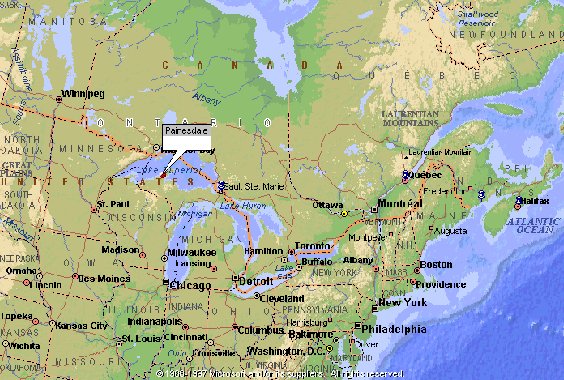
Copyright 1998 by Ruth Stierna and John H. Stierna. All rights reserved. Permission to reproduce this article for publication must be requested from the authors.
We hope this month's article will inspire other Juntunen family members to write about the history of their Copper Country communities and the lives of their ancestors in relation to them.
This month we are featuring a link to the story of the Niilo Juntunen Family of Oskar written by Valerie Tuomi. Valerie was a tenth grader when this article was written. It was an assignment made by her high school Finnish teacher, Jim Kurtti, to acquaint the students with their personal heritage.
We also look forward to featuring the history of other American communities where Juntunen immigrants settled. If you have a story for our newsletter, please send it to us!
This page was last modified on October 15, 1998
Comments or Questions? Internet
E-Mail