
May 1999
We are so happy to learn of the Juntunen project and want to buy the book/books. Thank you for all that you are doing. This is so very exciting, since we did not know much of the Juntunen family in Finland, and had always wanted to know more.
Reading the Juntusten Suku Book I was a challenge. However, it was greatly rewarding because it has given me a much better understanding of my ancestry and some history of the country where my ancestors lived. It was interesting to learn of the forms of the name Juntu and that it probably originated in the 1500's and meant polku or game path. It's amazing that the total number of Juntunens in Finland, according to new records, is 5,511.
For centuries in Finland, a farmer's oldest son inherited his father's farm and other sons had to go elsewhere to establish homes of their own. This evidently was the reason why my father, Edwin Juntunen, being the 2nd son, left Finland and came to America to establish his own home. When I visited Suomussalmi in 1957 and 1970, my father's brother, the family's oldest son, was still living at Käpylä in Kianta, on what had been their parents' farm -- and other brothers had homes elsewhere. At that time, we did not know about the interesting history of earlier family farms in Kainuu, in Ristijärvi and Hyrynsalmi. It is a history that we know now because of the new Juntunen research.
It is gratifying that by reading Juntusten suku I osa, I have learned about my family history (even family origin) and the history and customs of Finland that are woven into the story of the Juntunen family. I am looking forward to the next Juntunen book. Book I has certainly been an excellent beginning.
The latest update to the list of Juntunen ship arrivals. For the previous addition see the April newsletter.
| Row | Name | Port | Date | Place of birth | Age | Name & address of nearest relative in country whence alien came |
Destination & name of relative or friend to join there |
| 33 | Elsa Juntunen | Quebec | May 19, 1902 | ? Inf. | Tower, Minn. to father Herman | ||
| 34 | Elsa Juntunen | Quebec | June 15, 1900 | 11 | Calumet, Mich., Father Salomon Juntunen | ||
| 35 | Elsa Juntunen | Quebec | May 10, 1910 | Suomussalmi, Finland | 19 | Father J. Juntunen, Suomussalmi | Painesdale, Mich., Bro. Kalma Juntunen, Box 606 |
| 36 | Elsa Juntunen | Quebec & Montreal | June ?11, 1911 | Suomussalmi, Finland | ?24 | Sister Marie Juntunen, Suomussalmi, Finland | Cloquet, Minn., ? John Juntunen, 911 T ? |
| 37 | Elsa Juntunen | Que. | June 22, 1902 | 55 | Hancock, Mich., E. Juntunen | ||
| 38 | Elsa Stiina Juntunen | Quebec | June 16, 1911 | Suomussalmi, Finland | 54 | Daughter Ida Leinonen, Suomussalmi, Finland | Calumet, Mich., son John Juntunen, Box ?203, Mohawk, Keweenaw, MI. |
| 39 | Emil Juntunen | Quebec | May 28, 1909 | Suomussalmi, Finland | 20 (Born about 1889) | Father Tuomas Juntunen, Suomussalmi, Oululaani | Painesdale, Mich., Box 606, Bro. Thomas Juntunen |
| 40 | Emil Juntunen | Quebec | July 17, 1903 | 22 | Hancock, Mich. to friend Anters (Anders) Kinnunen, Box 533 | ||
| 41 | Emil Juntunen | Quebec | October 25, 1907 | ? tansaloc, Finland | 25 | Bro. Fali Juntunen, Heroing Lami, Olo Laane, Finland | Hancock, Mich., returning home |
| 42 | Emil Juntunon | Quebec | July 15, 1905 | 35 | Hancock, Mich., Kalle Waisanen | ||
| 43 | Emilia Juntunen | Quebec & Montreal | November 13, 1911 | Suomussalmi, Finland | 14 | Anna Juntunen, Suomussalmi, Finland, Aunt | Cloquet, Minn., Lauri Juntunen, 911 Ave. ? F or T, Father |
| 44 | Emma Juntunen | Hafx. & St. John | April 14, 1912 | Suomussalmi, Finland | 22 | Father Aaro Juntunen, Suomussalmi, Finland | Kearsarge, Mich.to Kalle Juntunen, Houghton Co., Box 13 |
| 45 | Erik Juntinen | Quebec | August 15, 1902 | 22 | Hibbing, Minn., Uncle Hasker Russila, Hibbing, Minn. | ||
| 46 | Eva Juntunen | Quebec | July 15, 1900 | 8 | Calumet, Mich., Father Salomon Juntunen | ||
| 47 | Everi Juntunen | Quebec | September 21, 1906 | 24 | Hancock, Mich., Bro. J. Juntunen, Box 114, Hancock | ||
| 48 | Frans Juntunen | Quebec | July 21, 1906 | 22 | Hancock, Mich., Bro. Johan Juntunen, Freta (Freda), Houghton Co., MI. | ||
| 49 | Fredrik Juntunen | Quebec | August 16, 1913 | Kemi, Finland | 20 | Wife, Lempi Juntunen, Kemi, Karskari, Finland | Astoria, Oregon, Friend, August Sunnari, Alamita Ave., Box 303 |
| 50 | Foivo (?Toivo) Juntunen | Sault Ste. Marie, Mich. | March 20, 1919 | Abel Jct., Mich. | 3 | Newberry, Mich. | |
| 51 | Greeta Juntunen | Quebec | July 9, 1903 | 16 | Kearsarge, Mich., Box 13, Calumet, Cousin J. Manninen | ||
| 52 | Hanna Juntunen | Quebec | May 6, 1907 | Puolanka, Finland | 11 | Superior, Wisc., W. Juntunen, 219 Brick Yard, Superior, Wisc. | |
| 53 | Hanna Juntunen | Quebec & Montreal | May 21, 1909 | Suomussalmi, Finland | 21 | Sister-in-law Emilia Juntunen, Suomussalmi, Kerala, Finland | Tri Mountain, Mich., friend Kalle Kummunen, Box 5, Houghton Co. |
| 54 | Hanni Juntunen | Halifax | April 14, 1903 | 22 | Carl Lankanin, Hancock, Mich. | ||
| 55 | Heikke Juntunen | Halifax | February 8, 1916 | Russia | 20 | 148 S. ? Cross Ave., Duluth, Minn., Bro. Otto Juntunen |
Sisu, that Distinctive Finnish Characteristic
Many of the immigration stories of our ancestors to the United States and Canada have not been passed down to the third and fourth generations of Finnish-Americans. Rita Karolina Gillis shared the story of her great-grandmother, Karoliina Juntunen Larson, her grandmother, Alma Larson Riippa, and her great-aunts, Anna Sophia and Hilda. Rita is her great-grandmother’s namesake.
Karoliina was born during 1850 in Suomussalmi, Oulu Laani, Finland to Juho and Greta Juntunen. She was one of seven children. Finland experienced a period of years of crop failures and famine during Karoliina’s early life. Many people died even though they made bread out of tree bark "flour" to provide nourishment.
Rumors circulated that food was plentiful in Vadso, Norway. Karoliina who was eighteen decided to ski to Norway. She was skiing to save her life.
In Vadso, Karoliina met and married August Larson (Moilanen) in June of 1881 who had left Puolanka, Oulu Laani, Finland. Karoliina and August had three daughters born to them in Vadso. In 1888, August departed for America to prepare a new home for his family.
Prior to leaving Norway, August prepared wood and food provisions to last Karoliina and the girls through the winter in Norway. The family experienced a very harsh winter there. Heavy snows completely covered the cabin only leaving the chimney exposed. The snow entombed Karoliina and her daughters and they could not open the door. Fortunately, shepherds noticed smoke coming from the chimney and realized that people were entrapped. They dug and dug and finally freed the family from the cabin.Around 1889, August sent for his family. It was a tremendous undertaking for Karoliina to travel with three young children from Vadso to California. She sewed her important papers into her dress for safekeeping. Aboard the ship the family was exposed to many new experiences and foods. They met people from other European countries. It was perhaps like going to another planet for the travelers because Vadso was so isolated.
During the journey across the ocean, the ship hit an obstacle and emergency repairs were required to fix the ship. Fortunately the repairs allowed the ship to continue its journey, otherwise the passengers would have been consigned to watery graves.
It is not known whether Karoliina and her daughters arrived in Canada or New York. But when they disembarked they went to a hotel for the night. Their money for the journey to California was stolen from their room. Karoliina’s foresight in sewing her train tickets in her skirts saved the day. They presented their tickets and boarded the train for California.
The conductor, when he examined the tickets, realized that they had been put on the WRONG TRAIN. Because Karoliina could not converse in English and explain where she was going, the family was put off the train in the middle of the night. It was a bewildering experience for the weary travelers. They walked toward a light in the distance and reached a small village. A door opened and a villager asked them in Finnish who they were. It was an answer to a prayer, for Karoliina and the children, to meet fellow Finns in this far off place.
The villagers took up a collection to buy new tickets for the family and put them on the right train to California. They rejoined August in Eureka, California where their son, John was born in 1890. They later moved to Oregon where two more children were born.
Rita states " It is interesting to note how many individual circumstances and their outcomes, made all the difference on whether the family line failed or continued on for many generations. If Karoliina had succumbed to any single one of the difficulties, we would not be here." Karoliina was a shining example of Finnish sisu.
During our ancestors' time in Finland, famine was always on the horizon because a rainy summer could prevent slash and burn agriculture, the way fields were commonly cleared in northern Finland to make them ready for planting. And late and early frosts often damaged crops. The ever-present possibility of famine caused some farsighted farm families to try to prepare for crop failures. In bad years, those people fortunate enough to have stockpiled rye flour mixed it half and half with "pettu", an ancient survival food made from dried and ground phloem, the soft inner layer of sugar and vitamin C-rich springtime pine bark.
On hunting trips, men collected pettu from the southern side of standing pine trees. In years when famine was predicted and an ample supply of pettu was needed, whole families would go out into the forest before midsummer to loosen tree bark.
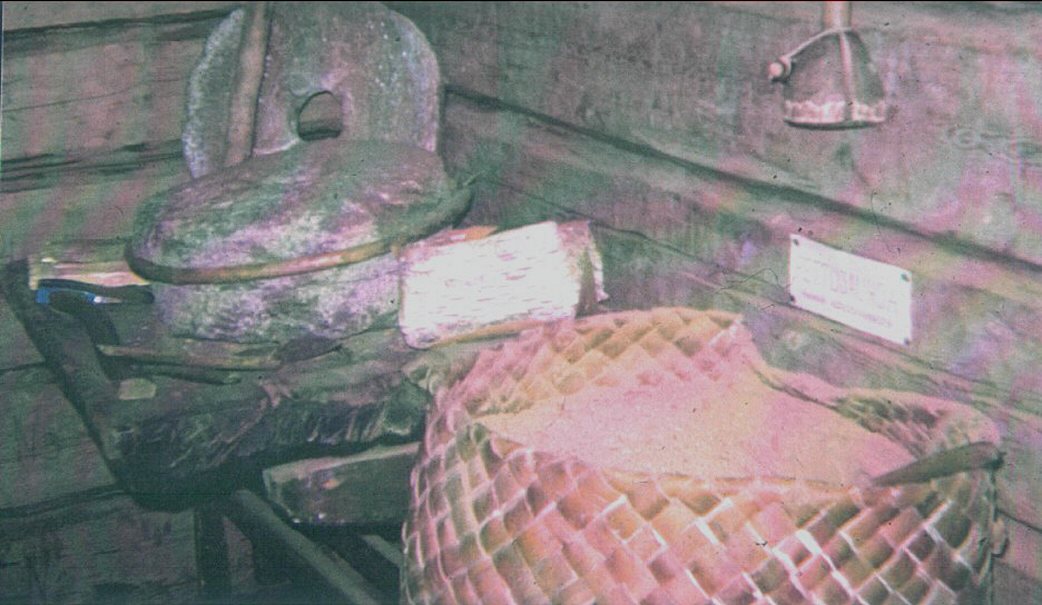
Once dried, the phloem layer of bark was ground into meal, which if stored under favorable conditions could last for as long as tens of years. Pettu meal was mixed into bread dough to make a palatable, if not as nutritious, bread as that from pure grain. Under conditions of extreme hardship, ground straw was added to stretch the amount of "bark bread" produced. When other food was scarce, this practice of diluting the nutritional value of bark bread contributed significantly to malnutrition during famine.
This page was last modified on May 10, 1999
Comments or Questions? Internet
E-Mail