Tre'r Ceiri
Tre'r Ceiri
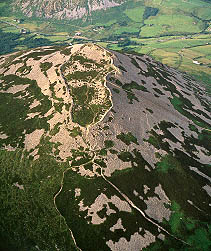
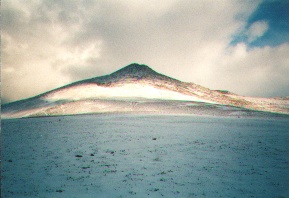
Until recently I lived among a range of three mountains, all in a row, called the Rivals, an English corruption of Yr Eifl. These are among my favourite places. On top of the end mountain, sits an Iron Age hillfort and amongst this a Bronze Age Cairn. (see above) The middle mountain is called Yr Eifl, and the mountain I lived part way up on, looks similar to a volcano (see below)
Yr Eifl in Winter
Tre'r Ceiri , the name of the hillfort, is a fort of 150 hut circles, amongst the best preserved in Europe. It has very thick walls and has commanding views over the the Lleyn Peninsula and Snowdonia. Tre'r Ceiri actually means 'Town of the Giants' , its 800 feet long and 300 feet wide. It seem to have been in occupation for a very long period of time, many centuries, the cairn gives support to activity in the Bronze Age and the fort was occupied throughout the Roman Occupation of North Wales. It is a very magical place, I heard a tale that you must not stay up there overnight or you will go mad! The Mountains are protected by a Guardian and the Spirit of the Mountain. Many people have told me that they have been up there walking and felt they were not alone, and some find that disturbing. I don't find it disturbing, rather, peaceful.
Littered over the mountains moors are standing stones, a stone circle (not on the Map!!!) buried entrances into the mountains, hut circles- the former homes of our ancestors. It is a very wild, ancient place , easy to feel transported back to the Bronze Age and beyond and when the mists are down beware you don't stumble into the land of Y Tylwyth Teg (The Fair People or fairies)
Nant Gwrtheyrn
The road down to Nant Gwrtheyrn
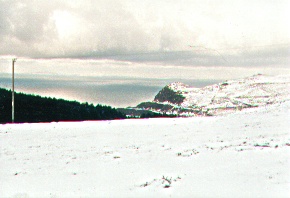
This is an old village, no longer lived in, reached by a steep winding lane that goes out of my village then plunges into a valley with wooded sides and waterfalls in Winter. The houses there now were mainly built during the 19th century, when the quarries were open. They began as weekly homes for men from Ireland paid to work the quarries. Eventually, their families arrived and it became a thriving community until the 1950's when the last inhabitant left. There is a story of a curse on the village, placed there by the clergy as punishment for being ungodly (i.e pagan!) and that none would marry other villagers so that the village would die. A legend attesting to this regards a pair of young lovers who were to marry. On the Wedding morning, it was customary for the bride to hide and for her groom and friends to find her. This she did. However as much as anyone looked she could not be found. The bridegroom to-be was obviously devastated and spent the next few weeks wandering up and down the beach, finally dying of a broken heart. Some 20 years after this incident, there was a very stormy night, with wind, thunder and lightening. In the morning, the villagers awoke to find trees had been uprooted. They were shocked to discover that on of the trees up rooted had revealed a skeleton. This was obviously the missing bride, as the skeleton wore the remains of a wedding dress. The bride had crawled into the tree and, unable to get out, had died there.
The legends regarding this village go much further back than this though, like the mountains above, it was probably inhabited in Neolithic times, being so close to the sea, and later, good land for farming. Nant Gwrtheyrn itself gets it name from Vortigern, a 5-6 century C.E. King of Britain, who fled to the remote valley to avoid his enemies, he built a castle, (now mostly washed away by the sea) and was buried in the valley. In the 18th Century a grave was found reputed to be Vortigern's, as bones belonging to a tall man were found within. Nant Gwrtheyrn means 'Vortigern's Valley'.
PLEASE CLOSE THE BROWSER WINDOW TO RETURN HOME
