
~ Happy St. Patrick's Day ~






In the true Tradition of St.Patrick himself ....
May Ye Find Ye Pot o' Gold...
an' catch yerself a Leprechaun as well !!
May the Luck of the Irish be with You !
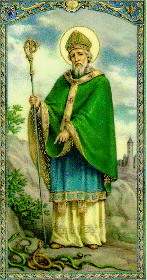
Saint Patrick and the Irish Kings
Maewyn Succat - later known as Saint Patrick - was born around
390, probably in England or Scotland. His parents, Calpurnius and
Concess, were high-ranking Romans and devoted Christians.
Maewyn's grandfather Potitus was a priest (at that time, priests
were permitted to marry and have children).
Despite his family's involvement in the church, young Maewyn was
not particularly religious. In his mid-teens he committed some
unknown sin. A few weeks later his village was invaded by Irish
raiders under the command of the great high king Niall of the
Nine Hostages. They killed Maewyn's father and kidnapped many
people, including Maewyn and his sisters Lupida and Daererca.
King Niall and his fleet returned to Ireland with their hostages,
where Maewyn was sold to a chief or king named Milchu. (What
became of Maewyn's sisters is not known.) Previously Maewyn had
known only a life of privilege and luxury; now he was a slave. He
spent six years caring for his master's sheep or pigs under very
harsh conditions. He believed that this was his punishment for
breaking God's commandments.
It was during this lonely, desperate time that he learned to pray
deeply. "Thus was I purged by the Lord; and He made me fit
so that I might be now what was once far from me, that I should
care and labor for the salvation of others, whereas then I did
not even care about myself," he later wrote.
When Maewyn was in his early twenties he dreamt that he heard a
voice telling him to leave Ireland, saying, "Lo, your ship
is ready." Knowing that it was a vision from God, Maewyn ran
away from King Milchu and made his way 200 miles south to Wexford.
There he found a boat that was bound for Gaul (France). He begged
the captain to give him free passage, but the captain turned him
away. Maewyn began to pray. Suddenly a crew member called him
back - the captain had changed his mind.
After enduring further misadventures, Maewyn returned to his
family in Britain. However, he soon left them again to journey to
France, where he became a priest and took the name Patrick (Patricius
Magonus Sucatus).
Saint Patrick's Day (March 17th), is an Irish holiday honoring Saint Patrick, the missionary credited with converting the Irish to Christianity (in the A.D. 400's).
Saint Patrick was not actually Irish. Historical sources report that he was born around 373 A.D. in either Scotland (near the town of Dumbarton) or in Roman Britain (the Romans left Britain in 410 A.D.). His real name is believed to be Maewyn Succat (he took on Patrick, or Patricus, after he became a priest). He was kidnapped at the age of 16 by pirates and sold into slavery in Ireland (I am not making this up). During his 6-year captivity (he worked as a shepherd), he began to have religious visions, and found strength in his faith. He finally escaped (after voices in one of his visions told him where he could find a getaway ship) and went to France, where he became a priest (and later a bishop).
When he was about 60 years old, St. Patrick travelled to Ireland to spread the Christian word. It's said that Patrick had an unusually winning personality, and that helped him win converts. He used the shamrock, which resembles a three-leafed clover, as a metaphor to explain the concept of the Trinity (father, son, holy spirit).
Legend has it that Saint Patrick drove all the snakes out of Ireland -- that they all went into the sea and drowned. Poor snakes. I don't know why he would want to do this, except that the snake was a revered pagan symbol, and perhaps this was a figurative tale alluding to the fact that he drove paganism out of Ireland.
In America, Saint Patrick's Day is a basically a time to wear green and party. The first American celebration of Saint Patrick's Day was in Boston, Massachusetts, in 1737. As the saying goes, on this day "everybody is Irish!" Over 100 U.S. cities now hold Saint Patrick's Day parades, the largest held in New York City.
Green is associated with Saint Patrick's Day because it is the color of spring, Ireland, and the shamrock. Leprechauns are also associated with this holiday, although I'm not sure why. Leprechauns of legend are actually mean little creatures, with the exception of the Lucky Charms guy. They were probably added later on because capitalists needed something cute to put on greeting cards.
What's good luck on Saint Patrick's Day?:
An Irish blessing to take with you today:
May your blessings outnumber the shamrocks that grow
And may trouble avoid you wherever you go.
written by Cinderella
Erin Go Braugh
Ireland Forever
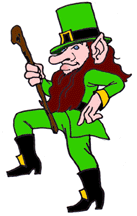
Leprechaun
Irish fairy. Looks like a small, old man (about 2 feet tall),
often dressed like a shoemaker,with a cocked hat and a leather
apron. According to legend, leprechauns are aloof and unfriendly,
live alone, and pass the time making shoes...they also possess a
hidden pot of gold. Treasure hunters can often track down a
leprechaun by the sound of his shoemaker's hammer. If caught, he
can be forced (with the threat of bodily violence) to reveal the
whereabouts of his treasure, but the captor must keep their eyes
on him every second. If the captor's eyes leave the leprechaun (and
he often tricks them into looking away), he vanishes and all
hopes of finding the treasure are lost.
Blarney stone
The Blarney Stone is a stone set in the wall of the Blarney
Castle tower in the Irish village of Blarney. Kissing the stone
is supposed to bring the kisser the gift of persuasive eloquence
(blarney). The castle was built in 1446 by Cormac Laidhiv
McCarthy (Lord of Muskerry) -- its walls are 18 feet thick (necessary
to thwart attacks by Cromwellians and William III's troops).
Thousands of tourists a year still visit the castle.
The origins of the Blarney Stone's magical properties aren't clear, but one legend says that an old woman cast a spell on the stone to reward a king who had saved her from drowning. Kissing the stone while under the spell gave the king the ability to speak sweetly and convincingly.
It's tough to reach the stone -- it's between the main castle wall and the parapet. Kissers have to lie on their back and bend backward (and downward), holding iron bars for support. Can you imagine kissing something that has had people's lips all over it for 500 years? Yuck!




Send your favorite lass or lassie or laddie a special card!
This is a rock slab graphic near
the top of on our disksAccording to legend, and person who kisses
the stone is henceforth endowed with the gift of eloquence and
persuasive flattery.
Directions for kissing this stone: Lie on your keyboard and kiss
it backwards.
Links You Wanna See !