Preface
to the Single Handed Warm-up Patterns
Provided here are my personal
individual warm-ups, as it pertains to playing on a single drum.
These warm-ups are intended as "calisthenics",
meant for preparing the muscles in the forearms, wrist, and fingers to perform.
They are not intended to be interesting musical phrases, and therefore may of
course be considered boring by most, but they are extremely effective.
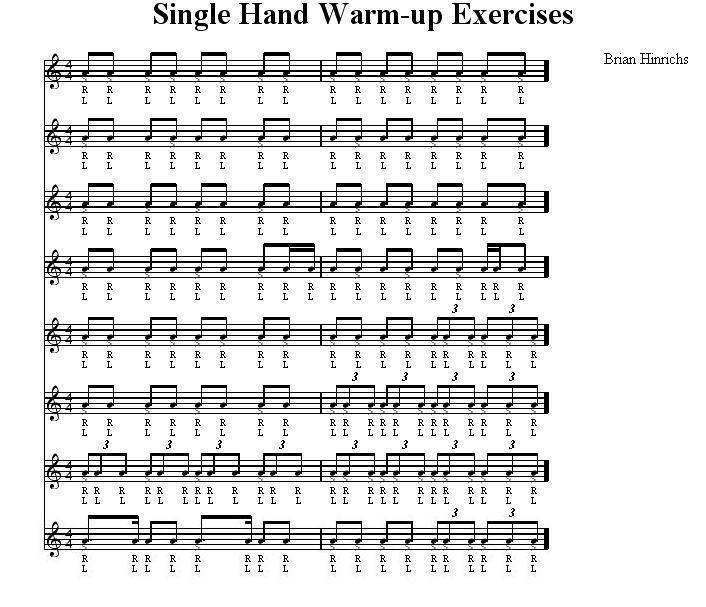
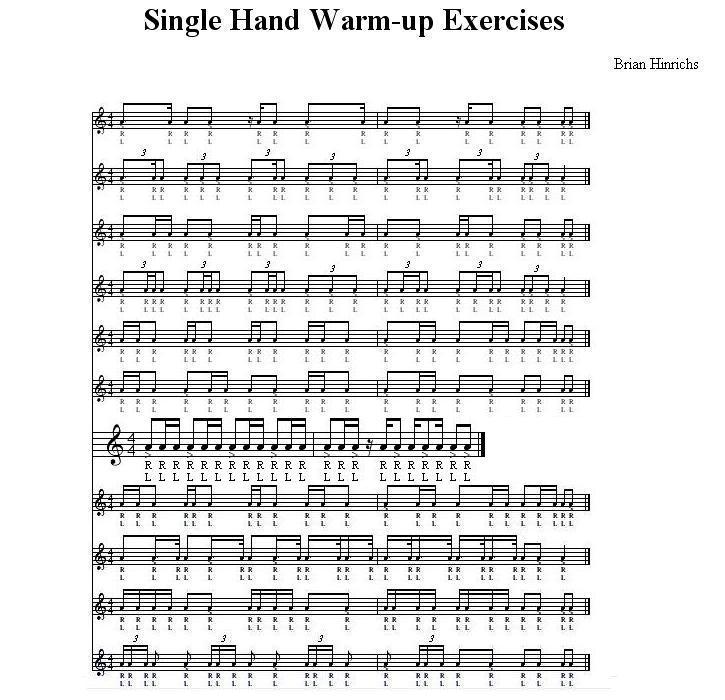
These warm-ups consist of one measure of a single
rhythmic pattern repeated over a length of a varying number of measures,
usually four or eight, sometimes more, on a single hand before changing hands
to repeat on the opposite hand. The hand that is not playing is allowed to rest
with the arm hanging down beside the body to allow relaxation of the muscles in
that arm.
The tempo on each pattern begins very slowly [@ MM=80 in
4/4, and @ MM=60 in 12/8] and kept under a moderate tempo [@ MM=120 in 4/4, and
@ MM=100 in 12/8], until all patterns have been played. After all patterns have
been played for some duration, they are repeated again in order from first to
last, slowly increasing speed after completion of all the patterns, until the tempo is past the point of a
moderate tempo, or until you feel you are warmed up.
The very first pattern, straight eighth notes all
accented played at an extremely slow tempo, is used between other patterns when
needed to relax the muscles, if any other pattern begins to get the muscles a
bit tense. If the muscle tension begins to get too prevalent, a few minutes of
not playing at all, and possibly doing stretches for the fingers, hand, and
forearm before then allowing relaxation time for a few minutes, might be
recommended.
IMPORTANT NOTE: No two patterns are played back to back
while warming up. Each measure is played repeatedly as an isolated pattern by
itself on one hand. The accents, as placed by the software I am using, are
somewhat difficult to see, placed just beneath the note.
IMPORTANT NOTE: The measures which are labeled at a dynamic
level of "mf” are done so to indicate playing all notes at a moderate
level, not loud, and not too soft, and the accent is actually a very soft
accent, not much louder than the other notes being played in the pattern.
SINGLE
HANDED WARM-UP PATTERNS, Page 1 of 1:
http://www.geocities.com/jumpin2drums/SingleHandWarmUpPatterns1_Final.JPG
SINGLE
HANDED WARM-UP EXERCISES, Page 1 of 2:
http://www.geocities.com/jumpin2drums/SingleHandWarmupExercises1.JPG
SINGLE
HANDED WARM-UP EXERCISES, Page 2 of 2:
http://www.geocities.com/jumpin2drums/SingleHandWarmupExercises2.JPG
There are rudiments and single count hand to hand
patterns I have found, which I will lay out, that correlate to each of these
single hand warm-up patterns. Though, I personally find the rest allowed to one
hand while the other hand is playing to be very valuable for my personal
warm-up.
The importance of keeping your hands
and arms relaxed.
A number
of older drummers re-entering the rudimental drumming arena after many years
away from it, seem to have encountered things like, numbness in a thumb,
finger, possibly at the fulcrum on either hand, nerve twinges in hands or
fingers. Muscle tension in the wrists
and forearms is common of course at first, but is not long lasting or damaging
as other things listed above, though it should try to be held to a minimum by
staying relaxed, limiting the difficulty of your playing material, and
incorporating many breaks.
I attribute
some of the above problems to such things as too much tension or pressure at
the fulcrum, which can also cause over-tension of forearm muscles, playing too
hard on the surface, overstretching wrists, fingers, and arms, which might
damage muscles, and pinch or bruise nerves.
I recommend a take-it-easy, slow-and-relaxed method of re-entering
rudimental drumming for the older drummer who has not performed rudimental
drumming in many years.
I use simple
single hand warm-ups using a very loose grip, keeping all my finger, wrist, and
arm muscles relaxed as possible. I think
of this single hand warm-up as calisthenics, similar in a way to the stretching
and warm-up an athlete will do. These
simple single hand warm-up patterns I use allow my wrist and arm muscles to slowly
stretch and loosen, while slowly increasing the flow of blood to the arm and finger
muscles, while the other arm and hand is being provided time to relax, thus
allowing me to perform my complete warm-up without taking any breaks for relieving
possible muscle tension, though I do take my time to slowly proceed through
this warm-up. My complete single-hand warm-up
actually takes longer than if I would use hand to hand warm-ups. As I progress on to completion of my
warm-ups, I try to keep my muscles as relaxed as I started. Difficult drumming passages are beyond single-hand
or hand-to-hand warm-up, and of course require more muscle tension, but I still
attempt remaining as relaxed as possible.
Attempting extremely difficult rudimental passages, extreme tempos, and
especially combining both, may cause an extreme amount of muscle tension, and
require taking numerous breaks while playing such material. At those times when you are performing such
extreme rudimental drumming, be aware that even though you are accomplishing
these feats, if you are using extreme muscle tension at the time, your muscles
will need time the following day or so to repair. You may need to spend more time on simple
warm-up patterns to regain loose muscles while your muscles repair themselves
from the stress of the extreme demands you had placed on them while playing.
My
re-entry into the rudimental drumming arena has given me personal rewards of
going beyond my playing abilities of my younger days, but has made me realize
not to press too hard, or too far too fast, as my body will most definitely
make me aware of its limitations, which I am trying to push beyond without
resulting in irreparable damage. One important
point is to give your body time to heal.
If you do encounter what seems to be a problem caused by playing,
consider giving your body a vacation from the beating you might be putting it
through, and stop drumming for a period of time. I have had to stop playing for a few weeks at
one point to allow my wrist or arms time to repair themselves, without external
medical intervention, other than aspirin, heating pads or the like. I attribute my problem to extreme over-stretching
of the left wrist. Though I still have
nerve twinges in my left wrist only if I over-twist, or over-extend the inner
wrist muscles, such as quickly turning a door knob clock-wise with the left
hand, which is a motion I do not do while playing, and a slight numbness in the
inner left thumb, the few weeks I had stopped playing had allowed these
problems to nearly completely disappear. Take it easy, slow, and stay relaxed.