http://chandra.harvard.edu/resources/illustrations/xlightScale.html
The Joy of X-Ray Telescopes
The goal of x-ray telescopes is to help astronomers better understand the structure and evolution of our universe. X-ray imagery is useful because it detects exploding stars, matter falling into black holes and other exotic celestial objects. Black hole research is actually one of the primary focuses of the Chandra research. In the years since Chandra has been in business, it has taken many images that point to black hole activity, helping astronomers to further understand black holes and their effects on area around them.
X-ray telescopes are able to observe matter that is millions of degrees Celsius, matter that is so hot that regular telescopes are unable to detect it. This matter is typically created by gigantic explosions, or intense magnetic or gravitational fields. Since black holes contain massive amounts of energy from all the matter that they have collapsed, Chandra is able to detect areas where black holes most likely exist.
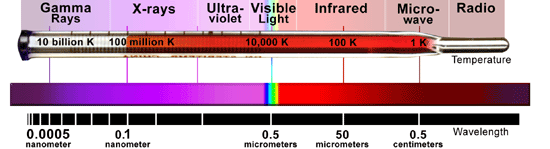
Expectedly, x-ray light is a highly
energetic form of light, as seen by the table below.
http://chandra.harvard.edu/resources/illustrations/xlightScale.html
X-rays are actually a form of radiation, discovered in 1895 by Wilhelm Roentgen. He called it X-radiation to take into account its unknown properties -- X, the unknown. Roentgen observed that x-rays could pass through many materials that visible light could not, and that it had the power to break electrons off of atoms. After a while, x-rays were determined to be another form of light, and later fitted into the spectrum of light shown above.
|
|||||||
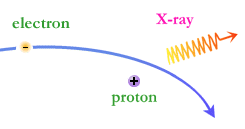
X-ray light is classified by its photon energy; x-rays range from hundreds to thousands of times larger in energy than optical photons. The photon limit is largely set by the collision speed or vibration of the particles. Speed is also a function of temperature; particles move faster in higher temperatures. Thus, the particles detected by x-ray telescopes are moving very fast, and they have enormous energy. These very high temperatures where x-ray particles are found are those which x-ray telescopes like Chandra detect.
The photons also can collide with electrons. When this happens, the collision creates more energy for the photons, and they are often changed from low-energy photons to high-energy photons. This is known as Compton Scattering, and is often located around black holes -- where matter is suddenly distorted when it is pulled in by the magnetic fields of the black hole.
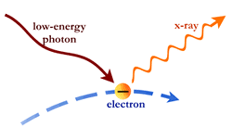
Inverse Compton Scattering (http://chandra.harvard.edu/xray_astro/xrays2.html)
The photons collected in space by x-ray telescope inform astronomers of the "hot-spots" in the universe, where matter is very hot and energized, like black holes or collapsed neutron stars. Determining the cause of this result is the larger function of the x-ray telescopes. Without x-ray technology, these things would not even be detected, and thus we would not have many of the answers that we have today.
For some examples of work that the Chandra observatory has completed, making new strides in knowledge about the cosmic universe, please see the section titled "Applications of the Chandra Observations."