|
|
|
| Images
of the Sun (as well as sunspots and the rotation of the sun) |
|
|
|
|
| Images
of the Sun (as well as sunspots and the rotation of the sun) |
|
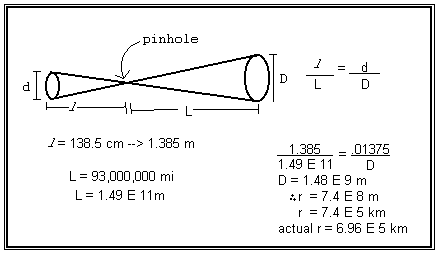
1. The first step of our work was to determine the radius of the sun using our pinhole telescopes. All these were were long tubes with two pieces of paper, one covering each end. The end closest to the sun was whole except for a tiny pinhole pricked in the center to allow light in; the other end's paper had a photocopy of a ruler inside. When we held the "telescopes" up toward the sun, the light from it entered through the tiny pinhole at the top, and reflected an image of the sun onto the bottom side, which had the piece of paper with the ruler on it. This made it possible for us to get a diameter of the sun (on a scale). The data from our class was the following: 13 mm, 14 mm, 14 mm, and 14 mm. Thus, the class average for the diameter of the sun was 13.75 mm on a scale, or 0.01375 m. Using this data and the knowledge of both the length of our tubes and our distance on Earth from the sun, we were able to find a scale and determine the diameter of the sun.
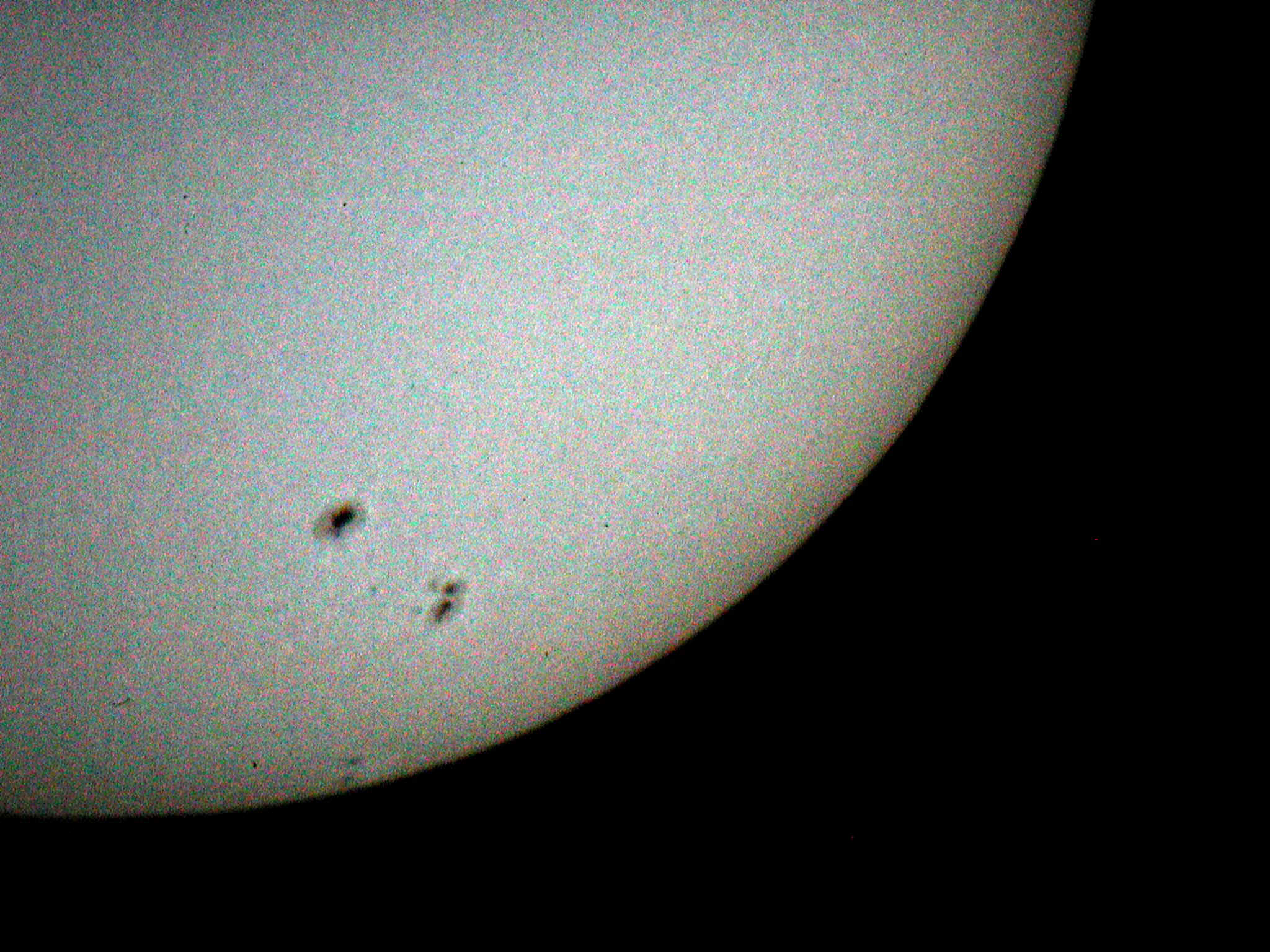
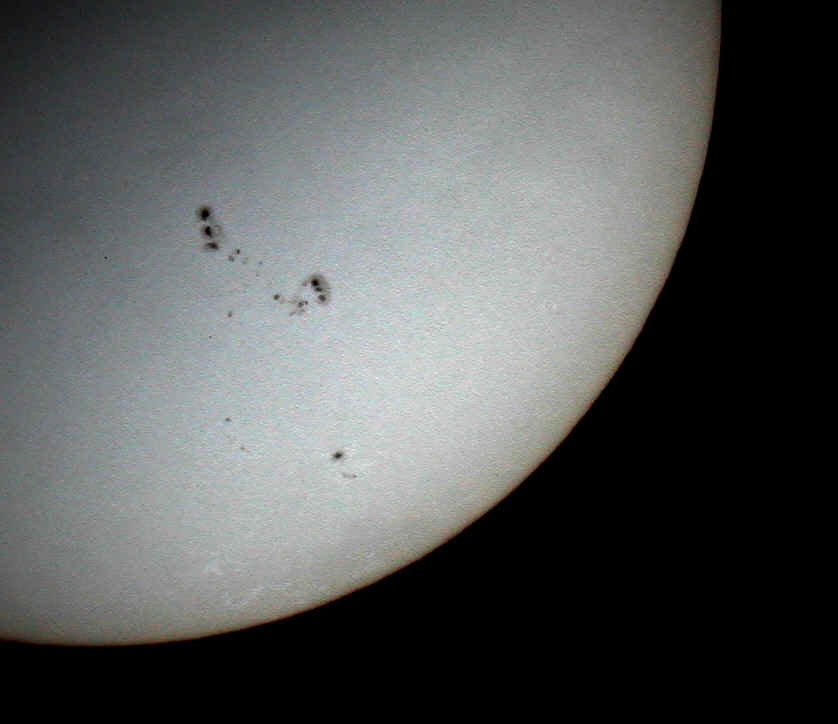
2. The above two images, along with many others, were taken by reflecting the image of the sun inside a dark box onto a white piece of paper. (Two holes were cut into the side of the box -- one for inserting a lens which was the viewpiece for the telescope, and the other for looking into the box with.) Once the telescope was properly aligned with the sun (a rather difficult task, since one had to use the reflection alone -- you can't look through the eyepiece bbeecause the light of the sun is too strong), the lens of a digital camera was inserted into the viewing hole and pictures of the sun's reflection inside the box were snapped. The exposure time was very short on these pictures, because the sun is so bright that any extended period of time with the shutter open lets too much light in and the photo is all white. The pictures we took were at the fastest exposure time.
3. The next step was using our pictures to determine the diameter of the sunspots visible in both pictures. There were two ways to do this. The first is to measure the diameter of the sun on a full picture of the sun, and then compare that width to the actual diameter, creating a scale. Then all that was necessary was measuring the width of a sunspot on the picture, and plugging it into a proportion utilizing the scale to find its actual width.
The diameter of the sun on the picture at left was 20.8 cm, or .208 meters, and the actual diameter of the sun is 2(6.96 E 8) meters. The width of the sunspot on that picture was 0.5 cm, so it is 0.005 meters. Thus:
0.208
= 0.005
2(6.96 E
8)
x
x = 3.3 E 7 m
(width of sunspot)
The second way of determining the width was a little more complex, but required less specific data: it only required a section of the sun, instead of the entire sun. This method utilizes the following geometric theorem:
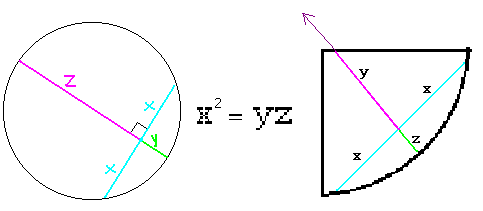
Thus, we only need to see enough of the sun to measure a chord and its perpendicular bisector, and then the distance from the intersection of the two lines to the edge of the sun.
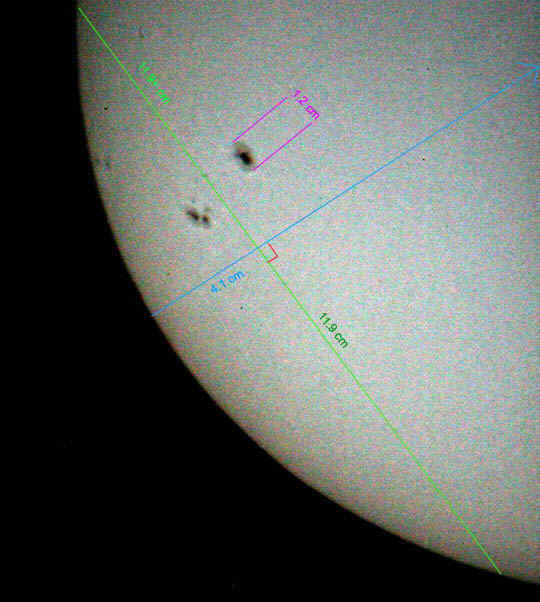 In
the picture, x is equal to 11.9 cm, and y is equal to 4.1 cm. Therefore, z is
equal to 34.5 cm. The diameter of the sun in the picture is equal to y + z, so
it is 38.6 cm (0.386 m) total. The sunspot was measured on the diagram as well,
and determined to be of width 1.2 cm (0.012 m). Another proportion to determine
the actual diameter of the sun spot using a scale of the diameter of our
sun to the actual diameter of the sun:
In
the picture, x is equal to 11.9 cm, and y is equal to 4.1 cm. Therefore, z is
equal to 34.5 cm. The diameter of the sun in the picture is equal to y + z, so
it is 38.6 cm (0.386 m) total. The sunspot was measured on the diagram as well,
and determined to be of width 1.2 cm (0.012 m). Another proportion to determine
the actual diameter of the sun spot using a scale of the diameter of our
sun to the actual diameter of the sun:
0.386 = 0.012
2(6.96E8) x
x = 4.4 E 7 m
(diameter of sun spot)
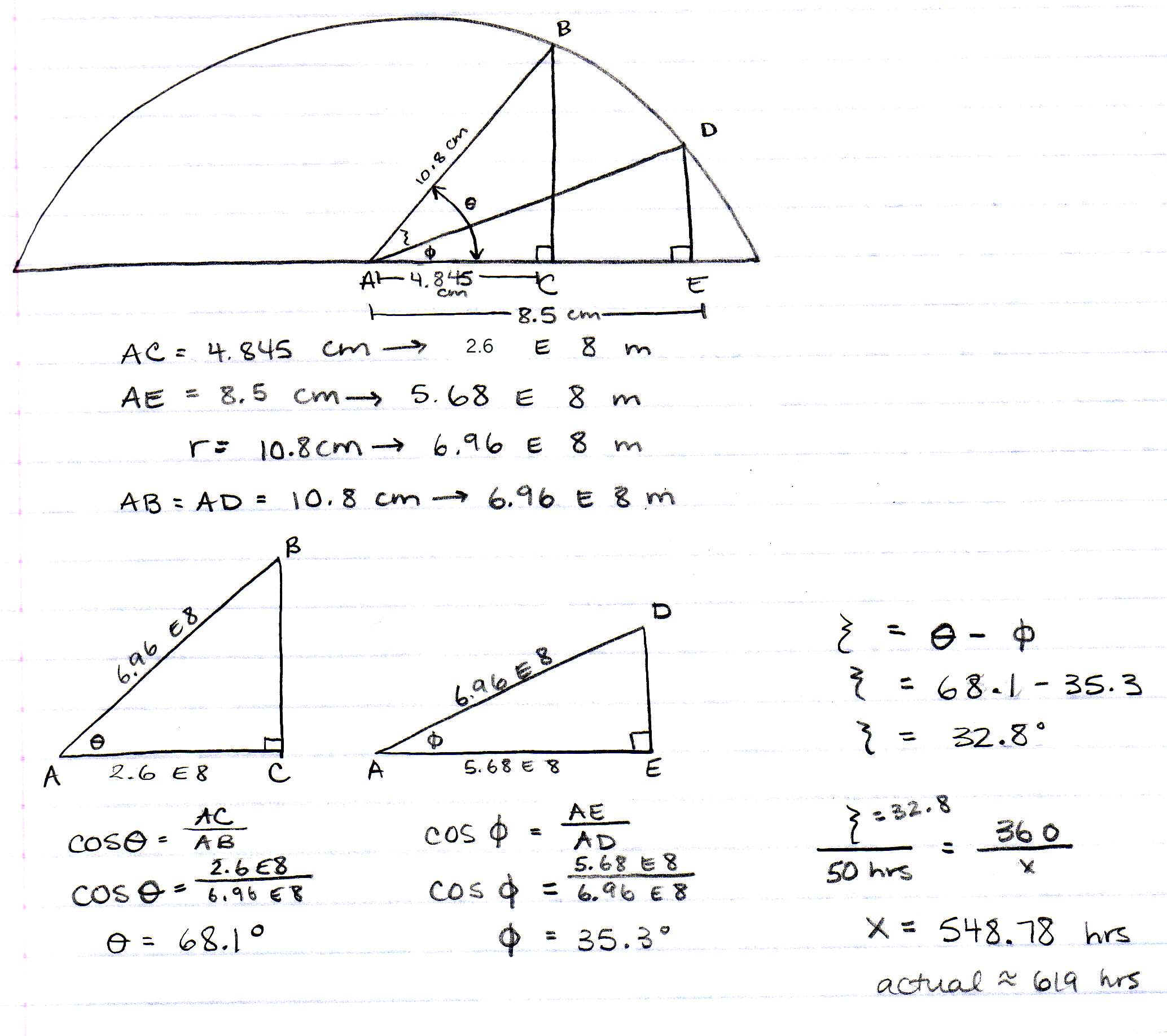
3. Now came the trickier part: using the movement of the sun spots over a period of 50 hours (from the first observation to the second) to determine the rate of rotation of the sun.
In the diagram below, AB and AD are radiuses of the sun (6.96 E 8 m). AC is the distance from the center of the sun to the sunspot on the second observation (determined using a proportion: (0.04845/x) = (0.2609/1.392 E 9 --> x = 2.6 E 8 m); AE is the distance from the center of the sun on the first observation (determined using a proportion as well: measured on the picture of the sun and then converted into a ratio --> 5.68 E 8 m). Two right triangles will be formed, ABC and ADE. Trigonometric functions can be utilized to determine the central angles of each of these triangles. The difference between the two angles is the angular rotation of the sun over 50 hours. The final proportion compares the angle traveled in 50 hours to the full 360 degrees traveled in x hours. The final answer I derived was that the sun takes 548.8 hours to complete one rotation. The actual rotation of the sun is about 619 hours.
4. So, then, what is a sunspot?
History
of Sunspots
Sunspots were noticed
as early as 28 B.C., astronomers in ancient China recorded systematic
observations of the cycles of what looked like small, changing dark patches on
the surface of the sun. There are also some early references to sunspots in the
writings of Greek philosophers from the fourth century B.C.
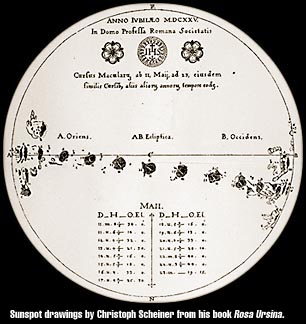
At left: sunspot drawings by Christopher Scheiner from his book Rosa Ursina, written in 1626 in protest of Galileo Galilei's astronomical work. Scheiner uses the movement of the sunspots across the sun to demonstrate that the sun's rotation axis is somehow aligned with the Earth. Though he was attempting to disprove Galileo, he actually came up with some excellent ideas of his own -- which Galileo ultimately used in some of his own work.
From http://www.exploratorium.edu/sunspots/research5.html:
| Scientists today have discovered a lot about the way the sunspots affect the earth. According to Dearborn, "The sunspot itself, the dark region on the sun, doesn't by itself affect the earth. However, it is produced by a magnetic field, and that magnetic field doesn't just stop, it comes to the surface and expands out above the surface...." Hot material called plasma near a sunspot interacts with magnetic fields, and the plasma can burst up and out from the sun, in what is called a solar flare. Energetic particles, x-rays and magnetic fields from these solar flares bombard the earth in what are called geomagnetic storms. When these storms reach earth, they affect us in many ways. | |
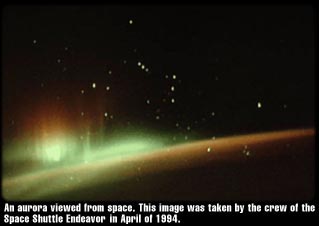
| Ordinarily, the earth's own magnetic field protects the earth from most of the sun's emissions. But during periods of intense sunspot activity, which coincide with solar flares and coronal mass ejections, the geomagnetic flow from the sun is much stronger. These magnetic storms produce heightened, spectacular displays of the Aurora Borealis and the Aurora Australis, otherwise known as the Northern and Southern Lights. |
 |
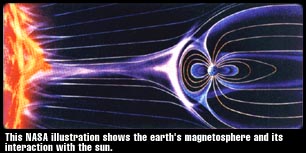 |
As Fisher describes it, "The earth has a protective cocoon of magnetic field called the magnetosphere, and it normally protects us from the magnetic particles of the solar wind, and the other energetic particles in the solar wind. But during a coronal mass ejection we actually have a chunk of the sun that breaks away and hits the earth's magnetosphere, and disturbs it, and this disturbance shows up as aurorae." |
Another (Simpler) Definition of Sunspots
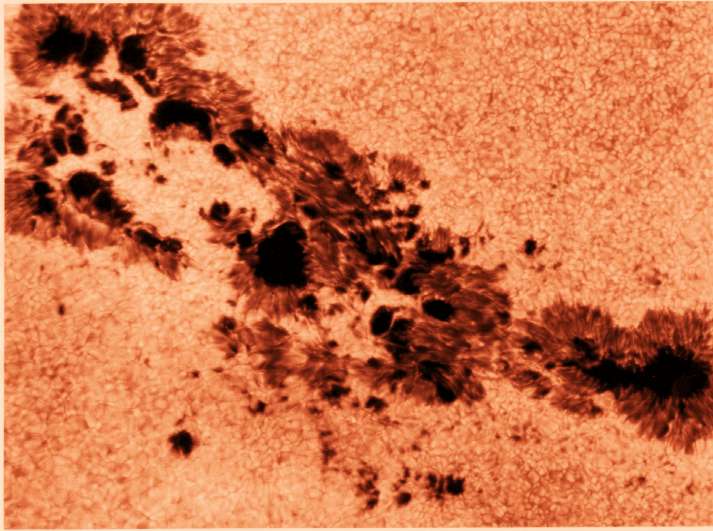
Sunspots, while seemingly tiny to us, are actually about as large as the entire earth. They are not usually present as individual entities; instead, they usually form in groups. Their occurrence is due to a concentrated portion of the solar magnetic fields (as described above) poking through the Sun's surface. The field slows energy from entering that particular area, which causes the area to become cooler and darker than the surrounding areas -- though these areas are still very hot and very bright. Sunspots are not permanent -- they last for a few days before they disappear. Because they are constantly coming and going, there is no set number of sunspots on the Sun. The range is usually spanned in about five years.
|
Some Pictures of Sunspots |
||
|
http://www.weathersage.com/forecasts/ |
|
|
|
|
|
|
Sunspots on the Web
Sunspots in General
http://www.exploratorium.edu/sunspots/
The "Sunspot Cycle"
http://www.exploratorium.edu/sunspots/research4.html
Scheiner's Rosa Ursina
http://www.hao.ucar.edu/public/education/sp/images/rosa_ursina.html