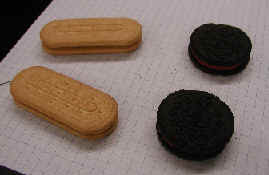
Force Required to Win the
Oreo Twisting Game
(well, not really...)
Abstract:
In this lab, we constructed an apparatus made entirely out of string that would allow us to separate the two halves of a sandwich cookie without actually touching it. The apparatus was then attached to a force probe which produced a graph of the force necessary to break apart the two halves of the cookie. Two trials were conducted to see the differences between different types of sandwich cookies.
Trial One: The Vienna Finger
The apparatus we constructed was made entirely out of string. What we did:
We took a piece of string and held it lengthwise. We then attached four other pieces of string to it perpendicularly, evenly spaced and in such a way that they were adjustable along the length of the string.
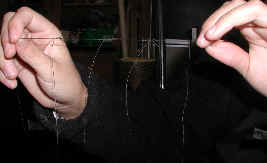
The two ends of the base string were then tied together tightly around the base of the Vienna Finger. We created an identical apparatus for the other half of the Vienna Finger.
Here is the Vienna apparatus:
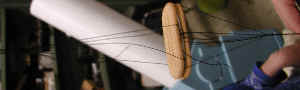
This is a close up view of one half of the apparatus. The string apparatus was basically conical; to imagine it try to think of the support for tire swings. (The best picture we have of the apparatus is when it's on an Oreo, but we used the same apparatus both times.)
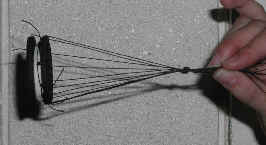
After we had the two sides of the string apparatus secured tightly around the Vienna Finger, with the "points" of them facing outward, we attached one of the "points" to the end of the force probe using a hook we had made by looping the ends together (see the first picture).
Then... we started the graphing program, and PULLED!!
This is the resultant graph, of force versus time.
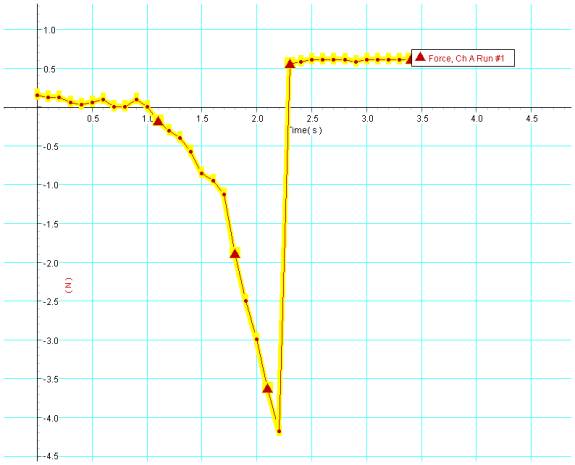
Thus, the force necessary to separate the two halves of the Vienna Finger was approximately 4.8 Newtons.
Here is the Vienna Finger after we split it (don't mind the cracks, we forgot to catch the Vienna Finger after we broke it apart... so we managed to create an apparatus that would break the cookie apart without breaking it... then let it fall to the ground and break.):
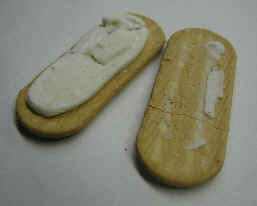
Trial Two: The Holiday Oreo
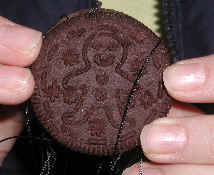
Holiday Oreos are very interesting cookies. They are like regular Oreos, but double stuffed. With red filling. And really cool holiday designs on the sides. Here is the cute snowman on the side of our holiday Oreo:
We used the same apparatus for this cookie as we did for the last one. It wasn't the easiest thing in the world, but all we had to do to transfer the apparatus to this cookie was unknot the base string (it was no longer tied around the Vienna Finger, because guess what... we split that cookie in half!)
Once we had gotten the apparatus open again, we tied it back around the Oreo. "But Oreos and Vienna Fingers are different shapes," you are thinking. "So how did the same apparatus fit both cookies?"
Ah, yes. And here comes in the story of the snazzy adjustable apparatus. All we had to do was slide the support strings along the base string, and behold, the Vienna Finger apparatus was transformed into a custom-made Oreo apparatus.
However, this trial was unsuccessful. Yes, the two halves of the snowman Oreo broke apart... but so did other parts of it. However, because we had learned at this point to catch the falling cookies, we were still able to eat it. Yum.
Trial Three: The Regular Oreo
Rule of thumb: the original is always the best. Yes, we decided that, despite the snazzy snowman decoration, the plain old Oreos are best. Why? Well, first of all, that red filling tastes weird. But actually, it's because this Oreo split nicely for us.
After the snowman Oreo died, we unassembled the apparatus from him, and reattached it to a new, plain Oreo in the same way as the other tests. And... we pulled!
This time it worked. This was the graph produced (force versus time):
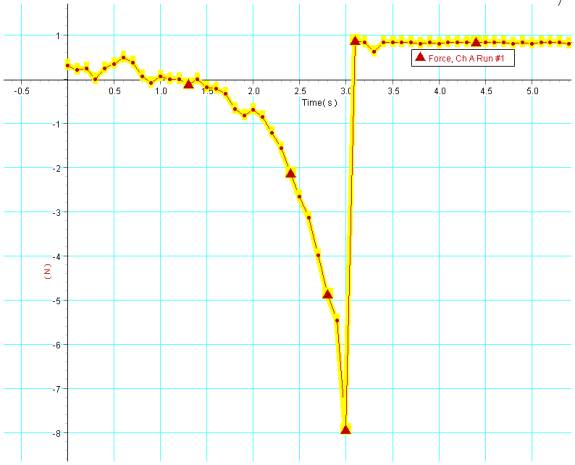
The force necessary to break apart the Oreo was about 8.8 Newtons.
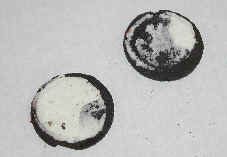
Here is the beautiful, split Oreo:
Why the difference in force?
It took 8.8 Newtons to break apart the Oreo, but only 4.8 Newtons to split open the Vienna Finger.
The answer to this question lies in the fact that the fillings of the cookies are not the same. The Vienna Finger most likely has a less concentrated filling, so it's easier to break those bonds.
Also, with more relevance to this lab, there was a lot more leverage for the Vienna Finger than for the Oreo, because the filling in the Oreo went almost to the edge, and the Vienna Finger had a good eighth of an inch of empty space on each side that allowed the string apparatus to have a stronger pull, and to pull more towards the center of the cookie than the Oreo did. This made it possible for the whole cookie to be lifted, instead of ripped from the sides, which might have resulted in some serious breakage.
Error Analysis
In doing this lab, there was clearly a lot of room for error. Most notably, it is painfully hard to be able to determine the exact force necessary to break apart the cookies from the graphs we created, because, as in the case of the Oreo graph, the force is marked only in integers, so we were obviously quite liberal in our rounding.
Also, in the lab itself, there were many conditions that affected the individual trials we conducted. For instance, the force necessary to break ALL Oreo cookies apart isn't 8.8 Newtons... just that one that we tested.
Similarly, when pulling on the apparatus to break the Oreo, we did not necessarily apply the exact amount of force necessary to break apart the cookie. In fact, because we had no way of knowing what the necessary force would be ahead of time, we probably applied too much force, and this was most likely shown (however slightly) in our graph.
Finally, we must take into account that which we think of for every lab: human error. We are not machines, and thus our labs will never be perfectly exact. There will always be that strange dent in the filling, or chunk missing from the edge where the cookie got crushed in the bag.
After we finished these trials came the best part of the lab:
WE GOT TO EAT THE COOKIES!