Julia Schwartz
September 6, 2003
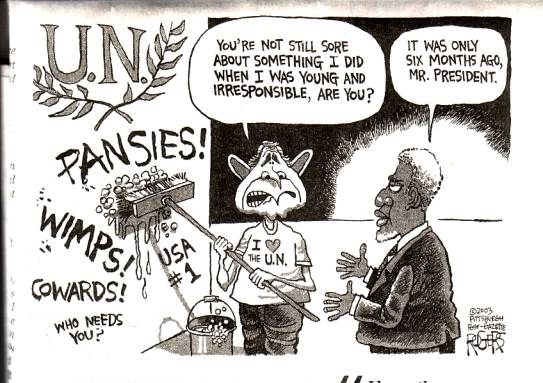
The following political cartoon depicts George W. Bush, President of the United States, washing down pro-American/anti-U.N. graffiti on a wall in the U.N. building, and asking Kofi Annan, Secretary-General of the United Nations, how he could still be upset over something Bush did when he was “young and irresponsible”… six months ago. This is meant to depict how Bush is presently catering to many of the desires of the U.N. right now in hopes of gaining economic and military support for the reconstruction of Iraq, despite his complete betrayal of its wishes earlier in the year before he gave the order to deploy troops in Iraq against Saddam Hussein.
I chose this article because it isn’t entirely pro- or anti-Bush; instead, it merely points out Bush’s current hypocrisy regarding his treatment of the United Nations. I think it’s very interesting how both we are acting as a nation right now in the U.N., but also how the United Nations are acting toward us. I think it was completely ridiculous of the United States to ask for United Nations support and investigation of Iraq, but then to ignore what the U.N. resolved because it wasn’t the resolution we were looking for. Now, we are back to asking the U.N. for help, because we need more military presence and we need more funding, seeing as we are spending millions a day in Iraq. On one hand, I see us using the U.N. rather blatantly, considering we didn’t heed their first response but are now back asking for money and men (those things we cannot manufacture); however, on the other, I don’t think it was entirely the responsibility of the United States to take care of Iraq, both in terms of freeing the people from Saddam Hussein and in terms of reconstruction. Yes, I do see an interest in the oil fields of Iraq, but I don’t think that this was our only intent in going there with our armies.
First of all, we are still a somewhat humanitarian country, and although we don’t necessarily go in everywhere, we have a rather full recent history of helping out the people of other nations in need. Yes, for every invasion where we have waged battles, one could cite benefits on our end; however, one has to wonder if the benefits were equal with the losses when balanced, taking into consideration all the post-military action work that needs to be taken. Beyond humanitarianism, there was still a rather profuse belief that Saddam was harboring nuclear or otherwise highly dangerous weaponry in his arsenals (including chemical weapons), and the knowledge of past actions of Hussein that have been entirely freaky – like his numerous body doubles. All of Saddam’s actions seemed to paint a picture of a ruthless dictator who was not afraid to kill and in fact wanted to. So, then, wasn’t there a valid threat upon our safety made by Saddam and Iraq? Who was to say that Saddam wouldn’t send out crop dusters with mustard gas to the United States, or unleash biological agents in our public places, decimating our population through terrible diseases? It’s not we didn’t have a previous record of clashes with Iraq.
As for what we are asking of the U.N. now, and their response, I think we do still have a right to ask for aid, though I agree with James Carroll in saying we need to admit that we failed in Iraq. I don’t think we need to say we made a mistake, because I do think we were justified enough in going into Iraq, though I don’t believe it was done under the correct circumstances. However, the lack of planning in going into Iraq has brought us to our current position, where we are presently the victors in a vague battle, and it seems no one is better off. If we can admit what ostensibly is merely the nature of being human (and being fallible), we do need the support of the U.N., as do the people of Iraq… After all, it’s not as if the rest of the world won’t eventually develop trade relations with Iraq after it’s been established as a nation. And as for us still wanting to have a large degree over the remaining reconstructive efforts… Well, that is partially our right. We shouldn’t have to do all the dirty work and reap no benefits. It would be unrealistic to believe in complete selflessness on the scale of billions of dollars and hundreds of lives lost.
Back to the cartoon: It seems that this cartoon is depicting the hypocrisy of the United States in its treatment of the U.N. as I discussed previously, in a tone that I might describe in one word as “scoffing.” The cartoonist, Rogers, is mocking the United States for the pretense of respect for the United Nations, and perhaps is edging toward the question of what the ultimate result will be if the United Nations does decide to cooperate with us in what we are asking of them right now: will we go back to heeding the decisions that the United Nations makes as an international council, or will we simply stay with them until they make a decision that isn’t entirely what we as a nation are hoping for, and then come crawling back later on?
Aside from the message that the cartoon is sending, I would definitely say that the cartoonist is anti-Bush, judging from his caricature of Bush alone – the large ears, pointy nose, and bushy eyebrows. Although I am not anti-Bush, I would have to say in this circumstance that I do agree with the discussion the cartoonist raises.
The Boston Globe
Saturday, September 6, 2003
Opinion/Page A11