Julia Schwartz
September 28, 2003
Sunday, September 28, 2003
Page H12
Letter to the Editor
(Just a caveat: This response is heading beyond the length of a page. I know that’s not requested protocol, but I find that this letter has too much in it to be restricted to one page’s length of response. ::slap of the wrist::)
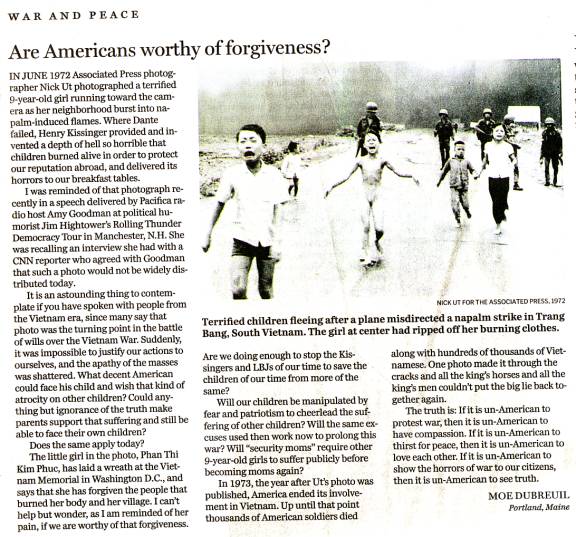
Moe Dubreuil’s letter to the editor of the Globe stood out to me as an important choice for a current events editorial for a number of reasons. First, the letter recalls the wide distribution of the photograph it shows, and the author says the letter most likely wouldn’t be distributed today. Censorship, anyone? (The word “clandestine” comes to mind.) Next, Dubreuil asks how the American soldiers in Vietnam could possibly commit such atrocities, even with so many of them with children of their own. (They’re taught to “dehumanize the enemy,” right?) Debreuil draws correlations between LBJ and Kissinger and our present administration, hinting at the question that has already been whispered among certain circles: are we involving ourselves in another Vietnam? How different is Iraq from Vietnam, really?
Those three concepts in mind, there’s one more thing that stood out to me as I read this, the one thing that the editors of the Globe who put that section together found as startling as I did, making this concept the title of the letter: forgiveness. Phan Thi Kim Phuc, the little girl in the picture who identified herself some years ago, placed a wreath at the Vietnam Memorial in Washington. She forgave the American soldiers who “burned her body and her village.” Dubreuil asks if we, as Americans, are worthy of her forgiveness. I, as me, think of Wiesenthal and the dying SS man, and ask how this is different.
The truth is, it isn’t, not really. The story Wiesenthal relates of the house in Poland and the My Lai massacre are virtually the same story. Maybe the motives were a little different in each scenario, but in truth the overarching motive was hatred, perhaps nurtured differently, but still hatred. Nazis hated the Jews (and so many others) because they were not “perfect,” they were polluting humanity, they had destroyed the German economy (hello, scapegoating). American troops hated the Vietnamese because… they were Vietnamese. All Viet Cong were evil – communists! – and if you made a mistake in identifying who was whom… oops?
So is there a way I can substantiate my inability to say that I, as Wiesenthal, would be able to forgive the dying SS man, but Phan Thi Kim Phuc was right to do so? That what she did was the “right” thing to do? How is it really any different?
When you read of Phan Thi’s action, of her forgiveness of the American soldiers, you’re surprised… but then your mind finds the reasoning she must have gone through to assume that position. It wasn’t their fault – they were just obeying orders. Maybe they made a mistake – they are remorseful. Perhaps the soldiers didn’t know that women and children were in the village – perhaps they didn’t realize that napalm burns skin as well as trees. (WHAT?) Yet how can any of this possibly make up for the inhumanity they inflicted upon the people of Vietnam – “where Dante failed, Henry Kissinger provided and invented a depth of hell so horrible that children burned alive.” (It’s interesting how much of Vietnam Dubreuil blames on Kissinger, incidentally.)
Clearly, it took extraordinarily personal strength and compassion for Phan Thi to forgive the American soldiers for their brutal actions, for destroying her childhood, and then to take the step beyond that: to place a wreath on their memorial – to show them respect. It’s a surprise, a big one – but at the same time, aren’t we supposed to forgive people? Isn’t forgiveness the height of human compassion? Don’t I hear the rabbis saying on Yom Kippur that we should forgive those who have wronged us in the past year, because hatred is not worth anything?
Yet I still can’t forgive. Maybe I am weak, maybe I am too harsh, maybe I am myopic – but you’d never find me placing a wreath on any Nazi memorial. (Then again, if you ever found anyone placing a wreath on a Nazi memorial – or even a Nazi memorial itself – he’d probably be arrested. How’s that justifiable in comparison?) In a certain sense, I wish I could say I could forgive. I wish I could show that strength, because I know on some level that past is past and we should move onto the future. Still, while perhaps I can let go, I can’t forgive completely. Phan Thi Kim Phuc was able to forgive, and the only question we ask is “Why?”
It’s a sad circumstance, and what Dubreuil asks is if the Americans are worthy of that forgiveness. Are we? As much as I’d like to say so, I lean towards the negative response. While there is without question regret on the part of Americans regarding action in Vietnam, on the whole, it’s done. Americans surely regret that their own sons were slaughtered, but as for the Vietnamese – well, they didn’t know them. And as it’s always been said, actions speak louder than words. If you believe the comparison of Iraq to Vietnam, well, no, we haven’t learned those lessons of Vietnam – and if we haven’t learned the lessons, if we’re doing nearly the same thing over again … then we’re not worthy of forgiveness. (No, I don’t think Iraq is nearly as bad as Vietnam – because presumably, the present-day killing of civilians is unintentional, “accidental.”) I guess all I’m saying is that I applaud Phan Thi Kim Phuc for her forgiveness, and she should be pointed out and respected for bravery and compassion that goes above and beyond anything that most people can claim for themselves. Her forgiveness goes beyond her and her experiences, and questions so many people. Essentially, it questions human nature, society – hatred, and evil. If she can forgive, why can’t the rest of us?
Imagine if there were no hatred… What would the world be then? The optimists say the world would be a much better place. (John Lennon, anyone?) But then you consider the pessimists, who figure if we didn’t have hatred, we’d have something else. (Thomas Malthus…) And then maybe there are the realists, who say that without hatred, there would be no friendship, no love. (Alan Watt, The Book.) Personally, I can endorse all three… but even necessitating hatred, or just understanding why it exists, calls into play no need for compulsive violence and inhumanity, no need for unfounded hatred, and certainly no repulsion of forgiveness. Whether its right or beyond right, Phan Thi Kim Phuc’s forgiveness should be cherished and remembered as a model for us all… unless there are some deeds that are too heinous to forgive.