Trajectories Lab
Abstract:
* * *
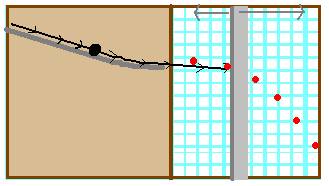
We began this lab with the apparatus that was set up for us. All we needed to do was put graph paper on it to graph the pathway of the marble, and then launch the marble. The apparatus looked like this:
In the first stage of our experiment, we found the points that the marble would travel in. To do this, we let go of the marble at the top of the ramp on the apparatus, and then used the mark it left on the carbon paper attached to the metal divider to plot a point on the trajectory’s pathway. The divider was begun at a distance of two centimeters from the end of the ramp, and it was moved roughly three centimeters away for each successive point. In doing this, we obtained a set of six points that we could use to find the constant, k, of our trajectory’s path.
Here are our points:
y = height*
x = horizontal distance
*
We made our x-axis at the line where the slide ended, so all of our points were
below it, resulting in negative y-values. In graphing these, however, we
made the y values positive, resulting in the upwards parabolic behavior of our
graph, in contrast to the motion of the marble, which actually was in a downward
parabolic arc.
Point 1 à
(2.0, 0.45)
Point 2 à
(7.15, -1.1)
Point 3 à
(11.2, -3.3)
Point 4 à
(14.75, -6.7)
Point 5 à
(18.7, -10.05)
Point 6 à (22.7, -14.8)
Here is the graph of the projectile’s path:
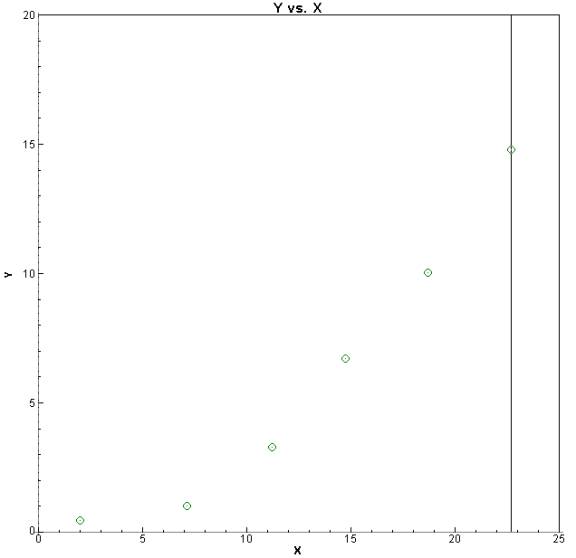
The formula given for the pathway of a projectile was y=kx2. To prove this formula was accurate, we went through the following procedure:
_x_
y
= -½gt2 where x = vxt and t = vx
SO
y
= ( g
) x2
2vx2
( g ) = k where k is the constant
2vx2
so y = kx2
Now all that was needed for us to do was plug in our x and y values and use simple algebra to find the k value. We used points three, four, five, and six:
Point
3: y = kx2
Point 4:
y = kx2
-3.3 = k(11.2)2
-6.7 = k(14.75)2
k = -0.026
k = -0.0307
Point
5: y = kx2
Point 6:
y = kx2
-10.05 = k(18.7)2
-14.8 = k(22.7)2
k = -0.0287
k = -0.0287
Now,
using these four values of k, we found the average value of k:
(-.026) + (-.031) + (-.0287) + (-.0287)
4
k = -0.0286
Since
each point on our line was (x,y), finding a point was easy once we knew the
value of k.
To
find the target and determine where to place the cup, all we did was measure the
height of the table the apparatus was placed on. This height was 99.9 cm, so we
made our y value –99.9, keeping consistent with our negative heights from
before (since our x-axis was above our points).
By
plugging the y and k values into our equation, we found the necessary x
to be 58.9986:
y = kx2
-99.9
= -0.0287x2
x = 58.9986
So,
our target coordinate for the bucket was (58.9986, -99.9).
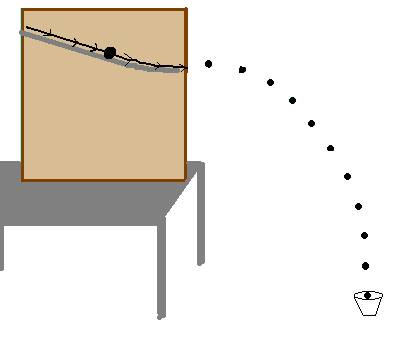
By dropping a metal weight from the edge of the table to find our zero point for our ‘x-axis’, we were able to make a zero, and measure out 58.9986 cm. (We couldn’t measure a number this exact, so we used a distance just short of 59 cm.) We then placed the cup on top of this coordinate (slightly ahead of it, to ensure the marble actually went into the cup and didn’t hit the edge), and let the marble go from the apparatus. The marble fell directly into the cup!
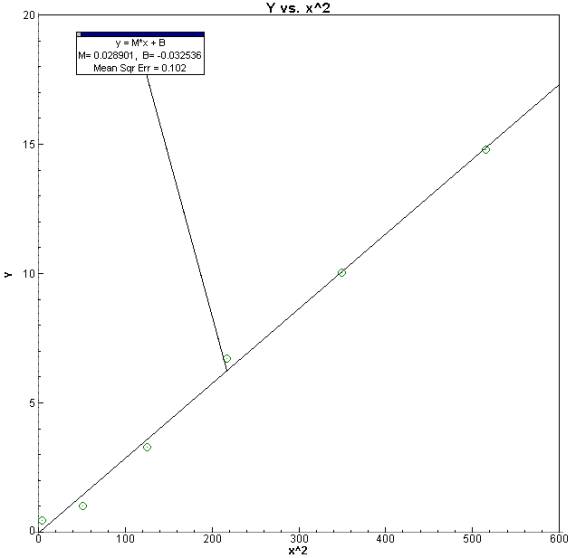
After we had conducted the experiment successfully to find k, we realized that graphing y versus x, as we had done, wasn’t quite as accurate as graphing y versus x2. We did this using the computer graphing program, which gave us a straight line instead of the parabolic one we received from the original y versus x graph.
The constant, calculated by the computer, for the line of best fit for this graph was 0.028—so we were very close in our own calculations (only 0.001 off).
Please see the next page for the resulting graph.
Error Analysis: The first time we tried to send the marble into the cup, we were unsuccessful. In retrospect, we realized that our constant value, k, was off (we got -.025) because we had somehow misidentified the points on our original line. These were the values we got for our third, fourth, fifth, and sixth points:
Point 3 (12.1, 3.4) Point 4 (15.6, -6.1)
Point 5 (19.4, -10.0) Point 6 (23.6, -14.75)
These values gave us an x-distance for our launch of 62.9 centimeters. Since we were using the smaller cup, the projectile missed the target by about three inches.
Questions
1. see earlier work
2. y = kx2
lower start d à
lower Vf (less time for a) à
lower k
3. height of table = 99.9 cm
y = kx2
-99.9 =-0.0287x2
x = 58.9986 cm è TARGET: (58.9986, -99.9)
*about 59 cm away from end of table [on floor]
y = -½gt2
-99.9 = -(1/2)(9.8)t2
t = 4.52 Time: .0452 seconds
y = (
g ) x2
2vx2
99.9 = (9.8/2Vx2)(58.9986)2
Vx = 13.066 cm/sec è Vx = .13066 m/s
Vf = Vi + at
Vf = 0 + 9.8(4.52)
Vf = 44.296 cm/s è Vf = .44296 m/s
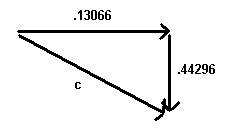
a2 + b2 = c2
.130662 + .442962 = c2
c = .4618 m/s