November 16, 2002
Incline Lab
Abstract:
We attached a frictionless cart to a force probe and monitored the relationship between the angle of elevation, theta, and the force exerted by the cart to determine the effect the angle of an incline has on the force an object will apply.
* * *
To do this lab activity, we attached a frictionless cart to a force probe. This apparatus was attached to a wooden board which was lifted to form inclines. Because the cart was frictionless, the impact of the wooden surface was none.
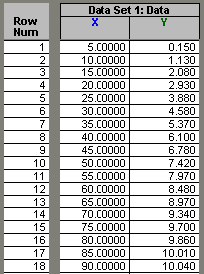
We got a group of 18 points—every increasing five degrees from five to ninety. We did not use the angle of zero because this would not result in any downward force.
These points were entered into the GAX Grapher program, and we graphed the function of just X versus Y—where X was the angle theta and Y was the force exerted by the cart.
The resulting line was curved.
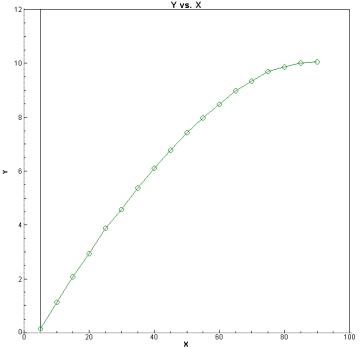
In order to use our results to find the formula for applied force, we needed to linearize our data. After trying a couple different functions of theta (we knew theta had to be in the equation, because it was a dependent variable), we decided that the line Y = sine (theta) was the best linear model. We then made a new data column for the sine of theta (the graphing program did the math for us using our theta):
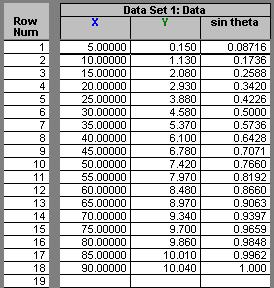
…and changed the axes of our graph to plot this line.
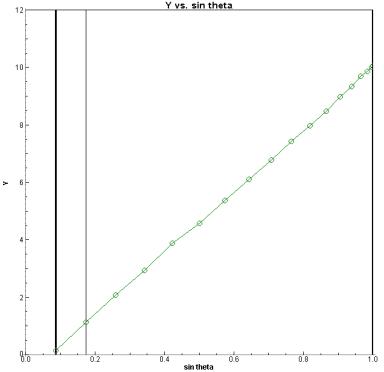
The result was an almost perfectly linear model. To use this to find the formula for applied force, we asked the program to calculate the line of best fit for the data. This graph shows the graph of force vs. sine of theta and the line of best fit:
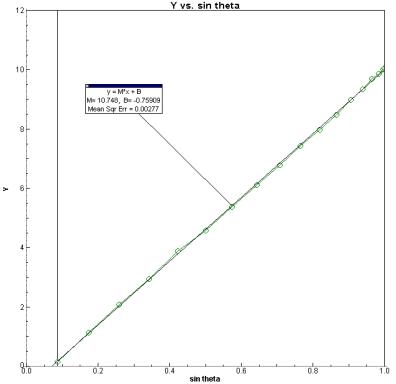
The line of best fit for this model is an exponential model; the line of best fit is the formula for applied force. Using this equation, the formula for applied force is:
FA
= 10.748x + (-0.75909)
In this situation, however, our x-value is really the sine of theta. So, our true equation is:
FA
= 10.748sin(theta) + (-0.75909)
To verify this, we found the weight of the cart, where force is equal to simply the mass of the cart times gravity. This was done by removing the force probe from the board and dangling the cart vertically so all its weight was exerted on the force probe. The weight of the cart was 10.04 N. To verify this, all we had to do was check our point for 90 degrees: our data told us 10.04 Newtons as well. Plugging this theta into the equation,
FA = 10.748sin(theta) + (-0.75909)
FA = 10.748sin90 + (-0.75909)
FA = 9.98891 N
Our numbers told us that the force applied by the cart here was 10.04 Newtons, a difference of 0.05109 N. To account for this error, we take into account two faults: one, the computers error (which was identified as 0.00277—about 2.8%), and human error. Our percentage of error was:
10.04 – 9.98891 = .0051146 = 0.51% error
9.98891
From this we can subtract the percentage of error by the computer:
.0051146 - .002277 = .002344
…which means that our percent error was in the vicinity of 0.23%. Thus, our data was extremely close to accurate.