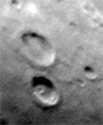
Look at the pretty crater! Hercules is the larger, top one.

Crater Height Analysis
Look at the pretty crater! Hercules is the
larger, top one.
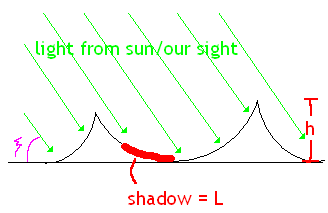
After we completed our mosaics of the moon, we wanted to find the heights of as many craters as possible. Because we can't just hop on a plane over to the moon to take a simple measurement, we had to find another way: we used the shadows of the craters' edges to calculate their height.
The first necessary task was to blow up our models of the moon. We initially created a scale of our moon picture to the actual size of the moon using known information. We then planned to use the same scale with the crater's shadow in scale and projected to real size. However, because the shadow is so small, the margin of error by measurement alone would be too large to be viable. Thus, we found a second scale, using a blown-up inset of the area surrounding the crater. On the inset, we found the ratio of the crater's total width to the width of the shadow. Then, the ratio was applied to find the width of the shadow using the width of the whole crater on the zoomed-out version. Therefore, we had a more accurate measurement for the width of the shadow in terms of our scale, which was used to find the "actual" width of the shadow of the crater on the moon.
The next step of the process was to find the actual height of the crater, using the shadow information.
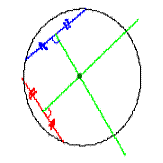
To find the center of the moon without having the entire picture of it, we drew two chords from a point on the circle's circumference and then a perpendicular bisector through each. The perpendicular bisectors, as proved by geometry, will intersect at the center of the sphere that is the moon.
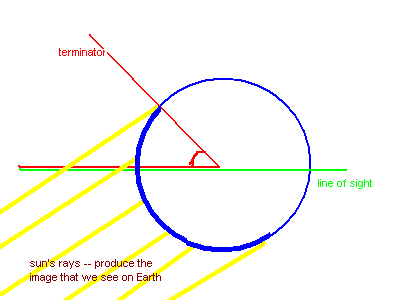
Next, we take into account the terminator -- the point where we cease to
see the image of the moon, a product of the sun's light rays and our line of sight
(See below)
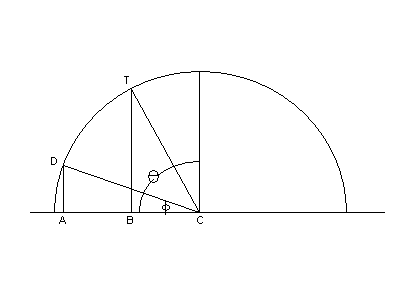
 Below, what the measurements we can take on our pictures and convert
using the scale will pan out to on a 2D circle.
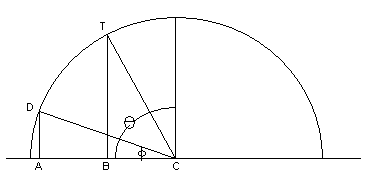
where C is the center of the moon, B is the terminator point, D and A are the
distance of the crater, and T is the terminator point, as well.
DC and AC are both equal to the radius of the moon, because this diagram is of the moon and
AC and DC are radii.
The difference between theta and phi is equal to a new angle, zeta[1], which is the degree of
separation between the terminator and the point of the crater - the distance, converted to
a circular measurement, because the moon is spherical.
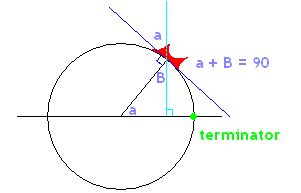
The angle from the crater to the terminator is equal to the angle that the sunlight creates with
with the horizon at the point of the crater:
Once we know this, we can go back to our two right triangles:
They are: CAD and CBA.
Thus, cos(phi) = AC/r
and
cos(theta) = BC/r
where r is equal to the radius of the moon.
Once we know phi and theta, we can find zeta, the difference between the two.
We can then draw another diagram, of the crater on the surface of the moon:
We can measure L from our scale diagrams, and use the equation
to find h, the height of the crater.
IN PRACTICE
x^2 = yz
9.85(9.85) = 1.85z
z = 52.44 cm
d = y + z
d = 1.85 + 52.44
d = 54.29459 cm (on our scale)
actual diameter of the moon = 1738(2) = 3476 km
scale = (54.29459 cm) / (3476 km) = .542946 m / 3476 km
to find a 1 : x ratio
.542946 =
3476
.542946 .542946
1 m = 6402.11 m
SCALE : 1 cm on picture = 64.02 km on moon
crater width = 1.1 cm
blown up picture of crater:
shadow 1.3 cm
crater 5.85 cm
shadow on the picture of the whole moon:
1.1 / x = 5.85 / 1.3
scale length of shadow = .24444 cm
apply scale
1 / 64.03 = .24444 / x
x = 15.649 km length of shadow
cos(theta) = BC/r(moon)
cos(phi) = AC/r(moon)
dist. from the center of the
crater to the center of the moon = 9.6 cm = 39.825 km (using scale)
dist. from the terminator point to the center of the moon = 58.667 km (using
scale)
r(scale) = 12.5
r(real) = 1738
1 / 4.4 = x/.4
shadow length using scale =
.0909 cm
length of shadow (actual) = 12.64 km
zeta = theta - phi
tan (zeta) = h/L
h = 4.3 km
Height of the crater Hercules: 4.3 km
Every member of the class calculated a crater height, and some did more than that.
We have a lovely mosaic of the moon (see mine for info on how we did this), but I can't put it on this page because the file is too large.
[1] Writer's note: the closest Greek letter to the one drawn in my notes would be zeta, according to http://www.ibiblio.org/koine/greek/lessons/alphabet.html. If this is not the proper name for the Greek letter used, please accept my profound apology.