The Analemma Question
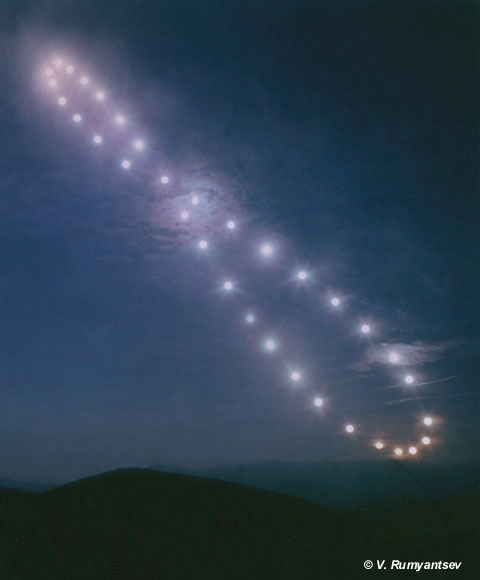
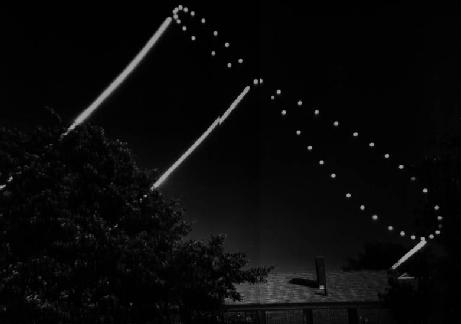
This is a picture of an analemma. As defined by www.dictionary.com, an analemma
is "A graduated scale in the shape of a figure eight, indicating the sun's
declination and the equation of time for every day of the year and usually found
on sundials and globes."
The figure eight shape is a result of the changing axis of the Earth due to its rotation, and thus the changing declination of the meridian. Analemmas were first observed by Paolo del Pozzo Toscanelli, a Renaissance priest, who punctured a hole in his ceiling to act as a gnomon (an object that casts shadows to act as indicators). He was able to watch the moving spot of sunlight that shone through to determine the time of day. This information was used to determine the equinoxes, information that had been desired for a while to be used to determine the exact date of Easter. As time went by, cathedrals began to be used as observatories, where priests could record the changing inclination of the axis of the Earth, making changes to the calendars.

When the 1800s rolled around, introducing train travel and the subsequent need for accurate, coordinated time, sun time became obsolete, as the sun is present at a different height in the horizon to different people in different locations. "Earth is tilted on its axis 23° 21' 19" and Earth revolves around the Sun in an elliptica causing a constant change in its velocity. As a result the Sun can be ahead of mean time by as much as 16 minutes and behind by 14 minutes at different times of the year. "1 By the turn of the century, the analemma was being used in conjunction with the meridiana (the Sun), changing "sun time" to "mean time." The arrival of the Sun's shadow using the gnomons specified noon, as opposed to the height of the Sun, as it had before, which made the coordination of time both easy and accurate. Mean time was officially adopted in 1834.
Picture at left: 18th century analemma. Source: http://www.analemma.org/photosautorisees/fig1courbeAnalpropre72dpi.gif
The picture at the top of the page shows the shadows of the sun at its different locations in the sky by the changing rotation of the axis at different times of the year. This was most likely done by the photographer leaving his camera in the same spot for the full year, and opening the shutter for a brief period of time at each interval, without rotating the film to a new picture, hence, it is almost a 45-over exposure.
The picture at the top of the page was taken by Dennis di Cicco. It records the different positions of the Sun in the sky at 45 different times of the year; the gaps in the figure eight shape are the effect of the passing of time. The graphic below shows the infinity-like shape that one standing in the same spot and observing the sun for a full year would see.

(click here
to enlarge graphic)
Some important times to note:
Some other pictures of analemmas:

http://faculty.rmwc.edu/tmichalik/images/anlemma1.jpg |
http://www.urania.be/sterrenkunde/images/analemma.jpg |
|
http://www.math.nus.edu.sg/aslaksen/projects/ |
http://antwrp.gsfc.nasa.gov/apod/image/0207/ |
Sources: www.dictionary.com (definitions of analemma, gnomon); http://www.analemma.org/pagesactives/definition.htm, http://www.astro.columbia.edu/~lawrence/Lects_A011Fa02/week4.html , http://antwrp.gsfc.nasa.gov/apod/ap020709.html
1 Quoted directly from http://www.analemma.org/pagesactives/definition.htm
2 Quoted directly from http://www.astro.columbia.edu/~lawrence/Lects_A011Fa02/week4.html