Length of Year Project
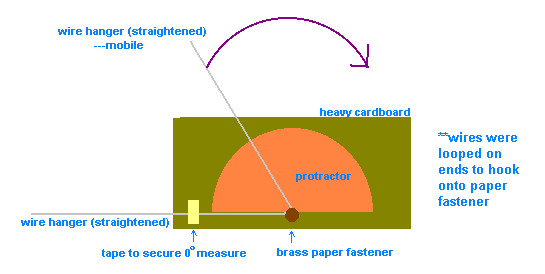
Designed Apparatus
(This apparatus was placed atop a view flat table in my very flat driveway. The center fastener was lined up with the North Star, a.k.a. Polaris. All I had to do was move the second hanger around to line it up with the star I was observing. The first hanger was attached to the cardboard so it wouldn't move around. The hardest part was getting the cardboard to stand up; this was achieved by having someone hold the two edges while I moved the variable hanger.)
Circumpolar
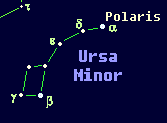
star observed: the Beta star in the "Big Dipper" (or Ursa Major)
Official name: Beta Ursinus Minoris, Kochab
The star is a 2.1 yellow giant star, and is located 110 light years away
from the Earth.
(Source: http://starryskies.com/The_sky/constellations/ursa_minor.html)
Right Ascension: 14 hrs 50 min
Declination: +74.09 degrees
(Source for RA/DEC: http://www.winshop.com.au/annew/Kochab.html)
Angle measure on first observation (Wednesday, October 22nd): 64 degrees
Angle measure on second observation (Thursday, October 30th): 83 degrees
Total change in angle: 19 degrees
Total time elapsed (9:00 PM 10/22 - 10:30 PM 10/30): 193.5 hrs total; 1.5 hrs by clock
difference
in observation time
= period of sidereal rotation
observed change in
angle
360 degrees
(1.5/19) = (period/360)
Period of sidereal rotation (calculated): 28 hrs 25.2 min
Actual period of sidereal rotation: 23 hrs 56 min
Margin of error: 18.75%
Circumpolar stars are stars that are viewable from the earth as going in complete circles around the North Star, also known as Polaris. If we wanted to, we could base all of our time measurements on the measurements of the locations of a particular star around Polaris -- this is known as sidereal time. However, sidereal time is slightly different than our synotic time (based on the Sun). The sidereal day is 23 hours and 56 minutes, while the synotic day is 24 hours to account for the need to rotate the Earth around the Sun a little more each time to ensure it always faces the proper direction.
Even though we know the actual length of a sidereal year, it is still an interesting calculation. The only data necessary is two different locations of one star around Polaris, the times at which each was observed, and the angle of separation between them. If we went by sidereal time, the star would be at the same location at 10:00 each night; however, we do not, so the star is in a different location at the same time. Thus, we calculate the difference in space. This difference, extended proportionally over the length of an entire year, will even out to be the full circle, 360 degrees.
By using comparisons of the change in angle measure compared with the change in time, we can determine the length of a sidereal day, which is the array of calculations displayed above. As you can see, there was a semi-wide margin of error on my part, but this was expected. The primary cause for error in this lab was the inaccuracy of my measurements. Because I was using a rudimentary measure of angle and measuring objects that are lightyears away, there was no way that I could possibly obtain the precise angles of separation between the zero mark and the location of the star.