Julians World | Exit | Areas of Interest | Motorcycles...Hope |


The UK Motorcycle Statistics

Last update: January 3, 2003


Are Motorcycle Accidents Peculiar?

The following two charts are from Department for Transport Transport Statistics Road Accidents Great Britain: 2001 The Casualty Report


Chart 2a: Indices of casualties by road user type: killed or seriously injured: 1991-2001

Chart 2a: Indices of casualties by road user type: killed or seriously injured: 1991-2001


Chart 2b: Indices of casualties by road user type: all severities: 1991-2001


Chart 2b: Indices of casualties by road user type: all severities: 1991-2001


In both charts, the line for Motorcyclists behaves differently from the lines for others. It is the only line which clearly trends up since 1996. These charts are based on the numbers of casualties, not rates. Let's see if we can observe anything when we plot the change of the fatality rates for TWMVs and Non-TWMVs.

A Comparison: TWMVs and Non-TWMVs: 1930-2001


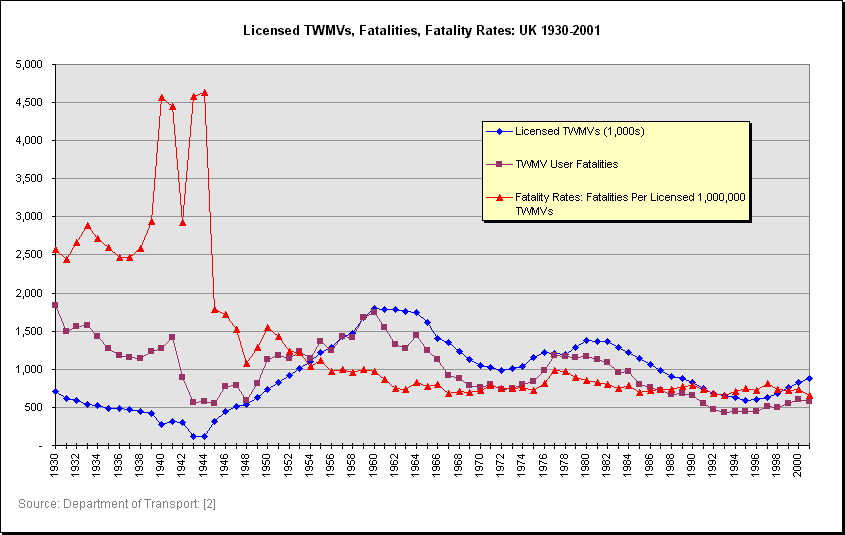
Licensed TWMVs, Fatalities, Fatality Rates: UK 1930-2001

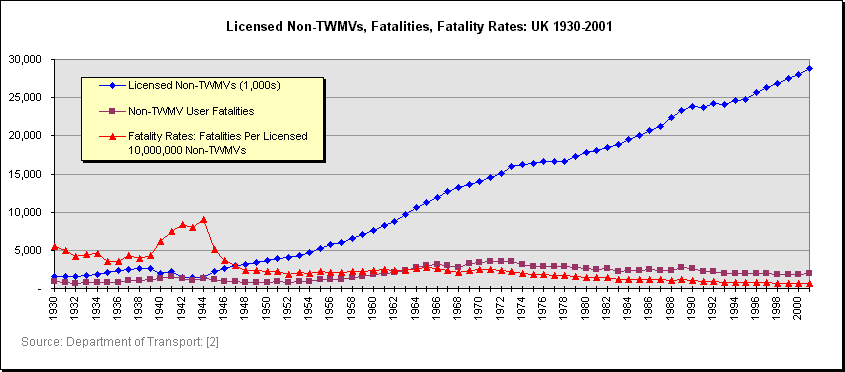
Licensed Non-TWMVs, Fatalities, Fatality Rates: UK 1930-2001

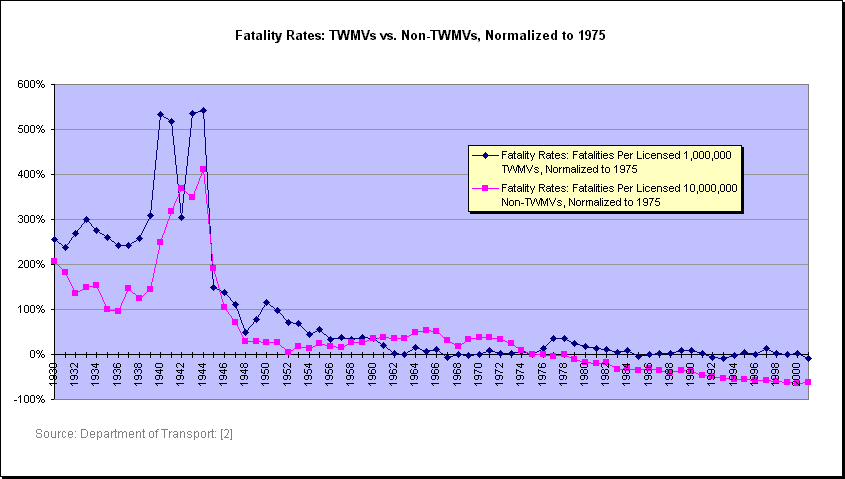
Fatality Rates: TWMVs vs. Non-TWMVs, Normalized to 1975


The fatality rate for TWMVs hasn't changed much since 1956. It has basically gone sideways.
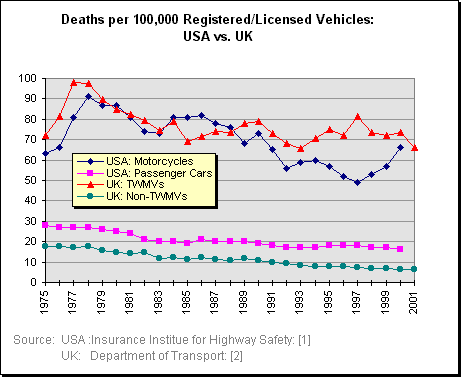


USA vs. UK Comparison 1: Fatality Rates of TWMVs and Non-TWMVs: 1975-2001


Deaths per Registered/Licensed Motor Vehicles: USA vs. UK

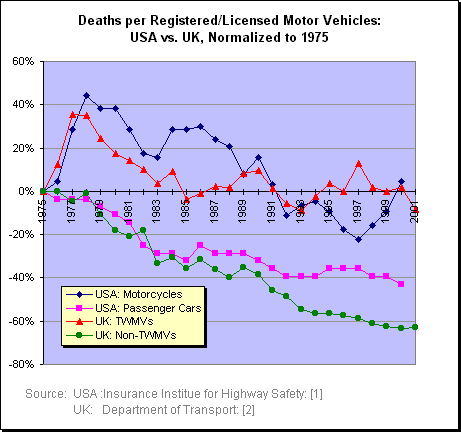
Deaths per Registered/Licensed Motor Vehicles: USA vs. UK, Normalized to 1975


The fatality rates for car users (passenger car users in the USA and Non-TWMV users in the UK have been clearly trending down throughout the period while the fatality rates for motorcycles in the USA and UK don't show a clear down-trend.


USA vs. UK Comparison 2: Injury Rates of TWMVs: 2000


According to a table by Department of Transport, All casualties: by road user type and severity: 1994 - 98 average, 1994 - 2001, in 2000, 605 motorcycle riders and passengers were killed and 27,607 were injured in motorcycle accidents. That is for every motorcycle rider/passenger killed, 46 people were injured. In the USA, the corresponding ratio is, for every motorcycle rider/passenger killed, 20 people were injured.


Observations:
  1. In both the USA and the UK, the fatality rates per 100,000 registered/licensed motorcycles were about the same in 1975 and 2000.
  2. In the period between 1975 and 2000, both the USA and the UK had the peak in the fatality rate per 100,000 registered/licensed motorcycles in 1977/1978, 91 and 98 respectively. After hitting the peaks, the fatality rates in both countries have stayed lower than their respective peak values for the rest of the period.
  3. In the UK, the odds of riders/passengers getting killed in motorcycle accidents is slightly higher than those of the USA, and the odds of getting injured is more than twice the odds in USA.


Possible Conclusions:
  1. In the UK, the bottom of the range of the fatality rate per 100,000 licensed motorcycles could have been reached already. It is about 66. It may not be possible to lower the fatality rate much below 66.
  2. Since the US fatality rate per 100,000 registered motorcycles has been in the same region as the UK counterpart, it may not be possible to lower the US fatality rate much below 50.


Source: [1]Fatality Facts: Motorcycles
[2]Population, vehicle population, index of vehicle mileage, accidents and casualties: by road user type and severity: 1926 - 2001


Copyright ©2003 Julian Solos. All rights reserved.
| Exit | Areas of Interest | Motorcycles...Hope |
Hosted by www.Geocities.ws

1