Julian and Hugo's Trip to the USA
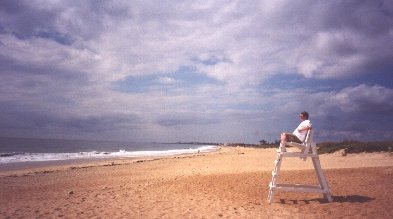
Misquamicut Beach, RI
Sorry this is such a mammoth read but we did manage to cram in quite a bit into those two weeks in September. If you do take on the challenge, please let me know if you find any slip ups or bits that make no sense and I'll try and sort them out.
Sunday September 3 2000
Hugo's mum kindly took us to Gatwick with plenty of time to spare, and our 767 took off only a few minutes adrift of its 10.30 departure time. We sat just behind the wing, and had an excellent view of Southampton as we flew along the South coast. Everything could be seen very clearly - the docks, the common, and all the bridges Hil we used to row under. With a few more moments I am sure I would have been able to spot 53 Portswood Road. We also got a great view of the whole of the Isle of Wight, the New Forest, Bournemouth, and much of Dorset and Devon before we cleared the coast and headed for Ireland and the Atlantic. Film of the day was "Gone in 60 Seconds" - a 90 minute car chase but good fun all the same. The food was OK and we even got Rodda's Cornish cream on our scones. We landed at JFK exactly on time, and got a good look at the Long Island suburbs as we did so. Baggage claim and immigration were fine and Perce was exactly where he said would be the other side of the doors. He took us out of the terminal and into America, full of yellow cabs, NYPD officers, stretch limos and all the other things you expect to find in New York!
Perce's car was "Mr Beige" - a rented Chevrolet Malibu (Mondeo size, but quite a bit wider and a little taller - an ideal fit for me actually - perhaps I should consider importing one). We negotiated our way out of the airport, and after a brief stop at Avis to put the names of Hugo and me on the policy, drove along the New York expressway, past the Bronx, Queens and other famous districts. We got a brief glimpse of the Manhattan skyline but the sky was getting very murky as the clouds continued to build. Finally the heavens opened and suddenly we had to cope with up to a foot of water because the roads were unable to drain it away quickly enough. If you think Coulthard has problems driving behind Schumacher in the wet, try driving along the I95 behind a Dodge Ram pickup! The rain began to subside as we crossed the Hudson river on the Whitestone bridge, but just as we began to relax there was an enormous blue flash right in front of us followed by a large puff of smoke. About 10 metres in front of us, the bridge had been struck by lightning!!!! Luckily we didn't drive into the river in shock but it was quite a surprise all the same.
We left New York behind us and drove into commuter land. Hugo told us that he had spent 4 years living in Greenwich, so we thought it would be fun to stop off and have a look. We parked in the high street which looked exactly as you would imagine "Main Street USA" to look, complete with fire trucks, post vans, town hall, and stars and stripes everywhere. Greenwich is very prosperous (this is the US version of Esher) and there were plenty of GAPs and LL Beans around. We had lunch in the local diner, and I had a BLT club sandwich, which seemed an appropriately American first meal. As we walked back to the car, Hugo showed us some of the places of his youth, including the tennis court, and the YMCA where apparently he had had a very active social life for a nine year old. We then drove on to his old house which was in a beautiful wooded street. We took a few photographs, met the present owner (and persuaded him we weren’t about to rob the place), and then drove on to the local park, right next to the ocean.
We got back on the highway and drove for an hour or so to Middletown, passing plenty of big trucks on the way, some of which sported neon crosses on their noses, a useful way of preaching to people's rear view mirrors. Before we got home we stopped in the local supermarket, the "Stop and Shop" – an enormous place, twice the size of any UK store. Hugo and I wandered about, open mouthed, whilst Perce filled up the trolley. There was no need to worry about closing time, as Stop and Shop is open 24 hours a day, every day.
We then drove the last mile back to Perce’s apartment. He lives in the North Woods "community" – a privately owned complex of blocks complete with clubhouse and swimming pool. The apartment was on the ground floor, and he has a decently sized bedroom and living room, complete with dining table by a French window, and kitchen area behind a counter. It seemed the ideal size for him, and I would guess that the majority of people living in the complex were either single or young couples. There were many more communities like North Woods along the road, in the no-mans-land between Middletown and the next suburbs. None had any shops and the whole area felt very anonymous and temporary, as if the woods would quickly grow back if given the opportunity.
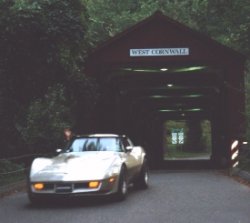
Friendly Corvette, West Cornwall, CT
Monday September 4 2000
We slept very well that night on our air beds in the sitting room and woke at a reasonable hour the next morning, already well adjusted to the time difference. Although it was a Monday, Perce had the day off, as it was Labour Day, the last American holiday of the summer. Keen to do as the locals do, Perce’s guidebook informed us that the most appropriate thing to do in Connecticut was visit the Goshen country fair, so off we went. Goshen is a tiny village in the west of the state and their fair had many similarities to an English agricultural show. However, instead of show jumping, the main highlight of the day was undoubtedly the tractor pull! This involved lots of classic tractors (the was built in 1932) pulling sledges full of breeze blocks as far as possible. They were divided into weight classes and the majority of them managed to pull at least twice their own mass before rearing up on their rear wheels and digging large holes in the mud. No Fergies in evidence, but there were plenty of John Deeres, Farmalls and Olivers giving it their best pull. The announcer was delighted to declare that it was going to be an "All female final" and the prize eventually went to Bobby-Jo in her 1952 John Deere.
Elsewhere at the show, we found plenty of livestock, giant vegetables, flower displays and other country paraphernalia. Unique to the US however was the Lego model competition, the vote Bush table, the Freightliner truck stand and the cattle pull - similar to the tractor pull with two yoked cows pulling surprisingly similar weights. After leaving Goshen we continued to explore and headed for, appropriately enough, Cornwall. This village had a classic covered wooden bridge, which we stopped and admired, and we also got to see what was probably a pair of hawks circling above it. We failed to find Cornwall's giant stone frog that, but in the process had great fun yomping down a stony track last seen in the X Files. Eventually the track led into the skiing hills around the town of Litchfield. The Malibu coped well with the off-roading but we probably won't mention it to Avis.
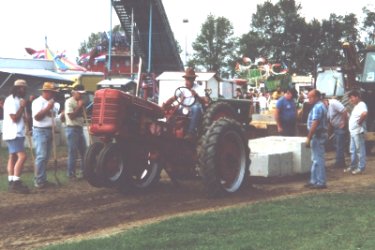
Tractor Pull, Goshen Fair, CT
Tuesday September 5 2000
This would be the first solo adventure for Hugo and me but, if we wanted the car for the day, we first had to deliver Perce to the office. So, at 7am I went jogging around the North Woods apartment complex, exchanging greetings with early morning newspaper buyers and dog walkers. This first run took me into the woods behind the buildings along a well-worn path which went down to the stream and beyond, offering occasional views of the I-91. It showed plenty of potential for further exploring.
After a bowl of Count Chocula and Special K (probably cancelling each other out), Perce gave me my first Malibu driving lesson. It's a very pleasant car. There was lots of room and I could see out of the windscreen without hunching forwards. The automatic gearbox was fine and the steering very light. The engine, although a V6, was not particularly eager and encouraged a relaxed driving style - a good way to prevent road rage.
The route to the office went through stereotypical American scenery - a strip of gas stations, K-Marts and 7-11s and a giant Stop and Shop supermarket - before joining the highway for a mile or two before entering the centre of Middletown. Perce's office was just off the wide main street, which was filled with more specialist shops able to compete with the out of town rivals, such as Bob's discount clothes, a cigar store and a model railway shop.
Our solo drive back to Dove Lane took place without incident, and we rewarded ourselves with extra slices of toast before consulting the Lonely Planet over what to do next. Perce's "Hidden Connecticut" suggested we look at the southern coastal town of Guilford (No "d"), which pleased Hugo, a resident of Guildford (with a "d"), UK. We drove through wooded valleys which would look spectacular in a month's time when the leaves had fully turned. Even now a few leaves were beginning to change colour, flashes of red and orange amongst the mass of green.
Guilford, CT looked very handsome. An early English colony, the town had been laid out around a large wooded green and many of its most important buildings dated back to the Eighteenth Century. Indeed some houses were much older than that. The Whitfield Museum dated back to Guilford's settlement in 1639 and was the oldest house in the state. Despite looking remarkably similar to Dipper Bridge, the house had stone walls that were several feet thick, a reminder that life in the early settlements was dangerous and unpredictable. The town centre was full of expensive stores to serve the well-off residents so, apart from browsing the bookshop, we did not stay long. Instead we drove to the marina, a collection of yachts surrounded by parkland which looked like a scene from "Dawson's Creek". The chandler also supplied lunches, so Hugo and I dined on sub sandwiches and square sausages, fending off the seagulls as best we could.
After lunch, we followed the coast to the west, through smart establishments such as Indian Neck and Pine Orchard where we were occasionally allowed us glimpse the sea, usually by peering over somebody's garden fence. Apparently the trams used to bring many visitors on weekends and holidays to stay in cheap hotels and enjoy a day out at the seaside. But as prices rose and the tramways closed, the area became increasingly exclusive - and empty.
The seaside suburbs gave way to the shipyards and warehouses of New Haven, a seaport similar to Southampton in many ways but with a rather more famous university - Yale. We parked on the New Haven green, where Bill and Hillary Clinton used to stroll as students, and had a look inside Trinity Church - founded by its first colonists. We would have liked to learn more about it but the guide was too busy on his mobile phone.
The Yale University Visitor Centre gave us a lot more information, although we may have been mistaken for lost freshmen. Their map allowed us to explore the large campus, clearly influenced by one or two trips to Oxbridge, as there were spires and towers everywhere. There weren't many students around, but it was still early in the term. Whilst walking down a quiet street we were suddenly swooped upon by a large hawk. Having failed to catch the pigeon it had spotted, it chose instead to perch on a lamp post and relieve itself on the Jeep parked underneath.
This took place just outside the Peabody Museum of Natural History, which helpfully displayed every bird native to Connecticut and allowed me to discover the bird was a red tailed hawk and we had probably seen ospreys the day before at Cornwall Bridge. It also had a impressive collection of dinosaur bones, arranged into brontosaurs and stegosaurs and suitably enormous.
It was time to get back to Middletown to pick up Mr Parrish. We were to rendez-vous at the Fleet Bank - a well-chosen spot on Main Street where we could observe the goings on at the police station across the road and watch Fire Engine Number One going about its business. Unfortunately we failed to spot Perce being given a hard luck story by a local trying out new ways to ask for money. Perce was not won over and felt a lot better when Hugo and I were given the same story (with a few variations) the next day.
On our first tour of Middletown, Perce took us to the First and Last Bar, which was helpfully in the same building as the police station and had done much since its opening to improve the ambience of the town centre. It also shared its name with the pub on Lands End in Cornwall and photographs to prove it. The tour continued with a visit to our second campus of the day, a mixture of sub-Yale buildings and rectangular concrete blocks, and our first trip to Bob's, which had a stack of Docker's and other useful stuff. We rounded off the night with dinner at "On the Border" - a Mexican chain, which offered piles of food and an eager waitress called Marissa. I learned that it is very rare for an American to finish what they are served and although I was commended for eating everything on my plate, I won't be doing it again…
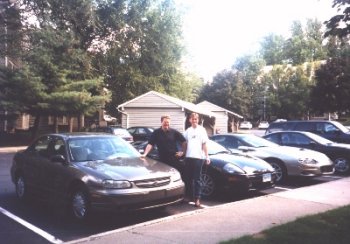
Hugo, Perce and the Malibu, Middletown, CT
Wednesday September 6 2000
I used up most of my Mexican calories running up and down one of the few pavements in the area before jumping into the Malibu for Perce's office run. Back in Dove Lane, Hugo and I decided to head south again to Essex, another handsome colonial town. It is the home of the Connecticut Valley Steam Railway, a long-established and efficient organisation which offers tourists a ride behind their impressive steam engine (twice the size of anything on the Bodmin and Wenford line) and a trip on the Becky Thatcher up the Connecticut River. We opted to spend a dollar more for the window-less carriage in front of the engine. The legally minded commentary warned us of the dangers of sticking our head out of the window and the possibilities of inhaling "smoke particles" (i.e. soot) but we couldn't hear it anyway once the engine got puffing. After thirty minutes or so we reached the landing stage. It would be great to think that one day the line would be reopened right back to Middletown but that probably wouldn't fit in with the railroad's business plan.
Following carefully controlled queuing an more safety briefs we boarded Ms Thatcher, along with several coach loads of OAPs dressed in the traditional trainers and golfwear of the American elderly on holiday. We sailed further up the valley past woods and marinas and the unmistakable Gilette castle, a folly built by an eccentric actor which came complete with its own (now derelict) railway. After Mr Gilette's death it was turned over to the state and is now a popular park. The boat took us as far as the Haddam highway bridge and Godspeed opera house before turning for home. On the top deck Hugo and I took photographs and enjoyed the sunshine, ducking occasionally to avoid low flying seaplanes.
We got a bit lost trying to get out of Essex and mused that American road signs are generally terrible. There either aren't any, are placed too vaguely or don’t provide any useful information. The only signs that appear regularly appear to be those warning of fire stations or announcing that we are leaving a watershed area. Why do we need to know this?
Tour guide Perce took us to Atticus books, an academic but comfy shop that also sold chocolate brownies. Whilst taking tea he told us about the many outlets in the area, where high street names pile up their stock and sell it cheap. They also stayed open late, so we decided to go and see one for ourselves. Unfortunately Clinton Crossing's hours weren't quite as generous as we had hoped and we only had fifteen minutes to sprint round the Polo and Gap stores. I abandoned Hugo to his quest for pants, and found a bookshop, which was in some disarray but did have the ideal coffee table book on sale - the encyclopaedia of tractors.
Thursday September 7 2000
Boston day. An ambitious plan but we felt it was possible to drop Perce off, drive for two hours, have a good day in the city and return without stranding Perce in his office overnight. The driving was fine - we avoided the worst of the Hartford rush hour and didn't get stuck behind many trucks. Indeed, as everyone had the same speed limit then more often than not the trucks overtook you. Although the limit is 65 mph most traffic drives well above that. The police still do plenty of radar checks but most of the officers we saw were busy supervising road works, which meant leaving the lights of their patrol car switched on while they stood around drinking coffee in the sunshine. We pulled over at a rest area which had a rather continental spartan-ness. I think this is because most people prefer to go to a McDonalds and a gas station which can be found close to every major junction. So we were able to enjoy a bit of peace and quiet amongst dozing truckers before continuing on our way to Massachusetts.
We parked just off the Boston ring road at the Riverside "T" station - the T being the name for the Boston city-rail network. The T's ticketing system is not immediately obvious and we may well have defrauded the city as a result. Nevertheless we were carried right into the city centre and emerged, blinking in the sunlight, on Boston Common.
Boston likes to portray itself as the setting for many of the events that shaped the United States and the Common, America's oldest public park, used for cattle grazing, public hangings and military manoeuvres since 1634, seemed a good place from which to start. It also had a decent information centre, which provided plenty of maps and a machine, which stamped unwanted pennies with historic scenes, much to Hugo's delight. The centre is also the start of the Freedom Trail, a red brick path which wends its way across Boston's city centre past most of its historic sites. This, a ready-made tour from which only the very stupid could lose their way, seemed ideal for us.
The sun was shining (not always this case this summer, apparently) and the city seemed in good spirits. The mixture of old and new buildings, churches beneath skyscrapers, reminded me of Sydney, as did the relaxed but businesslike attitude of the place. I'm not sure things would be the same in the middle of winter, though.
We made a few diversions from the path if we found something interesting. The King's Chapel had had plenty of experience dealing with trail tourists and had annotated all the main points of interest. This included the wooden pillars, which had to replace slate ones promised by Ralph Allen of Bath which proved to be too expensive to deliver. The church had had a precarious early existence - its stone structure had been built over the top of the original wooden church to prevent the city claiming the land back once the plot became vacant. Once the stone building had been completed, the wooden one was knocked down and thrown out of the windows.
Everywhere we went George Washington had given a speech or Samuel Adams had organised a meeting (when he wasn't busy brewing beer). Close to the Borders bookshop was the old state house, site of the Boston Massacre in 1770, one of the key events before the Declaration of Independence six years later, read our to Bostonians on the same spot.
We took lunch in the Faneuil Hall marketplace, a redevelopment of a historic building which persuaded other cities, including the architects at Covent Garden, that there were alternatives to simply erecting skyscrapers everywhere. It was a good place to eat Boston bagels (salt on one side, sesame seeds on the other), watch the world go by and take time out from the red bricks.
The trail continued through a confusing maze of construction work. (Boston's "big dig", which will eventually bury its main highway underground and reunite districts separated by concrete for decades.) The North End of Boston felt very different from the city centre. This was the home of the city's Italian community, with restaurants and trattoria everywhere. Amongst all these we found a grey wooden house that used to be the home of Paul Revere, hero of the revolutionary period whose ride through enemy (i.e. British) lines was made famous by Henry Longfellow's ballad. He was skilled in metalwork, creating bells, armour-plating for ships, plates and much else, allowing him to live in what would then have been a grand town house. Later the area became much poorer and the building later housed five or six immigrant families at a time and narrowly escaped demolition before being restored to its Eighteenth Century condition.
The trail crossed the Charlestown Bridge and we parted company with it at the USS Constitution, which was built in 1797 and is still a commissioned ship in the US Navy. Looking across the harbour and back to the Boston skyline, this felt like a good place to end our first day's tour and hurry back to the nearest T station and on to Boston.
We returned a little later than we had promised, delayed by our inability to work a US petrol pump (don't press too hard, turn all the handles and press all the buttons) - but a least the fuel's cheap. Perce took us to the local student coffee shop (sideburns and piercings mandatory) which made me wonder why trendy folk in the US try to copy Lloyd Grossman's accent. It had a very impressive loo filled with every map you could ever need, such as the Tokyo subway and metropolitan Manila.
After curry at home we went out to "Digger McDuffs", an Irish bar with a row of Harley Davisons outside. DMcD's was having a very quiet night, perhaps because of Connecticut's draconian measures barring anyone under 21 from having a drink. It is very irritating having to carry a passport everywhere to prove your age, as staff are obliged to check anyone they think looks under 35. I will take a photo driving licence with me next time to avoid this.