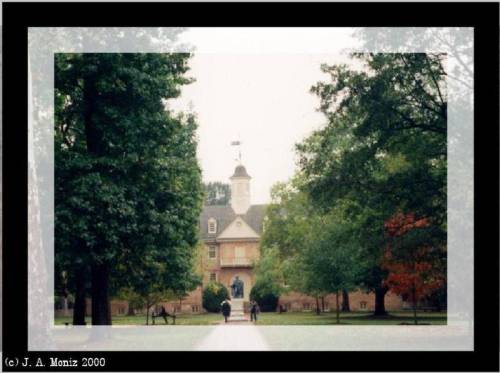
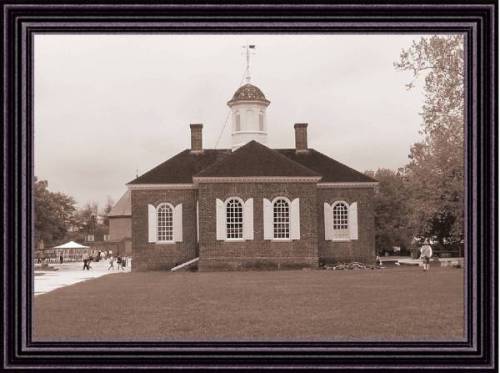
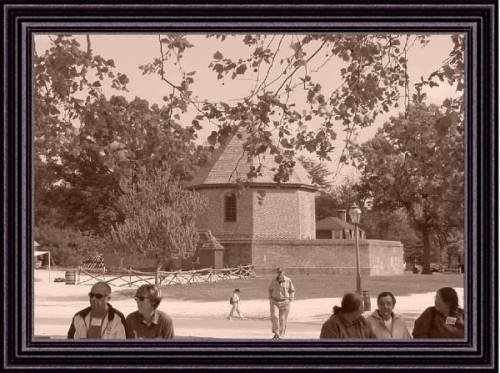
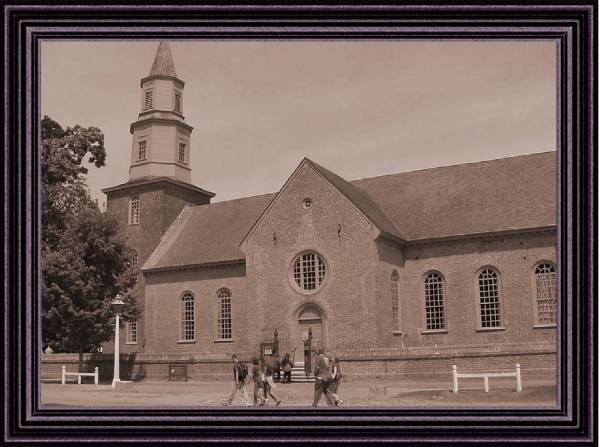
| Williamsburg Capital of the Colony of Virginia from 1699 � 1776 Capital of the Commonwealth of Virginia from 1776 � 1780 Williamsburg is the second Capital of Virginia � the first being Jamestown. It was named after King William It was designed by Francis Nicholson and the two back streets bear his name � Francis St. and Nicholson St. The City is approximately 1 mile long and � mile wide The main street is Duke of Gloucester St. It was named after Queen Anne�s son (the Duke of Gloucester) under whose reign Williamsburg was designed and the Capitol was constructed. Major landmarks are: The Capitol at the east end of Duke of Gloucester St. The Wren Building (College of William and Mary) at the west end of Duke of Gloucester St. The Courthouse approximately midway between the Capitol and Wren Building on the north side of Duke of Gloucester St. The Magazine across from the Courthouse The Governor�s Palace on the north end of the city Bruton Parish Church on Duke of Gloucester St. at the end of Palace Green Map of Williamsburg Historic Area (courtesy Colonial Williamsburg Foundation) General Geography Williamsburg lies between the York and James River on the Lower Peninsula approximately 27 miles from the Chesapeake Bay. It is an incorporated city and does not fall under the jurisdiction of any county � it does, however, geographically lie in two counties � York County and James City County The Colony of Virginia, after the Seven Year�s War (French and Indian) covered territory from the Atlantic Ocean, west to the Mississippi and up as north as the great lakes. Part of what is today Pennsylvania (around Pittsburgh) was a part of Virginia. Political Information Williamsburg was a Royal Colony of Great Britain. It was the first colony settled by England and the richest of the 13. In it�s colonial period is had bi-cameral legislation � The Royal Governor and his council made up the upper house and the House of Burgesses formed the lower half. The Royal Governor was appointed by the King and his council generally served a life term. The Burgesses were elected by the Freeholders of Virginia. A freeholder was: a white male, over 21, property owner, member of the Church of England. Only very small percentage of Virginians actually met the guidelines to be considered voters. Voting was considered a priviledge and duty, not a right. Some famous men elected Burgesses of Virginia were: George Washington, Thomas Jefferson, Patrick Henry, George Mason, George Wythe, and Richard Henry Lee. Although the government was bi-cameral, the Royal Governor had absolute power and could dissolve the House of Burgesses whenever he pleased. The last Royal Governor of Virginia was John Murray, Earl of Dunmore (Lord Dunmore). He arrived in Virginia 177___. In early 1774 his wife and 6 of his 7 children travelde from England to Virginia. In fall of 1774 his eighth child was born. She was named Virginia after the Colony. Lord Dunmore was often out of favor with the Virginians, however, his wife was well loved by the colonists. Political Situation In 1764 the Stamp Act was passed � Patrick Henry speaks in the House of Burgesses and makes his famous Ceasar/Brutus speech. 5 of his Stamp Act Resolves are passed. Shortly thereafter the Stamp Act is repealed. The Townsend duties are almost immediately passed after the repeal of the Stamp Act. This puts a tax on paints, lead, glass, tea, etc. The colonists protested and the Townsend duties were repealed � save the tax on tea. In 1773 the East India Tea Company found themselves in financial troubles. A law was passed that only East India Tea may be imported to the colonies and sold at a price � that even with the tax � will undercut any other tea available. The colonists again protested. In December 1773, outraged colonists in Boston dumped 358 chests of tea into the Boston Harbor (The Boston Tea Party). When word of the Tea Party reached Britain, several acts were passed to punish the people of Boston. Among these are the Boston Port Act which closes the Port of Boston, and the Quartering Act which calls for the quartering of British Soldiers in private home. Collectively these acts became known as the Intolerable Acts. When word of the Intolerable Acts reached Virginia, the House of Burgesses declared a day of Fasting, Humiliation, and Prayer on June 1st 1774 (the day the Port of Boston is closed) to show support of Boston and Massachusetts Bay. Lord Dunmore became upset with this and dissolved the House of Burgess leaving the Colony with no local government. Social Structure Even though there was no nobility in the colonies there was definitely a social structure. Depending on where you were on the social ladder determined what you did in life. The upper class was known as the Gentry Class. Normally you were born into this class. The Gentry did not do any type of work with their hands. They were the lawyers, doctors, and plantation owners. The gentry were the people who had the most time for dancing lessons, music lessons, horsemanship, fencing, etc. which demonstrated to what tier of society they belonged to. The gentry were also required to give the most time to public service because they had the most time to spare. This class makes up approximately 2% of Virginians but the hold the most power in the colony. The next class was the Middling which is analogous to our Middle Class. They were the artisans, shopkeepers, tavern keepers, printers, etc. Within the Middling class, there were different tiers depending on how much wealth you had. The other social classes were the poor, free blacks, indentured servants, and slaves. These classes accounted for most of the population but they had the least power in the colony. Unlike the colonies in the North, Virginians put a lot of emphasis on social pleasures. It was written that �Virgnians would dance or die�. Dance was very important to Virginians as it was a demonstration of what you�re social status was. The gentry class were all expected to be accomplished dancers, musicians, and horseriders. The men were also expected to be accomplished fencers. The theater was very popular in Virginia and , aside from church, was the one place that all classes of society went. The Colony of Virginia had a state church � The Church of England. Everyone was expected to attend church services one Sunday in four or pay a fine. It was possible to obtain a license in order to attend a dissenting Church (Presbyterian, Methodist, etc.) |

| HISTORICAL/GENERAL INFORMATION |
| Broken link? Questions? Comments? Let me know - [email protected] |
 |
 |
 |
 |
 |
 |