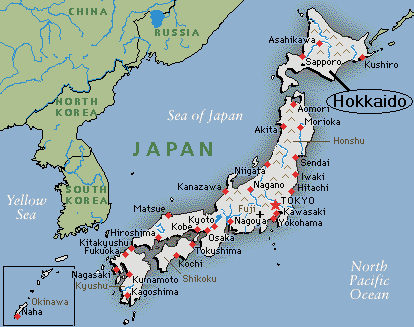
 Hokkaido is the northern most of Japan's four main islands. It was only recently settled by the Japanese and is the least populated and most undeveloped part of Japan. For this reason it makes an excellent area for cycling and hiking during the summer months. Hokkaido holds a wealth of beautiful mountains, farmland that can only make one think of Europe, and a host of quite backroads that are just begging to be cycled. Japanese students flock to the region during their holidays, many travelling by bicycle. I travelled through the western part of Hokkaido for about three weeks in September/October 2001 trying to travel on the cheap. I didn't keep extensive notes but from memory this is some of what I learnt and experienced during that time.
I caught the ferry from Maizuru (107km flat cycle from Kyoto) to Otaru which cost �8480 (US$68) for me and my bike. The ferry left late in the evening so I was able to cycle from Kyoto on the day of departure. The other ferry I used was at the end of my time in Hokkaido from Tomakomai to near Tokyo which cost �8200 (US$66). There are other ferries that the guidebooks and tourist info centres will tell you about.
The ferries were operated by different companies but of similar standard. Accommodation was a space on a carpeted floor in a large room which would hold more than 40 people. Being late in the season the ferries were not busy so there was plenty of space. A blanket and pillow are supplied and if you aren't used to hard Japan matresses you may not sleep too well. Showering can only be done in the japanese style bath (sento) on board. There is a restaurant on board but the food is expensive. Do as the Japanese do and buy all your meals from a supermarket or convenience store before the journey. Hot water is available free if you have pot noodles. Just in case you do as I do and eat your entire 2 days food supply on the first day there is a small store on board which sells pot noodles for about US$1.50. The best part of the ferry ride is getting to know the locals you are sharing the carpet with. Many of them will be cyclists or motorbikes riders and will sit around studying their 'Touring Mapple'. One guy I met had a great camping guidebook which contained all the free camp sites in Hokkaido. I spent some time marking them on my map.
Without a doubt the best maps of Japan for cycle touring are the 'Touring Mapple' put out by Shobunsha. There are seven volumes which cover Japan. Volume One covers the entire island of Hokkaido at a lovely scale of 1:200,000. Campsites, youth hostels, off road rides, onsen, and loads of other information are marked on the maps (in Japanese). Near the end of the book are photos of some of the campsites and onsen marked on the maps. The map reference appears in the top right of the photo - if the background colour is red the onsen or campsite is free. The disadvantages of the Touring Mapple are its book format (rip out the maps you need for the day) and its almost complete lack of English. Now this may seem a bit scarey at first but most Japanese roads are numbered, followed the numbers and you can't go wrong. Also, by taking a little time and looking closely at the Kanji on the map for the place you are heading to you'll have no problem following the signs that don't have the road number marked. In some cases road signs have no English so it's worth sticking with a Japanese map. The map in your guidebook or a freeby from the tourist info is sufficient for general planning.
Love: After struggling up a long uphill a tunnel literally takes the edge off a hill. Out of the wind. Out of the rain.
Hate: Dangerously dark and narrow. There is usually a raised foot path often not wide enough to safely cycle on. Smelly with fumes. The shoulders are littered with dangerous rubbish. The sounds of traffic are applified and I wouldn't have been surprised to have seen a Boeing Airbus pass me for all the noise that the traffic made.
Advice: Bring lights and always use them in tunnels. If there is a wide footpath use it.
Free camping in Japan is an excepted way of travelling. There are numerous free camp grounds throughout Hokkaido and many that charge only a few hundred yen a night. As I travelled late in the season these charging camp grounds were closed, however, it is still possible to camp in these places. Every town has a park of some description where you can set up after dark. My favourite parks are those with playgrounds with little forts. You don't even have to set up your tent to have a roof over your head in these parks. Youth hostels are much as they are anywhere in the world. They are a pricey accomodation option with prices in the area of �3000 (US$24) per night. I used them a few times to have a rest from the cold.
Easily my biggest expense for the trip was food. Japanese food is excellent, however, I found that it took quite a lot to fill the gaping hole in my stomach. I carried a stove with me and cooked many of my evening meals. Breakfasts were cereal and milk or rice and tinned tuna. Throughout the day I relied on the ever present convenience stores that are in every town. The Seicomart became my good friend in Hokkaido. There are many covenience chain stores in Japan, all the biggies are there (Seven-11, Family Mart, Lawson) but Hokkaido has its own local chain that isn't present anywhere else in Japan - the Seicomart. Pretty much any town of size has a Seicomart or two and it was these stores that I generally relied on for food. Everyday bento lunch boxes are delivered to each store and these along with salads, pot noodles, snacks, and even wine are enough to get you through a day. The other god send for those on a budget are the �100 shops that are in the larger towns and cities. There are even �100 supermarkets where I had to hold myself back from buying too much and overloading my bike. In Japan the 5% tax is not included in marked prices so even at a �100 shop you have to pay �105 per item.
Every town in Japan has a sento, or public bath. Unless you stay in youth hostels, sentos are your only option for having a wash. They cost �300-500. In some instances youth hostels will let you use their bath for a fee.