 |
|
| NONI: Polynesia's Natural Pharmacy |
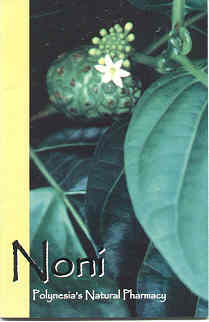
| NONI: MORINDA CITRIFOLIA Whether being used by a Polynesian healer to treat a child�s fever or being placed on a slide for closer examination in a biochemist's tab, the noni fruit has one of the most intriguing histories and exciting futures of any natural remedy available. Noni is the common Hawaiian name for Morinda citrifolia. The plant, indigenous to Polynesia, Malaysia, Australia, India, and Southeast Asia, is a type of ever-green ranging in size from a small bush to a tree 20 or 30 feet tall. Due to its medicinal and nutritional value, M. citrifolia is considered the "queen" of the other 80 species which belong to the Old World Rubiaceae family Approximately the size of a potato, the noni fruit has a lumpy appearance with a waxy, semi-translucent skin that can range in color from green to almost black. Natives of Polynesia recognize it sight unseen because of the fruit's rancid smell (and taste) when fully ripe. This polygonal-shaped fruit has numerous red-brown pits that contain several seeds. It is called a wandering plant because attached to each seed is an air sac that allows it to travel on water for months from island to island. More unusual than noni's appearance and smell is its long history of effective medicinal use by natives. Traditional Polynesian healers (Kahunas) employed every part of the noni plant-leaves, flowers, bark, roots, and especially the fruit-to treat health problems ranging from thrush to rheumatism. Intestinal worms, fevers, and skin infections were among the most common ailments treated by this Polynesian cure-all. Noni is receiving more and more attention from modem herbalists, medical physicians, and high-tech biochemists. Scientific studies within the last few decades lend support to the Polynesians' claims of its unusual healing power. These studies have shown the fruit juice to contain several healing attributes including but not limited to: antibacterial, anti-inflammatory, analgesic, anticongestive, hypotensive, and cancer-inhibiting compounds. These studies implicate noni as a natural remedy that lowers blood pressure, reduces joint swelling, stops internal and external infections, clears up congestion, and even stops pre-cancer cells from growing, In addition, one researcher, Dr. Ralph Heinicke formerly at the University of Hawaii, has pinpointed within the fruit's Juice a proenzyme that stimulates the human body to produce xeronine, a vital element to the body's protein molecules. Due to its protein-enhancing properties, the alkaloid xeronine potentially affects the human body in a multitude of ways from increasing a person's stamina to decreasing a drug dependency. Proteins are the most important catalysts in the human body, and they affect nearly every aspect of one's health. The application of xeronine from noni to external burns and infected tissue has significantly accelerated the time necessary for the tissue to repair itself Other internal and neurogenic disorders may also positively react to xeronine because of the compound's ability to normalize protein found in all essential living tissue, even that of the brain. POLYNESIAN MEDICINE: AN OVERVIEW Around 100 AD historians believe immigrants from Southeast Asia arrived on the Polynesian islands. They brought only the essentials in order to survive in a new land: food, clothing, building tools, and medicinal plants. Taro, yam, breadfruit, bananas, and sugarcane, for example, are five Polynesian foods that have origins in Southeast Asia and are believed to have been brought to the islands during an ancient migration. In addition to the foods mentioned, noni seeds are also believed to have been carried the long distance. The ancient travelers, however, regarded the noni fruit differently than the others. It was brought intentionally to the new land to treat the majority of ailments that afflicted the Polynesians at that time (i.e. cuts, burns, tumors, indigestion, menstrual irregularities, etc.). The knowledge of how to use the herbal remedies were in the stories and songs of certain families, and they were passed from generation to generation usually from mother to daughter. The first contact with the Western hemisphere came in 1778 when Captain Cook and his crew arrived. With them came European diseases that killed literally thousands of the island natives. "The introduced diseases demonstrated not the deficiency of Polynesian herbalism, but rather the deficiency of Polynesian immune systems, long-isolated from the diseases and plagues of Europe," writes ethnobotanist Dr. Paul Cox. Years later when Christian missionaries came to the islands, they outlawed Huna (the Polynesians' art of natural healing). It was not until the 1960s that these laws were officially repealed. Despite this opposition, the medicinal knowledge of the noni fruit juice and other Polynesian herbal practices were kept alive by the dedicated Kahunas. Most of these ancient healing methods have been guarded within the Polynesian culture. Approximately 66 percent of the medicinal plants used by island healers today are used uniquely in Polynesia. (See Table 1.) |
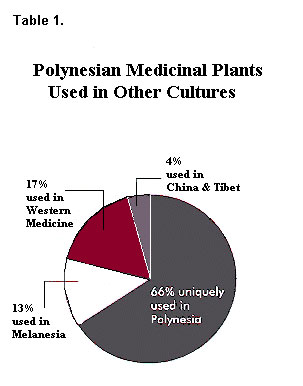 |
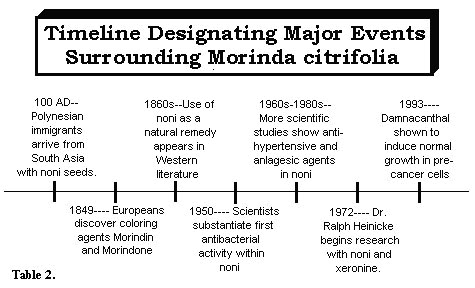
| Source: Paul Alan Cox, "Polynesion Herbal Medicine," In P.A. Cox and S.A. Banack (eds.), Islands, Plants, and Polynesians. Portland: Dioscorides Press, 1991. NONI: PAST AND PRESENT While The Hawaiian name noni is the most popular vernacular name given to the fruit, other cultures know it by different names. For example, in the Cayman Islands it is known as the "hog apple," and in Australia it is called, "cheese fruit.". Other names of noni include: Indian mulberry, lada, pain killer tree, and nonu. As seen by the plant's varied vernacular names, the noni fruit played, And continues to play, different roles in various Polynesian cultures. To some it is an annoyance due to the strong, rancid smell of the mature fruit (hence the name cheese fruit). Others use the fruit to feed hogs and other livestock. In some cultures, the noni fruit is eaten as a dietary staple while others only consume it as food in times of famine. Before synthetic dyes, almost all of the cultures used the noni roots as a natural dye for cloth and other items. The most important of the fruit's uses was and still is for medicinal purposes. Polynesian Kahunas, or healers, effectively used the fruit's juice to treat fevers, infections, diarrhea, constipation, asthma, insect and animal bites, and many other ailments.8 For example, the Kahunas' prescription for digestive problems is to pound two young noni fruits together with the roots and leaves of Boerhavia diffusa L., and then mix the juice with water and drink. Another ancient prescription that is used today to treat a fever accompanied by vomiting is simply to eat the immature noni fruit. (For a complete listing of the Kahunas' uses for noni, see Appendix A.) Noni lost popularity in many Polynesian communities during the early and mid 1900s because of its unpleasant smell. Many natives cut the trees down in order to rid residential areas of the odor. Recently, however, the fruit has become a sought-after commodity. According to a professor of botany at the University of Hawaii, the college receives at least ten calls per week concerning the once abundant fruit. Noni in North America Recorded modern uses in North America for the noni fruit are widespread. According to Dr. Isabella Abbott, an expert in botanical sciences, the more common recent uses of noni include to control diabetes, high blood pressure, and cancer. In addition, biochemist Dr. Ralph Heinicke has reported noni being used to treat menstrual cramps, arthritis, gastric ulcers, sprains, injuries, mental depression, senility, poor digestion, atherosclerosis (blocked arteries), and drug addictions. Dr. Joseph Betz, a research chemist with the FDA�s Division of Natural Products Center for Food Safety and Applied Nutrition, has said testing on the noni fruit shows it induces smooth muscle stimulatory activity and a anti-histaminergic (or anti-allergy) effect. The root is also reported as having pain killing and tranquilizing properties." Many of these modern uses have been supported by scientific studies. Medicinal research regarding noni began in the 1950s and has slowly increased since that time. In the 1990s, several published reports about the discovery of a cancer-inhibiting compound called damnacanthal in noni have heightened interest in the plant. (See Table 2 for a timeline of the major research events regarding M. citrifolia.) |
 |
| CHEMICAL CONSTITUENTS AND THEIR FUNCTIONS Noni fruit contains a little over 52 percent moisture. A number of experiments have been performed in order to identify all of the elements which make up the remaining 48 percent. These studies have identified a number of interesting compounds within the fruit's juice. However, not all of the elements of noni have been identified. As recently as 1993, researcher Helen Sim reported unknown substances in the noni fruit that neither she nor her associates could identify. A large portion of health-related compounds have been isolated from noni. These are listed below. Terpene compounds Morindone Morindin Acubin L. Asperuloside Various anthraquinones Alazarin Caproic acid Caprylic acid Scopoletin Damnacanthal Alkaloids Terpenes Multiple tests have shown strong evidence of terpene compounds in noni. A terpene is an isometric hydrocarbon also found in essential oils. Terpenes aid in the body's organic synthesis and cell rejuvenation, and they are used by herbalists to promote general health. Morindone and Morindin - Natural Dyes The first scientific research performed using the noni fruit was based solely on the Europeans' commercial drive to find natural dyes for clothing. In 1849, researchers labeled morindone and morindin as being the natural coloring agents in the roots of the noni plant. Since that time, morindin has been identified as possibly containing antibacterial properties. The compounds produce a yellow and red dye. It was from this early European research that the plant's scientific name Morinda was derived. Antibacterial Agents & the Immune System Acubin, L Asperuloside, alazarin, and some of the anthraquinone compounds within noni are all proven antibacterial agents. These compounds, which are found in the juice of the noni fruit, have been shown to fight against the infectious bacteria strains: Pseudomonas aeruginosa, Proteus morganii, Staphylococcus aureus, Bacillis subtilis, and Escherichia coli. Additional tests have shown antibacterial activity in noni controls two pathogens: Salmonella and Shigela. Discovery of the antibacterial elements within noni juice support is use to treat skin infections, colds, fevers and other bacteria-caused health problems. The Acids-Nutritional Properties The ascorbic acid present in noni is an excellent source of vitamin C. The caproic and caprylic acids are fatty acids. These two acids are the culprits of the ripened fruit's pungent odor. As a whole, the noni fruit is an extremely nutritious food. Many Polynesian cultures both past and present use the fruit as a dietary staple. Nearly all of the South Pacific natives used the abundant fruit to stay alive during famines. Soldiers during World War II were taught by the Polynesians living on the islands to eat the fruit to sustain strength. Scopoletin-Brain, Blood, and More In 1993, researchers at the University of Hawaii isolated the compound scopoletin from the noni fruit. By itself, scopoletin has medicinal value. In addition, it is one of the several substances in noni that scientists believe binds to serotonin, an important chemical found in the human body. The other serotonin-binding compounds in the noni Juice have not yet been isolated, but they are known to exist due to the extremely high ability of the juice to bind to serotonin in laboratory testing. On its own, scopoletin has produced hypotension (a lowering of the blood pressure) in laboratory settings. Scopoletin dilates blood vessels which lets the blood pass more quickly and that results in lower blood pressure levels. Additionally, scopoletin has been proven to kill a variety of bacterial species and it is considered fungicidal to Pythium sp. Anti-inflammatory and histamine-inhibiting effects have also been observed from scopoletin. These properties are linked to the numerous reports of successfully treating arthritis and allergies with noni. The discovery of scopoletin in M. citrifolia coincides with other studies that showed noni produced a consistent and reproducible fall in blood pressure in anesthetized dogs." Studies have also shown noni to contain analgesic or natural pain killing properties. Scientists in France reported that mice, given a liquid extract from the noni root, had a significantly decreased amount of contortions and writhing. Another set of mice which were administered the root had an increased. reaction time to a hotplate. Not only does scopoletin have medicinal properties on its own, but it is also one of the chemical compounds within the noni fruit that binds to serotonin, a necessary component found in the human body's blood platelets, lining of the digestive tract, and brain.24 The lab at the University of Hawaii at Manoa tested the extracts of eight other medicinal plants and none had as dramatic effect in binding to the serotonin receptor as did noni. The importance of the noni juice binding to serotonin is seen by examining the function of serotonin in the body. In the brain, serotonin acts as a neurotransmitter and as a precursor to a hormone called melatonin. Serotonin is thought to play a significant role in activities such as sleep, temperature regulation, hunger, and sexual behavior. In addition, a lack of serotonin has been implicated in a number of conditions including migraine headaches, depression, and even Alzheimer's disease. Damnocanthal-Anti-cancer Agent Some of the most recent research conducted using noni has been with the substance damnacanthal. While searching for substances that would induce a normal structure in abnormal K-ras-NRK cells (pre-cancer cells), four Japanese scientists came across the damnacanthal found in noni. Their experiments centered around isolating ras cells, which are precursors to many malignant growths, and then injecting the cells with damnacanthal taken from the chloroform extract of noni. Researchers observed that the damnacanthal injection significantly inhibited the ras cells from reproducing. Out of 500 plant extracts, M. citrifolia contained the most effective compounds against ras cells. They concluded that "damnacanthal is a new inhibitor of ras function. A later study conducted at the University of Hawaii showed similar positive results regarding noni and its use as an anti-cancer agent. Researchers in Hawaii reported that mice clinically infected with Lewis lung carcinoma (LLC) and left untreated died within nine to twelve days. However, mice infected with the same strain of LLC and then injected with an extract from noni juice lived significantly longer. More than half (thirteen out of twenty-two) of the treated mice survived over fifty days, and four of those mice continued to live, On average, the noni juice extract prolonged the life span of the infected mice by 119 percent. The scientists concluded that the noni extract acts as an inhibitor to the LLC infection by indirectly enhancing the macrophages and lymphocytes activity in a mouse's immune system. Alkaloids - Noni's Hidden Ingredient Alkaloids are colorless, complex, bitter organic bases, and they are essential to maintaining life. Dr. Ralph Heinicke, a respected biochemist formerly at the University of Hawaii, has dedicated himself to the study of one alkaloid in particular called xeronine. The body produces xeronine in order to activate enzymes and to regulate and give structure to proteins. According to Dr. Heinicke, without xeronine life would not exist. However, extracting xeronine from the human body has been impossible to date. The body's protein molecules consume the alkaloid immediately after it is created; and therefore, there is never an appreciable, isolable amount in the body. Even though the noni fruit has only negligible amounts of xeronine, it does contain very large amounts of a precursor to the essential alkaloid called proxeronine. Proxeronine is a colloid that, unlike most colloids, contains neither sugars, amino acids, nor nucleic acids and thereby has been overlooked by most biochemists. By raising the intake of proxeronine, a person will raise the level of xeronine in his or her body. In the body's intestines, proxeronine comes into contact with a specific enzyme found within body. This interaction initiates release of xeronine in the body. From the intestinal tract, xeronine travels to cell tissues containing proteins that have receptor sites with which to absorb the xeronine. Once absorbed, the xeronine activates inactive proteins or regulates the rigidity and shape of already active proteins. "Since proteins have different functions, we have the unusual clinical situation where administering one simple drug causes an unbelievable wide range of physiological responses," reports Dr. Heinicke. Some of the reported physiological responses from the xeronine include: lowers high blood pressure stops menstrual cramping relieves arthritis eliminates gastric ulcers helps heal sprains promotes injuries to mend prevents mental depression slows senility aids with poor digestion lessens atherosclerosis reduces blood vessel problems stops drug addiction decreases pain heals burns cures topical infections inhibits pre-cancer cell growth Therefore, it is the ability of the compound proxeronine found abundantly in noni which initiates the increased production of xeronine that Dr. Heinicke believes makes the noni fruit different from all other natural remedies. THE DISCOVERY OF XERONINE Growing up in the cold state of Minnesota, Ralph Heinicke had no idea he would one day become the world's expert on a fruit indigenous to the warm, sunny islands of Polynesia. His interest in noni began after graduating in biochemistry with his doctorate degree from the University of Minnesota and accepting a job in Hawaii with the Pineapple Research Institute. He was first hired by the Pineapple Research Institute in the 1950s to find a way to make pineapple compatible with gelatin. Previous attempts at flavoring gelatin with pineapple prohibited the gelatin from setting up. His research lead him to certain enzymes in pineapple called bromelain which prevented pineapple-flavored gelatin from functioning. He and his associates at the institute isolated and extracted the enzyme from the pineapple, and then Dr. Heinicke set out to find a commercial use for the crude bromelain. In his search, he came across a gynecologist who was having trouble taking x-rays of the female reproductive system because the mucus found in the vagina was hard to distinguish from tumorous growths. When the doctor injected bromelain into the vagina, however, the mucus was eliminated. The first indication of medicinal properties in the bromelain came when a woman receiving x-rays reported that the painful complications she had had for years disappeared after being injected with the crude bromelain. However, when Dr. Heinicke tried purifying the bromelain to conform the product to FDA standards, it did not exhibit the same medicinal properties. Dr. Heinicke�s research with the pineapple eventually led him to the noni fruit which also contains proxeronine but to a much higher degree. After years of trying to understand why purification of the bromelain destroyed its pharmacological properties, Dr. Heinicke eventually identified the alkaloid xeronine and its percursor, proxeronine. Dr. Heinicke is confident that the noni juice is the best raw material available as a source for the vital alkaloid. FROM ANCIENT TO MODERN TIMES From its ancient beginnings in Southeast Asia, through its migration into Polynesia, and now with its spread into North America and other parts of the world, the noni fruit may prove to be one of the most effective natural healing agents and promoter of well-being known to humanity. For the medicinal knowledge of the noni juice to survive two millennia in Polynesia, and for scientists to continue to be intrigued by it after nearly 40 years of research indicates that noni may be used to naturally treat health problems for many years to come. This book is available from Direct Source, see Marketing Tools. (Since 1999 scientists have discovered more than 140 active substances in noni juice. As they exist naturally and aren't concocted by someone in a lab, they are in perfect balance, allowing the body to get what it needs to heal itself. If an individual is getting a well balanced diet this product may be the only "supplement" needed.) APPENDIX A A list of all the known uses of Morinda citrifolia by Polynesians healers. Complaint Digestive System Diarrhea (adult) Diarrhea (infant) Intestinal worms Chest Infections Cough Chest colds (infant) Pleurisy Tuberculosis Eye Infections Conjunctivitis Irritated, red eyes Sty Fevers Fever (adult) Fever with vomiting Mouth and Throat Infections Inflamed, sore gums Sore throat, pharyngitis Thrush Toothache Skin Infections Abscess Boil Centipede bite Elephantiasis Dark spots Wounds General Jaundice Obstipation Rheumatism Woman's complaint Published by: Pride Publishing |
 |