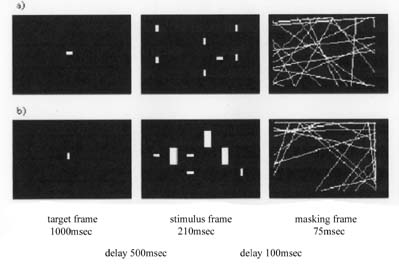
In this study, a novel visual search paradigm was used to test the hypothesis that the compromised magnocellular function in dyslexics may be its role in visual attention. Poor readers and age-matched normal readers were compared on two different types of visual search tasks; one which required the detection of a target defined by a single feature, either size or orientation, and the other where the target was defined by a conjunction of features, namely size and orientation.
Poor readers were classified based on a reading lag of 2 or more years behind age matched normal readers, with cognitive development (IQ) within the normal range, and no contributing social, cognitive or somatic disturbances. This resulted in a sample consisting of 7 females and 7 males, with an average age of 11 years. The sample of normal readers demonstrating average reading ability and cognitive development (IQ), consisted of 5 females and 7 males with an average age of 10 years 10.
The visual search paradigm used in this study was so designed that the effect of set size could be directly related to the visuo-spatial attentional demands of the task. As set size increased, the presentation time was increased by 30 msec for each extra item. Since it is known that visual search in conjunction tasks proceeds at a pace of about 30 msec per item (Wolfe, Alvarez & Horowitz, 2000), performance scores should not be affected by the set size in our paradigm. On the other hand, if visual search cannot proceed at this speed for whatever reason, increasing set size should have a deleterious effect on performance.
Figure 1. Examples of a single, �target present� trial among 7 items in a (a) parallel and a (b) conjunction search. Target frames were followed by stimulus frames (presented for about 30 msec/item), which were followed by a masking frame. |
Consistent with predictions, poor readers were found to be as competent as normal readers in detecting targets based on simple features (size or orientation).
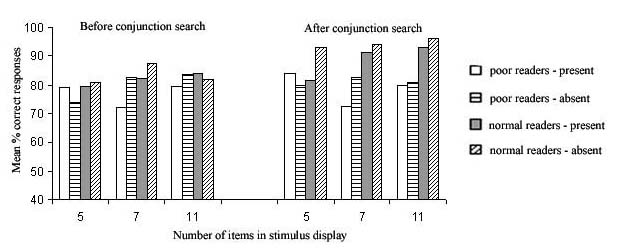
Figure 2. Mean percentage correct scores for normal and poor reading groups on a feature search task for orientation, before and after completion of the conjunction search task. |
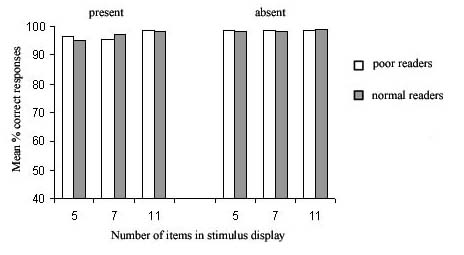
Figure 3. Mean percentage correct scores for normal and poor reading groups on the feature search task for size. |
When targets were defined by a conjunction of features (size and orientation), set size showed no effect on the performance of normal readers, thus the functioning of their visuo-spatial attentional mechanisms was able to accommodate the increasing number of items in their visual field. However, the performance of poor readers demonstrated deficiencies in conjunction search, with further declines in performance as the number of items in the visual field increased, thus indicating deficiencies in their visuo-spatial attentional mechanisms.
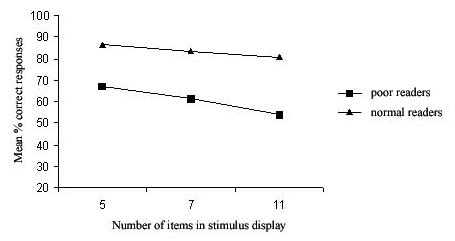
Figure 4. Mean percentage correct scores for normal and poor reading groups over the different set size conditions in the conjunction search task. |
According to Vidyasagar (1999, 2001), reading requires an unnatural use of visual search mechanisms. Normally, visual search is a random process which does not keep track of previously inspected locations (Horowitz & Wolfe, 1998). However, when reading, the attentional spotlight needs to be trained to move 'sequentially and systematically' over the words in a line. In this way, the letters could be attended to and integrated into words. Individuals who have a deficient magnocellular pathway may not be able to learn this skill effectively and therefore their reading capabilities will be poorer and slower to develop.
