Canada Corps
Are
you polite and tall, with a polished set of teeth? Does your credo run along the
lines of "follow the rules?" Does it tick you off more than a little bit when
you find a group of hosers acting out of line? If the answer to any or all of
these (most preferably all of them, but we're not going to argue with you) is an
understated but fully back up "yes," then Canada Corps may be right for you!
Editor's note: Hey,
this is Ted. Sorry about that exclamation mark, we didn't mean to startle you.
It's just that the recruiting office is trying to bring in a group of
go-getters. I tried like heck to convince them that it was too much, I really
did, but they won out. We compromised and they let me write this in. Once again,
sorry for that - if you'll forgive my rudeness - downright un-Canadian display
of needless exuberance.
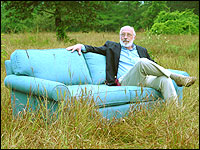 Canada Corps was founded in 1967 by Duane Martel after Canada declared
independence and nobody heard. Needless to say, it was an immediate success. The
first joining members, who, along with Duane, comprised the forefathers (or, as
we like to say, threefathers) of the Canada Corps, enlisted on the second
day of its existence after seeing a recruitment poster in Priestley Bar in
Saskatoon, Saskatchewan. Their names, Jim "Antlers" Flanders and Rick "Socket
Wrench" Nugent, would very quickly find their way into Canada's history books.
Although membership would remain plateaued at three until June 17, 1984,
interest in the Corps was always evident. The first public rally held in support
of the clean grit and moxie displayed by the Corps was held on June 16, 1984 in
Moose Jaw, Saskatchewan; upwards of 16 people attended. Canada Corps historians
have never been able to draw a concrete connection between this event and the
membership's doubling to six the next day.
Canada Corps was founded in 1967 by Duane Martel after Canada declared
independence and nobody heard. Needless to say, it was an immediate success. The
first joining members, who, along with Duane, comprised the forefathers (or, as
we like to say, threefathers) of the Canada Corps, enlisted on the second
day of its existence after seeing a recruitment poster in Priestley Bar in
Saskatoon, Saskatchewan. Their names, Jim "Antlers" Flanders and Rick "Socket
Wrench" Nugent, would very quickly find their way into Canada's history books.
Although membership would remain plateaued at three until June 17, 1984,
interest in the Corps was always evident. The first public rally held in support
of the clean grit and moxie displayed by the Corps was held on June 16, 1984 in
Moose Jaw, Saskatchewan; upwards of 16 people attended. Canada Corps historians
have never been able to draw a concrete connection between this event and the
membership's doubling to six the next day.
Today, Canada Corps does it threefathers proud. After Duane Martel perished in
an as-yet unexplained ice fishing mishap in the Yukon Territories, an ice
sculpture was erected in his memory; as it is in the Yukon, it naturally has
never melted, and holds the world record for longest-lived ice sculpture outside
a freezer. It would be in the Guinness Book of World Records were it only
possible to obtain documentation. Awesome though that may be, Canada Corps is
about even more than sculpting people out of the ice that is so readily
available up North. We stand for the life of the moose: tall, proud, noble,
helpful. We preserve Canadian culture and foster the Canadian way of life by
example. Are you ready to heed to the call? Simply send an
email with your address and we will get you started in the politest way
possible.
Glossary
Hoser (n). Oaf,
simpleton.
Saskatchewan (n).
The middle member of Canada's three prairie provinces.
Moose (n).
Largest member of the deer family, characterized by unique palmate antlers on
males. Name from Algonquin, meaning twig eater.
Province (n). To
Canada what states are to the United States of America. All-told, there are ten
Canadian provinces: Ontario, Quebec, Nova Scotia, New Brunswick, Manitoba,
British Columbia, Prince Edward Island, Saskatchewan, Alberta, and Newfoundland
and Labrador.
Back to Main