Application of Rational Root Theorem to Composite Functions Author: JC Castellanos-Smith
Let's say you were asked to find the roots of: f(x) = 3(x+2)3 + 2(x+2)2 + 4(x+2) + 5 You could expand everything and then try and solve, but it would take you a very long time and most likely will turn out to be impossible to solve. Instead let's look at this problem a different way. Let's think of it as a function within a function. Let's think of it as: g(x) = x+2 h[ g(x) ] = 3 [g(x)] 3 + 2[g(x)]2 + 4[g(x)] + 5 If we instead decide to represent g(x) by "a" then we begin to notice something. a = g(x) h( a ) = 3 a3 + 2a2 + 4a + 5 This function is simpler and more familiar. ± p/q = ± {factors of the constant / factors of the leading coefficient} ± { 5 , 1} / {
3 , 1} = ± { 5 , 3 , 5/3 , 1}
We write a statement for the possible RATIONAL roots of h(a) as: a = ± { 1 , 3 , 5, 5/3}
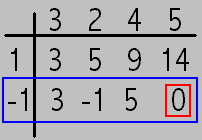
Then you would use synthetic division to find out which of these are actual solutions of h(a). Synthetic Division and the Remainder Theorem tell us that because a = -1 produces a remainder of zero, that -1 is a solution of h(a).
Now that we know a = -1, we continue on our journey to find a solution of f(x). Since we defined "a" as being equal to "x+2" we write a statement:
a = -1 a = g(x) = x + 2 x + 2 = -1
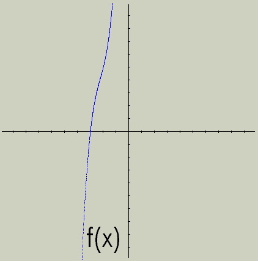
We subtract 2 from both sides of the equation to find that x = -3 is a solution of f(x). The graph of f(x) shown at the right shows f(x) crossing the x-axis at -3.
x + 2 = -1 x + 2 - 2 = -1 -2 x = -3
To further understand why this subtraction is necessary, continue reading and examine the graph f(x) and h(a) shown alongside the explanation.
Now here is the flaw with the application of the Rational Root Theorem to composite functions, there may in fact exist a few more RATIONAL roots of f(x) than this process for h(a) provides.
The Rational Root Theorem does not list a = 0 as a possible solution because 0 is not rational. If you find that a = 0 is in fact a solution, then you should write that off to the side.
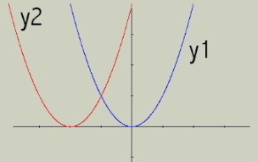
Let's look at the transformation of a simple function. y1 = x2 y2 = (x+2)2 The graphs of y1 and y2 are the same in every aspect, with the exception that y2 is shifted to the left by 2 units from y1.
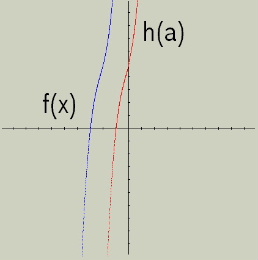
Now look at f(x) and h(a) [ h(a) is graphed using the same x- and y- axes as f(x) ] : f( x ) = 3(x+2)3 + 2(x+2)2 + 4(x+2) + 5 h( a ) = 3 a3 + 2a2 + 4a + 5 f(x) is the same as h(a) except that
f(x) is shifted to the left by 2 units from h(a).
This is why we subtracted 2 from the root we found, not long ago. Now the final point, because you know that a = 0 is a possible root of h(a), you must subtract 2 from it in order for it to be a possible root of f(x). Therefore: a = x+2 = 0 (a)-2 = (x+2) -2 = (0) - 2 a - 2 = x = -2 x = -2 So, x = -2 is a possible rational root of f(x) even though it is not provided by the h(a) rational root method.
You can also apply the Rational Root Theorem to trigonometric functions such as: j(x) = 4 (cos x) 3 + 3 (cos x)2 + 2 (cos x) + 1 a = cos x j(a) = 4 a3 + 3 a2 + 2 a + 1 Using the process I've explained where cos x is used as the inner function, you arrive at the possible rational solutions as: a = cos x = ± { 1 , 1/4 ,1/2 } and then you would follow with synthetic division to find which of these are possible roots of cos x. After that you would find the "x" angle(s) in degrees or radians that correspond to the ratios 1, 1/4 or 1/2. The "x" angles would be the solutions.
I hope it makes your life easier in the realm of mathematics. Enjoy. |
|