John T. Wood's Mental Tools Page
HOME
The Structure of Explanation/Models
When building or analyzing a model or explanation it is important to explicitly recognize the following features of the model building/explanation process.
Set of Assumptions
All explanation/models are built on a Set of Assumptions.
Many times these assumptions are not explicitly stated or acknowledged, but are there nonetheless.
Assumptions are those principles, assertions, or concepts that are taken on faith to be true.
This faith may either be blind, as in religious belief (blind faith), or empirical (based in experience), as in the sciences.
Circle of Reasoning
By applying logic to the set of assumptions we have chosen, we construct a Circle of Reasoning based on the presumed truth of these assumptions.
This process leads to the unfolding of the relationships that are implicit in the Set of Assumptions (i.e. makes the relationships explicit).
Paradox/Contradiction
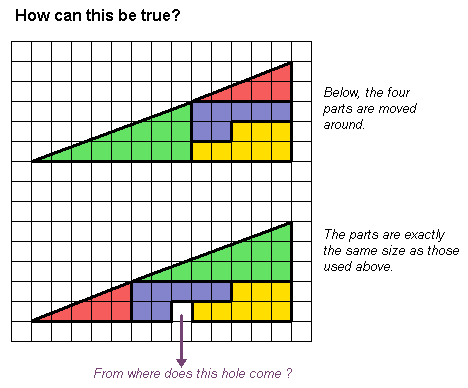
At the extreme end of the Circle of Reasoning, Paradox/Contradiction are encountered.
This may occur directly within the explanation/model analysis or between the explanation/model and the empirically observbable realm to which the explanation/model is being applied.
Limit of Validity for the Set of Assumptions
Encountering Paradox/Contradiction is a sure sign that we have reached or exceeded the Limit of Validity for the Set of Assumptions we have chosen.
It is time to go back and reexamine the Set of Assumptions in an effort to identify the source of the Paradox/Contradiction and to understand how the assumption-paradox are related to each other.
Range of Validity for the Set of Assumptions
Having identified the Limit of Validity of our explanation/model, we are now in a position to define the Range of Validity for the explanation/model.
The explanation/model validity is always based on the relative truth of the Set of Assumptions.
Degrees of Approximation
Dissolving the Paradigm
Reconstruction and Expanding the Approximation
HOME