
JTW's Chemistry Web Page
HOMEChemistry - Table of Contents
The Neutralization Reaction
HCl(aq) + NaOH(aq)
 NaCl(aq) + H2O(l)
An Acid-Base Neutralization Reaction
is always of the form:
Acid + BaseSalt + Water
Where:
- The Acid is represented as HnX(aq)
(The acid is n-protic.) - The Base is represented as M(OH)m(aq)
- The Salt is represented as MnXm(aq)
- The Water is represented as H2O(l)
- The number of protons H+, which is p*n, should be equal to the number of Hydroxide ions OH-, which is q*m.
(ie. The balanced equation must have p*n = q*m.)
[p] HnX(aq) + [q] M(OH)m(aq)
[(p*n)/q] MnXm(aq) + [p*n] H2O(l)
The Reactants:
|
(as you might find them in the lab) |
The Reaction:
(as you might observe upon combining solutions)
HnX(aq) + M(OH)m(aq) --- H2O(l) + MnXm(aq)
The Balanced Equation:
(what you must do to perform calculations involving the stoichiometry of the reaction)
Remember to check for Conservation of Mass and Charge.
You should also always include the States of the Reactants and Products.
m HnX(aq) + n M(OH)m(aq) --- ((m+n)/2) H2O(l) + MnXm(aq)
Complete Ionic Equation:
(This is what the solution actually looks like in terms of Ionic Species)
Break Ionic Compounds (aqueous substances) into their constituent ions.
m*n H+(aq) + m Xn-(aq) + n Mm+(aq) +
m*n OH-(aq) --- ((m+n)/2) H2O(l) +
n Mm+(aq) +
m Xn-(aq)
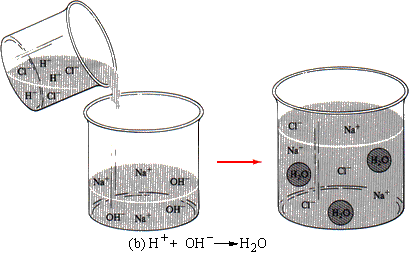
Net Ionic Equation:
(This is what actually happended in the reaction)
Cancel Spectator Ions that show up on both Reactant and Product sides of the Complete Ionic Equation.
m*n H+(aq) +
m*n OH-(aq) --- ((m+n)/2) H2O(l)
Simply to lowest common integer ratio:
H+(aq) +
OH-(aq) --- H2O(l)
Because H+ shows up in aqueous solutions as Hydronium (
In an aqueous solution the net ionic should actually look like this:
H3O+(aq) +
OH-(aq) --- 2 H2O(l)