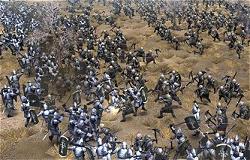
Battle of Dagorlad: The decisive battle of the War of the Last Alliance, in which the last great alliance of Elves and Men, led by Gil-galad and Elendil, faced the forces of Sauron. The Battle took place on a wide and dusty plain before the entrance to Mordor, and many who took part were lost in the marshes that bordered the battlefield on the west. There was great loss on either side, but Sauron was defeated and fled back to Barad-d�r. After the Battle was won came seven more long and bitter years of siege, but Sauron was finally defeated and the Second Age came to an end. The Battle of Dagorlad was one of the greatest Middle-earth had ever seen.
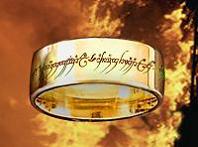
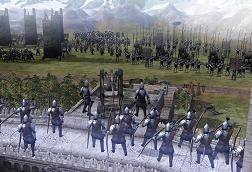
War of the Rings: The great conflict at the end of the Third Age, named for the One Ring and the importance this had in the final outcome. The war was fought between a loose alliance of Elves and Men led by Gandalf and Aragorn, Sauron the Dark Lord, and Saruman as a third power based in Orthanc. Sauron held the military advantage the entire time in the War, due to his overwhelming forces; not only Orcs and Trolls, but Men of Harad and the East. His main target was the overthrow of Gondor, his near neighbor and the strongest of his enemies. He had such forces at his command that he was able to fight the war on many fronts, also attacking Dale, Erebor and the Wood-elves in the far north, and L�rien from his secondary stronghold at Dol Guldur. Had Sauron regained possession of the Ring, he would have been victorious. Saruman had claimed alliance with both the Free Peoples and the Dark Lord, but was ultimately fighting for his own ends. In alliance with the Dunlendings, and having Orcs and Uruks at his own command, his objective was the defeat of Rohan. Until late in the War, he held the advantage, defeating Rohan twice at the Battles of the Fords of Isen. He had not considered the Ents of Fangorn in his plans, however, and when they were roused to anger at his actions, they brought about his downfall. The Council of Elrond was based around the Quest to Mount Doom; a company of nine under the leadership of Gandalf traveled from Rivendell with the One Ring, with the hope of reaching Mount Doom in Mordor and destroying it there. Because the Ring held much of Sauron's native power, they realized destroying it would also defeat its creator. Against all hope, the Quest was achieved by Frodo with the help of Sam and Gollum. Sauron was finally defeated.
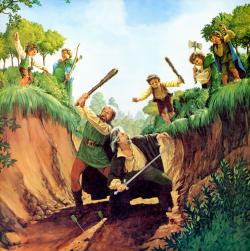
Battle of Bywater: The Battle of Bywater was the last battle of the War of the Ring. The battle was fought in the village of Bywater. The Hobbits defeated the Men and freed their land from the rule of the invaders. Men had started coming to the Shire from the South and some even seemed to have orc blood. At first they worked for Lotho Sackville-Baggins, who was expanding his business interests and selling goods from the Shire to outsiders including Saruman. Lotho, through force of the Men, set himself up as Chief, and the Men came to be called the Chief's Men. The Chief's Men intimidated the Hobbits and arrested anyone who tried to stand up to them. After Saruman left Orthanc, he came to the Shire and took over as Chief. When Frodo and his companions returned to the Shire and came to Bywater, they were shocked by the new "rules" and changes that had happened to the Shire while they were away. They began to rally the Hobbits to expel the invaders. Merry blew the Horn of the Mark and over 200 Hobbits from the Bywater area answered the call. They drove off a group of twenty Men from Hobbiton, but the Men sent scouts to bring reinforcements. Pippin rode off to Tookland to rally the Tooks. Merry was in charge of organizing the Hobbitry and he used his war experience to prepare them for the upcoming battle. He had barriers set up on the roads and posted look-outs for the night. He scouted and returned with news that around 100 Men were heading toward Bywater. Pippin arrived before the Men, leading 100 Hobbits from Tookland. Under Merry's direction, the Hobbits had set up a barricade of carts about a furlong up Bywater Road at a point where there were high banks and hedges on either side of the road. When the Men came up the road the Hobbits pushed more carts in behind them, and the Men found that they were trapped in a confined space with armed Hobbits looking down on them from the banks above. The Men were leaderless and inexperienced in battle; they were used to ruling by intimidation and had not expected such an organized resistance. Some of the Men fled, but others fought fiercely and several Hobbits were killed. Merry and Pippin then charged the ruffians from the east side and Merry slew the leader, who appeared to be part orc. The rest of the Men were surrounded by Hobbit archers. Those who had escaped were pursued and the Men were driven out of the Shire. In the end, nearly 70 Men were killed and 12 were taken prisoner, while 19 Hobbits died and about 30 were wounded. The dead Men were buried in a nearby sand-pit that was called the Battle Pit. The dead Hobbits were buried on a hill in Bywater, and a stone was placed on their grave with a garden around it. The Battle of Bywater was the last battle fought in the Shire.