Places in Middle Earth
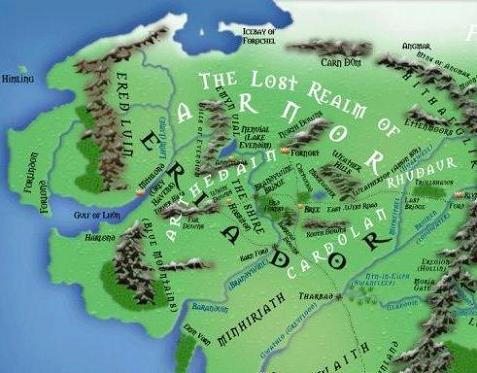
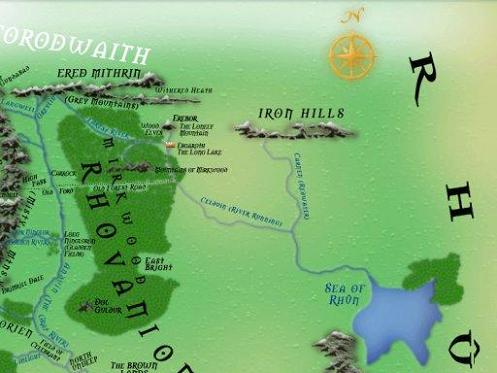
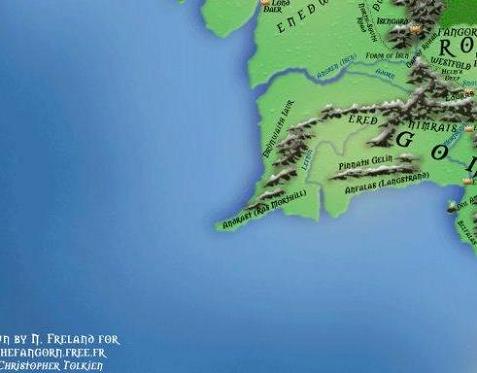
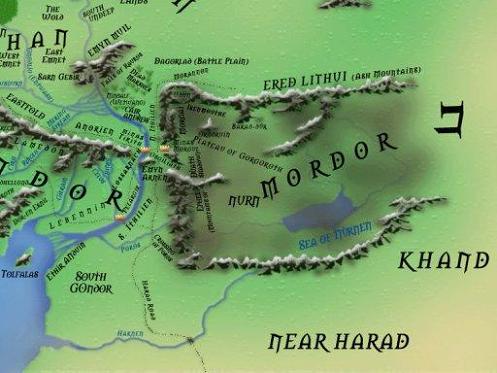
(See map below for locations)
Gondor
Ithilien: Ithilien was once a beautiful area of Gondor, often called the Garden of Gondor, though it was eventually abandoned after the taking of Minas Ithil. Ithilien was located between Minas Ithil and the Anduin. Even in the years of the War of the Ring, the hobbits could see the remaining beauty of Ithilien, though it was no longer tended and had fallen into ruin. After the War of the Ring, Ithilien was given to Faramir, by Aragorn.
Minas Tirith: Minas Tirith, whose name means Tower of Guard in the tongue of the High Elves, was built in the year 3320 of the Second Age of Man. The city, whose original name was Minas Anor (Tower of the Sun), was the fortress of Anarion, son of Elendil. The city's name was changed in year 2002 of the Third Age, when its sister, Minas Ithil was beseiged and fell to the Nazgul. With Minas Ithil (which was re-named Minas Morgul, the Tower of Black-Magic) captured by the enemy, and Osgiliath, the original capitol of Gondor, in ruins, Minas Tirith became the chief city of Gondor and the focal point of the struggle against Sauron. The city was built on the Hill of Guard, which is on the easternmost spur of Mount Mindolluin, near the great river Anduin. Its design consisted of seven more-or-less circular levels, each one higher than the one before it. The main gate of the city faced east, but the gates to each succeeding level were north or south, so the traveler had to turn south, then north to move through the levels. The uppermost level of the city was known as the Citadel, and housed the White Tower, the Court of the Fountain, and the Tower Hall, which was the seat of the Kings of Gondor.
Osgiliath: Osgilliath was built on both sides of the Anduin river and on the River itself. It was about 15 miles northeast of Minas Tirith. The 'Fortress of the Stars' was the central and chief city of Gondor during its early years. It was largely deserted after the plague of the mid-Third Age, and lay in ruins at the time of the War of the Ring. It also housed the Palantir that was stolen by Sauron.
Rohan
Edoras: It is the chief city of Rohan and is located under the northern feet of the White Mountains. Edoras houses Meduseld, the Golden Hall. The Golden Hall has been the high seat of the Kings of Rohan since it was completed by the 2nd King of Rohan, Brego in the Third Age.
Fangorn Forest: The deep, dark woodland that grew beneath the southern Misty Mountains, under the eastern flanks of that range. Millennia before the War of the Ring, these woods had spread across the western lands of Middle-earth, but the forestry of the N�men�reans had seen them dwindle during the Second Age, and by the end of the Third, the Forest of Fangorn was the last large part of that old forest to survive, though not the only one. The forest took its name from the Elvish Fangorn, 'Treebeard', a reference to the old Ent who dwelt there. The Ents had once walked freely in the western lands, but with the failing of the forests, their range was diminished, so that by the time of the War of the Ring, they were only found in any numbers in the Forest of Fangorn.
Helm's Deep: Helm's Deep is the traditional refuge of the people of Rohan in time of war. Legend has said that Helm's Deep will never fall so long as there is men defending it. It is located on the far side of the Westfold Vale under the shadow of Thrihyrne. The Deeping Wall surrounding the fortress was twenty feet high, and so thick that four men could walk abreast along the top, sheltered by a parapet over which only a tall man could look. Here and there were clefts in the stone through which men could shoot. This battlement could be reached by a stair running down from a door in the outer court of the Hornburg; three flights of steps led up onto the wall from the Deep behind; but in front it was smooth, and no great stones of it were set with such skill that no foothold could be found at their joints, and at the top they hung over like a sea-delved cliff. The only entrance was a long narrow ramp that led to it's gates.
Isengard: The citadel of Isengard was built by the N�men�rians in a sheltered valley at the southern limits of the Misty Mountains. Its main purpose was to defend the gap of Rohan and the Fords of Isen against attacks by Sauron's forces. Self-sufficient and enchanted, it later became the virtually impregnable fortress of Saruman. No spire in Middle Earth was stronger, save the Dark Tower of Mordor. Surrounding Isengard was a ring of rocks, like jagged teeth, coming up from the ground. In it's center, is the Tower of Orthanc.
Tower of Orthanc: The tower built by the early Gondorians to guard the wide pass between the Misty Mountains and the White Mountains. It was later given to Saruman, who was at that time, working as an ally of Gondor. Isengard's tower of Orthanc rises 500 feet above the plains, an indestructible spire of black rock. Although not as impregnable as Sauron's tower of Barad-dur, Orthanc is capable of withstanding great assaults.
Mordor
Cirith Ungol: The Spider Pass, near to Minas Morgul on the borders of Mordor. Cirith Ungol was the route chosen by Frodo, on the advice of Gollum, to enter Mordor. It was a high, narrow pass overlooked by a fortress at the top. As an added safeguard, there lived Shelob, the greatest of the giant spiders remaining in Middle-Earth. The route through Cirith Ungol, included two very long stairways and a branching orc tunnel where Shelob lived.
Mount Doom (Orodruin): The fire-mountain in the northern parts of Mordor, in which Sauron forged the One Ring during the Second Age, and into which the same Ring fell thousands of years later to bring about the Dark Lord's downfall. When Sauron chose the land of Mordor as his dwelling-place, Orodruin was the reason for his choice. He 'used the fire that welled there from the heart of the earth in his sorceries and his forging. So powerful was the sorcery used in the making of the Ring that it could not be unmade, except by casting it back into the same fire that had forged it. Orodruin was far more than a natural volcano - Sauron seems to have extended his own power into it, and was able to control its fires. It seems to have lain dormant when Sauron was away from Mordor, and sprung into life when his power grew.
Tower of Barad-Dur: The mighty shadow-shrouded stronghold of Sauron in the Second and Third Ages. The first building of Barad-d�r, when Sauron first came to Mordor, took six hundred years to complete. In the Last Alliance of Elves and Men it was destroyed by the forces of Elendil and Gil-galad. Though destroyed, its foundations were left in place until Sauron had it rebuilt later on. It was black and constructed mainly of metal. From the steel gate of the Tower, a causeway ran out into the plain of Gorgoroth, across a mighty bridge. Lava from Mount Doom was channeled back across that plain to Barad-d�r. It was hidden by a cloud of shadow and darkness at all times. The topmost tower of Barad-d�r is the place where Sauron dwelt. At least, the Window of the Eye, from which the Lidless Eye stared out across Middle-earth, was located there.
The Shire
Bag End: A large and comfortable hobbit-hole, wellknown as the home of Bilbo Baggins and his heir, Frodo. Its round green door opened into a large, well-appointed hobbit-hole that took up much of the Hill above Hobbiton. In the tradition of hobbit-holes, all the rooms at Bag End were on the same level.
Hobbiton: Large town in the central regions of the Shire, within the borders of the Westfarthing. The town was overlooked by Hobbiton Hill.
Elven Cities
Lorien (Lothlorien): Its name means "City of the Trees". This beautiful forest city lies in east Arda, west of the River Anduin and just north of where the Anduin meets the Celebrant river. L�rien is the only place where the golden mallorn trees grow in Middle Earth, brought there from Valinor by Lady Galadriel. It is the wooded homeland of the Sindar, the Silvan Elves, and also the home of Galadriel and Celeborn. It is located southeast of Khazad-d�m.
Mirkwood: The great forest East of the Anduin River. It was originally called GreenWood but changed it's name when the shadow of Sauron spread through the forest. From East to West at its widest 210 Miles, from North to South about 480 Miles. At the Northern Mirkwood eaves was the foothills of Ered Mithrin and the Western eaves followed the course and vales of Anduin until it was at the heigth of L�rien at the other side of the river. Here it turned East North of the Brown Lands and the North Undeep in a big curve until it ran North again bordering Rhovanion and Wilderland to the East. Through Mirkwood ran in the Northern part two trails, most Northern was the Forest Path starting at the Forest Gate 75 Miles South of the Northern end of the forest and further South was the Old Forest Road some few Miles from Rhosgobel comming from the Old Ford. Between the Old Forest Road and the Forest River in the East of the Forest was Emyn Duir, the Mountains of Mirkwood. The South-West corner of Mirkwood was treeclad highland and the highest point here was Dol Guldur.
Rivendell: Rivendell was a deep valley in eastern Eriador near the Misty Mountains. It was hidden from view in the heather-covered moors. There was a steep, zig-zagging path leading down into the valley. Fir trees grew on the higher slopes and beech and oak trees grew farther down in the valley. The southernmost of the two mountain streams that formed the River Bruinen flowed westward through the valley. A narrow stone bridge spanned the river, and on the north bank stood the Last Homely House where Elrond dwelled. There were gardens around the house and a terrace overlooking the river.
Other Misc. Places
Bree: An ancient colony in Eriador shared by Hobbits and Men. Bree was the chief village of the Bree-land, a small inhabited region, like an island in the empty lands round about. The village of Bree had some hundred stone houses of the Big Folk (men), mostly above the road, nestling on the hillside with windows looking west. On that side, running in more than half a circle from the hill and back to it, there was a deep dike with a thick hedge on the inner side. Over this the Road crossed by a causeway; but where it pierced the hedge it was barred by a great gate. Also in Bree was the famous inn, The Prancing Pony.
Dead Marshes: The Dead Marshes are an ancient battlefield (Battle of Dagorlad), that lay between the Emyn Muil and the northern marches of Mordor. The Last Alliance fought the forces of Mordor and it was here, the fallen had laid to rest. Through the years, the battlefield became marshes and swallowed up the dead. Now it is nothing more than fetid swamplands and it is still said to be haunted at the end of Third Age, three thousand years later.
Dwimorberg: Among the White Mountains, at the head of the valley of Harrowdale, the ancient hold of Dunharrow stood above a cliff on the valley's eastern side. Beyond the hold to the east was a forest of pine and fir, the Dimholt, that shrouded the lower slopes of a brooding black mountain. That was the Haunted Mountain, named Dwimorberg in the language of the Rohirrim. In the depths of the dark Dimholt wood, at the entrance to a glen, stood a single standing stone. Behind that stone, in the depths of the glen, was a Dark Door, the entrance to the Paths of the Dead. Those Paths beneath the Mountains had been haunted by the betrayers of Isildur throughout the Third Age.
Emyn Muil: The range of hills that massed on either side of the Anduin above the inflow of the Entwash. At one time they marked the northern borders of Gondor. This rugged landscape is composed of razor sharp rocks and treacherous cliffs.
Harad: Harad is the name given to the wide, sun-baked lands to the south of Gondor and Mordor. The men of Harad, called the Haradrim, were ancient enemies of the Gondorians and allies of Sauron during the War of the Ring.
Moria (Khazad-d�m): The grandest and most famous of the mansions of the Dwarves. It lays in the central parts of the Misty Mountains, tunneled and carved through the living rock of the mountains themselves, so that a traveller could pass through it from the west of the range to the east. It was founded in very ancient days by Durin. As the millennia passed, the descendants of Durin sat upon the throne of Khazad-d�m, and their cavernous city became famous throughout the world. Much of its great wealth was based on the mithril that was found in its mines, and as the centuries passed, the Dwarves mined deeper and deeper for the precious metal. They finally dug too deep, and unleashed a nameless terror from the depths beneath the city. The creature wreaked dreadful destruction, and in slaying the King, Durin VI, became known as Durin's Bane. In the following year, Durin's son, N�in I, was also lost, and the Dwarves fled their ancient home. After millennia as one of the richest cities in Middle-earth, Khazad-d�m stood dark and empty, but for the brooding menace the Dwarves had released. In that time it was given a new name, Moria, the Black Pit. The monster of Moria - a Balrog of Melkor, as was later known - lurked alone in Moria for nearly five hundred years. After that time, the old city of Khazad-d�m began populated, but not by Dwarves. Sauron directed his creatures there, and it began to fill with orcs and trolls. Eventually after the fall of the balrog and the War of the Ring, it was reclaimed by the dwarves and their hammers rang again in their great halls beneath the Misty Mountains.