Article: Search Extends to Latin America
Summary
The hunt for those suspected of involvement in the Sept. 11 suicide attacks in the United States has spread to Latin America, where extremist Islamic groups are believed to be operating in at least five countries. Although an the extent of a terrorist threat in the region is still unclear, Latin American security agencies are ill-equipped to deal with the problem.
Analysis
At the request of the FBI, government security services in Argentina, Brazil, Paraguay, Uruguay, Ecuador and Colombia are investigating the movements and activities of Arab nationals suspected of having ties to Islamic extremist groups. Washington's request comes in the wake of last week's terrorist attacks in the United States.
Even if the investigations fail to find any links to the attackers, they will produce a clearer picture of potential terrorist threats in Latin America to regional and U.S. security interests. Unfortunately, they will also reveal the deficiencies and shortcomings of Latin American security agencies in combating international terrorism.
Evidence has been discovered suggesting ties between the suspected attackers, their U.S.-based support network and Arab nationals in Mexico and South America. For example Mexico was a secondary escape route for many suspects after the Federal Aviation Administration grounded all aircraft Sept. 11.
Mexican authorities are
searching for more than a dozen people, including two Bolivian nationals, sought
by the FBI for questioning as possible material witnesses to the suicide
attacks, according to the Mexico City daily Milenio. Also, some of the suspected
hijackers lived and trained for their deadly mission in South Florida, a major
gateway to Latin America, and San Diego, a key crossing point into Mexico.
The Bush administration has asked the governments of Brazil and Paraguay to
investigate the movements of Palestinians and other Arab nationals on the
Brazil-Paraguay border, the BBC reported. Investigators are focusing mainly on
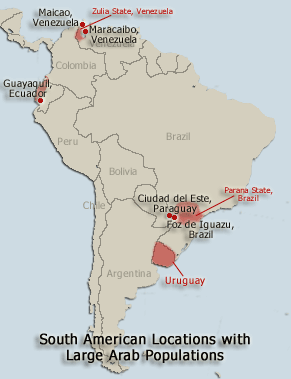
Ciudad del Este on Paraguay's "triple frontier" with Argentina and
Brazil, where individuals associated with Hezbollah, the Islamic Jihad and other
Islamic extremist groups have operated since the early 1990s.
According to officials with the Argentine Federal Police Directorate of International Terrorism, "cells maintaining active contacts with Islamic terrorism" have been detected in Ciudad del Este. The city is also viewed by Argentina and Brazilian authorities as a regional hub where organized criminal enterprises, insurgent groups and, increasingly, terrorist organizations enjoy safe haven and opportunities for strategic alliances.
U.S., Israeli and Argentine intelligence agencies believe Arab extremists based in Ciudad del Este were responsible for bombing Israel's embassy and a Jewish community center in Buenos Aires in the early 1990s. Moreover in October 1998 a suspected member of the pro-Iranian Hezbollah was arrested in front of the U.S. Embassy in Asuncion, Paraguay while surveying the facility, possibly in advance of a terrorist attack.
Despite tougher security measures on the triple frontier, known criminals continue to move with ease between Argentina, Brazil and Paraguay. In fact, Argentina's Telam news agency reported Sept.13 that four individuals with outstanding international arrest warrants for terrorist crimes crossed the border between Argentina and Brazil in the past month.
Government security services in Uruguay, Ecuador and Colombia are also cooperating actively with the FBI and CIA. On the day before the attacks, the U.S. Congressional Research Service published a new report saying extremist cells linked to Saudi exile Osama bin Laden are believed to be operating in Uruguay and Ecuador.
The government of Uruguay has not yet responded officially to the report. But the Brazilian daily newspaper O Estado de Sao Paulo said last week that Uruguay's intelligence services have shared information with the Brazilian government linking the mayor of Chuy, a Brazilian city on the border with Uruguay, to bin Laden. The mayor, Mohamad Kassem Jomaa, said the allegations against him are untrue.
Ecuadorian Foreign Minister Heinz Moeller announced that CIA and FBI investigators would arrive in Quito this week to help the government determine whether the report is accurate. Ecuador has a large ethnic Arab population concentrated in the port city of Guayaquil and along the country's Pacific coast.
U.S. and Colombian officials also indicate that Arab extremist groups have established a foothold in Colombia, mainly in Maicao, a lawless city in Colombia's Guajira region on the border with Venezuela. Like Ciudad del Este in Paraguay, Maicao has a large Arab population.
The city is a hub for legal and illegal activities, involving contraband consumer goods, arms, drugs and money laundering, ranging as far away as Ecuador, the Caribbean and Central American countries such as Panama and Nicaragua. Last month the Colombian news magazine Semana reported that known Arab extremists have been moving between Ciudad del Este and Maicao and in some cases have acquired Colombian citizenship illegally.
In fact, Colombia, Paraguay and Bolivia are known internationally as countries where passports and citizenship papers can be purchased easily. Identity laundering allows immigrants to circumvent country quotas imposed by the U.S. Immigration and Naturalization Service. It also allows wanted criminals and terrorists to hide their international movements and escape detection and arrest.
While terrorists appear to be using the region to avoid detection, Panama on Sept.18 also launched an investigation to determine if bin Laden used bank accounts and companies with headquarters in Panama to finance his alleged terrorist activities. News reports are saying bin Laden used a Panamanian company and its Swiss affiliate for financial transactions, the Financial Times reported.
The attacks last week are forcing the United States and Latin America, very belatedly, to rethink their bilateral relationship. Since the end of the Cold War, trade expansion was the priority while hemispheric security was ignored, with the exception of pursuing an increasingly militarized drug war in Colombia.
After Sept. 11, however, U.S. willingness to expand trade relations in Latin America likely will be influenced by how much the region cooperates with Washington on security-related matters. U.S. Secretary of State Colin Powell has been very clear on this point. The manner in which foreign governments respond to U.S requests for support and assistance will determine the future of American relations with those countries.
As international drug trafficking, insurgency and terrorism in Latin America blur into a single hemispheric security threat, U.S. and Latin American policymakers will be challenged to develop a new security framework without derailing closer trade relations and harming the region's fragile political institutions.
Thanks to:
(c) Strategic Forecasting L.L.C. All rights reserved.