Kemeny wanted a language that could be written and understood easily by non-scientific students without loosing the power that the scientific students counted on. Kurtz wanted a language that was a subset of the FORTRAN or ALGOL language. When they started experimenting with these two ideas they came to the conclusion that the outcome would be a completely new language. BASIC (Beginners All-purpose Symbolic Instruction Code) was the outcome.
The earliest form of BASIC had only 14 commands which included LET, PRINT, GOTO, IF, and THEN. It featured line numbers for easy correction capability. It also had default settings such as the number of decimal places to carry out a calculation. The beginner would not need to tinker with these settings, but advanced users had the ability to.
In those days the BASIC language was so simple it could be taught to just about any student in just two lecture sessions.
Kemeny and Kurtz never put a copyright on what they had created because they wanted it to remain open for anyone to use and by 1970 there were over 20 different versions of BASIC, most of which were based on the version that GE distributed with their computers.
The version of BASIC created by Bill Gates (pre-Microsoft) was an interpreted language, not a compiled one and was so because of the small amount of memory available to the early PCs. Many don't know it but, the first program every created and distributed by Microsoft was Microsoft BASIC. It was the most popular implementation of BASIC in the 1980s and was distributed on over 50 brands of PCs and quickly became the standard.
Kemeny and Kurtz had moved on to other things and had not continued to update BASIC to their standards. The first time they used a personal computer in 1983 they were appalled at what had been done to their language, so in 1984 they came out with an updated version of the original called True BASIC.
Several years later in 1989 Bill Gates said "Future versions of BASIC increasingly provide for this kind of programming [Object Oriented Programming or OOP]. . . . A visual BASIC program will be a mixture of code, programmer written objects, and visually specified objects." Three years later Microsoft® came out with Visual Basic®. This Visual Basic® offers programmers experienced at BASIC the chance to create Windows®-based applications without having to learn a completely new language.
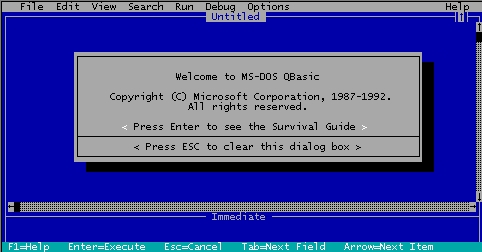
MS-DOS QBASIC - Scaled down version of Quick BASIC distributed with MS-DOS 6.x and MS Windows 9x.
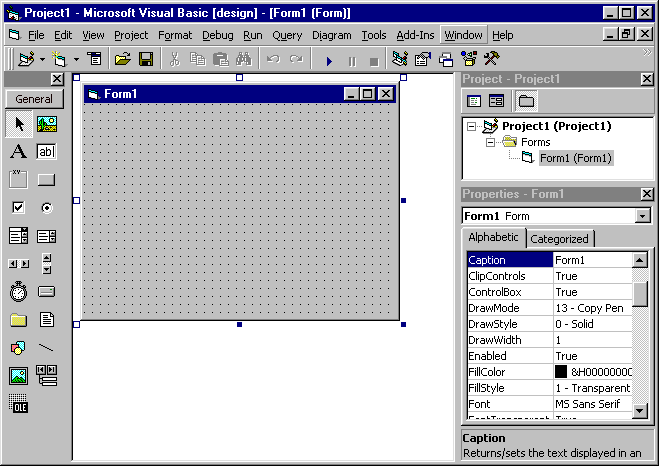
Microsoft® Visual Basic® 6.0 Learning Edition
Return to Table of Contents