
And waiting to get on living
By Jason Straziuso
Then a miltary helicopter touches down and you realize where you are. This is no ordinary community. True, there are dozens of off-road vehicles, just like in the streets of middle America. But these vehicles are all white and they have funny initials on them like CRS, UNHCR and ICMC.
Everywhere you look people tend to plastic jugs of water over small fires. It's the only way to get hot water. In order to wash your hair, you lean over a small tub and try not to get too wet.
The toilets are okay for a weekend camping trip - not okay to use daily. Phone calls are free, but you have to wait over an hour in line for a three-minute call. And the fence forces your evening walk into a circle.
I spent seven days in and around the refugee camps of northern Macedonia and two things were reinfoced everywhere I went: 1) these are great people and 2) they want to go home. The news reports have it right; ever single refugee I talked to said "We want to go home" and "We can't live with the Serbs."
But right now these people want to live life. Vivre, in French, not just habiter. At night the camp comes alive. People stroll in the central area, girls (and some guys too) arm in arm - European style, as if it were a seaside boardwalk. They might stop to watch a pick-up basketball game or to read the information board, where the lists of people being transferred to third countries has just been posted.
They call it "The City," and it's alive and vibrant. Energetic, animated voices fill the air. Maybe night's blanket covers the fence that holds them in -- literally and figuratively. But the next day the sun returns and brings with it a day of watching the clock from inside a tent.
At the Stankovac refugee camp I was taken in by a fmaily with spare room. I spent three days and nights with two brothers, age 26 and 19, and their sister, 18. Their parents are still in Kosovo, through they don't know their whereabouts or their safety. It was a wonderful opportunity to get a true insight into the situation - and to see how friendly a people they are.
The insisted I eat more than they, and that I sleep in the most comfortable spot. "You will sleep here because I invited you here and for you it will be like home," Ali, one of the brothers, told, no, ordered me. Then reality set in. "Not home, because it's not a home, it's a tent, but..." But he had the right idea: hospitality. Now if only everyone could adopt that attitude.
Of course that's a sensitive topic. That's what caused this whole mess. By the end of the week I had dropped the word Kosovar. All the refugees wanted to be called Albanians.
For instance, while eating breakfast in Skopje, I was talking to Alex, a worker at he bakery. He's a 24-year old ethnic Macedonian - and a real nice guy, but said the dumbest thing: "I've heard stories of how Serbians kill Albanians and how NATO kills Serbians and how Albanians kill Serbians. I don't give a (explative), I ahve a good life here." This kind of attitude, obviously, won't help anything.
The answer is caring - and cooperation - from all sides. Most would agree that we Americnas persevered through a period of ethnic (racial)tension, and now have relatively peaceful relations - at least by the Balkans' standard. One model to llok to is Romania. There, Romanians and hungarians live on a disputed area of land, but work out differences through politics. Rodney Kings' words come on to mind.
Erekm told me the refugees at Stankovac were merely surviving and it's time for them to start living again. I watched his family agonize over whether or not to go to Italy and Australia before finally deciding to go to Norway. All the while, a snow-capped view of a Kosovo mountain lay just outside the tent walls. The irony never escaped anyone.
Stankovac is a large prison - a prison with a view. Macedonian police stationed along the fenceline remind the regfuees they can't leave. Not that they need the reminder. Repetition and boredom prevail. "This way of life is very difficult because I used to be very busy. Now I am very bored," one refugee woman told me.
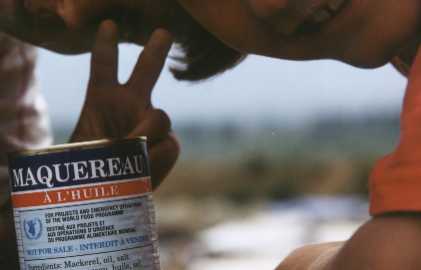
Even the meals are the same. What do you eat? I asked Ali, Ekrem's brother when I first met him. "Fish, fish, fish, fish, fish," he said, with just a teensy bit of disdain. Norway herring, sardines, cheese spread and bread -- every meal.
That's plenty to survive on, but it's nothing to live on.