
Despite Poverty, "We Have Open Doors"
By Jason Straziuso
I found two brothers who spoke broken English, at best. Bu they were willing to let me ride in the back seat. On the way we tried to make idle conversation. The most interesting thing Ramadan, the older brother, said was, "Serbian people good. Regime not good. Milosovich murderer."
That was the first time I had heard either a Kosovar or Macedonian Albanian refer to the Serbian people in polite terms. This was going to be an educational ride. As it turned out, Ramadan's family was hosting over 30 refugees, and they invited me to spend the night with them.
Arriving at their homestead, I found a peasant farmer's family homes. Five brothers and their families lived in a five-house complex, along with their parents. I was invited into their Muslim home. First removing my shoes, I entered a room with cushions along the edges of the floor and walls.
Everyone got up to greet me, including a Kosovar journalist, Avni Zogiani, from the Koha Ditore, the Albanian-language newspaper distributed free in all the refugee camps. Also a refugee, he would serve as my guide and translator.
Immediately I was served a dinner of rice and cabbage salad. Afterward, a bottomless cup of Turkish tea was served as we watched the news and spoke about the conflict.
As a report about the KLA came on, the room became quiet.
"I wish I had Milosovich in here," said the father of the family, a man of 66 years. "I'd rip his heart out."
The family has taken in two families of refugees that share two of the houses in the complex. All the brothers and the father are sitting in the room with me. The women sit in a separate room.
El Hilel, a relief agency, gives out food and blankets to the host families, but it's a struggle for this family of farmers, where only one of the borthers has steady employment as a mechanic, to house 30 refugees.
"They are not rich as you can see," Avni said. "They can not afford to feed the refugees." But that didn't diminish the family's desire to help.
"Albanians in the area are ready to accept more refugees," Ramadan said. "But the police won't let them leave the camps. We have open doors for our brothers."
This is obviously a special occasion for the family, hosting an American journalist. Everyone stays up late to talk, including the father, despite urges from his sons to go to bed.
The father is curious. Do I think the Americans will send in ground troops? He is disappointed at my answer. Will they at least arm the KLA? I said I doubted it.
"Why should people have to sleep outside? the father asked. "There's not a nationality in the world that deserves these kind of things," he said, referring to the reported atrocities.
If Albanians are mistreated in Kosovo and even here in Macedonia, maybe moving to Albania, where there will be no ethnic troubles, is the answer?
"My father's father was born here," the father said. "We shouldn't have to move." Besides, Avni added, if all Albanians moved to Albania, "There wouldn't be room to step."
The conversation turns to the KLA. Why dont' these brothers join the KLA and help fight? The answer is simple, the men say: money.
"Even if you want to go, they have as many soldiers as they can use," Avni said. "But they don't have enough money. It's not that these people aren't ready to suffer, to fight, it's that they dont' have anything to fight with.
On the BBC, we hear a refugee at the Kosovo border say, "Maybe it would have been better if (NATO) hadn't started." The report makes me want to crawl underneath the cushions I'm sitting on.
The next morning we wander through Ramadan's fields. As the oldest brother, it seems it is his responsibility to show me the fields of cabbage and beans. We munch on ripe strawberries along the way. Everywhere I go there is one or two little ones following along.
We stop at the house with 14 refugees in it. They all sleep on the floor in one of the rooms. One of the good things about having a Muslim home, or perhaps a poor farmer's home, is that there is no furniture to move.
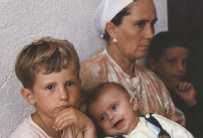
I talk with the grandmother. She has several grandchildren climbing over her as we speak. She is thankful that her family has somewhere to live for now.
"I'd like to thank the (host) family," Azize said. "Without them we wouldn't have anyplace to go and we are comfortable." She is one of the lucky ones. Her family has a home to sleep in. There is running water and a place to cook.
According to the United Nations High Commissioner for Refugees, (UNHCR), there are over 120,000 Kosovars living in Macedonian refugee homes and over 75,000 refugees living in camps, a number that is decreasing as evacuations are made to third countries.
This family does not want a third country. They have moved enough already, they say. But they have no home to go to, saying the Serbs destroyed it.
"NATO will be successful. It is our only hope," Azize said. This family share the one trait I've found in all Kosovar Albanians I've spoken with: they want to return to their homeland.
"We will stay here as long as we need to, " said her son, Vlaaznmim. "But we will return as soon as it's possible to return."
"We don't have anything to return to, but we can do something about that," Azize said. Even if they return in the winter they could prepare one room and live in that she said. But first, the Serbs must leave.
"It's impossible to like the Serbs," Vllaznime said. "They've killed so many people, we can't live with them."
Right then we are called to breakfast. We walk back to the main house. A train passes on the horizon. "I hate the train," Avnis says. "I rode the train from Kosovo and it was awful. I hate seeing trains now."
Our meal is scrambled eggs and home made bread, eaten by hand. They bring the American, who looks like he doesn't know what to do, a fork. Again, we have Turkish tea. The only difference between after-dinner tea and breakfast tea is that there is more sugar.
There is no toilet in the house and only one sink, in the bathroom. The kitchen is very simple and there is no furniture.
"Here living is hard," Ramadan said. "I've been in Western Europe so I know how life should be. Life is good here, but difficult."
An influx of a hundred thousand refugees only makes it harder. After breakfast I hear Ramadan on the phone with relatives in Germany. Avni tells me they are asking for money to help with the refugees.
I step outside and just then there is a low rumble with a lot of pop to it, and a slight shaking sensation. It's a bomb - a scary cross between an earthquake and thunder.
"It makes my hear feel good to hear that," the father says.
But not mine. For me it is a sickening sound, one that fills me with a nervous, tingling fear. The Serbs have done horrible things to these refugees who I have spent so much time wiht, but for me the deep, heavy pulse of a bomb spells trouble for human lives, no matter what border they're across. Three other bombs soon follow.
"Of course no one want to hear bombiong," Avni tells me later. "But for one year we just heard bombs from the Serbians, so it's a pleasure for us to hear it against the Serbians."
The bomb puts a cap on my stay. The Kosovar Albanians don't want to live with the Serbs and the Macedonian Albanians feel uncomfrotable in their own country. For now, the destructive rumble of a distant bombing is the only answer. I remember what Ramadan first told me in the car.
"Serbian people good. Regime bad." I can only hope that everyone will see it like that.