 |
|
|
|
|
|
|
|
|
|
|
|
|
|
|
|
|
|
|
 |
|
|
Old and Alone, with no one but Eli and Eachother
by Jason Straziuso |
|
|
|
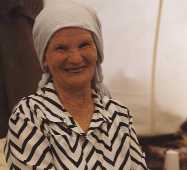
| This woman lives in a special tent for those without family. She was separated from hers upon leaving Kosovo. |
|
|
|
|
| In the Stankovic refugee camp, just 10 kilometers outside of the capital of Macedonia, there are over 3,000 tents in one fenced-in area. Each of those tents contains a family, often two. But one very special tent contains those without family. It is a tent mostly of senior citizens separated from their families in the rush to leave Kosovo. |
|
| Created by the International Catholic Migration Commission (ICMC), the tent provides a home, and a family, for those without. About fifteen men and women stay in two tents, sleeping on foam mattresses and multiple pillows. Their guardian, a Macedonian woman named Eli, lovingly watches over them, scrutinizing media members before she lets any in the tent. |
|
|
| "I love them really," Eli says. "It�s just a shame they have nobody." |
|
|
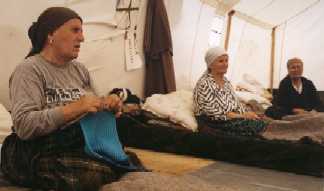
| Hyra, a woman in her 60s, sits and knits. Her son sent her to Pristina, the capital of Kosovo, to supposed safety. The next day Serbian police forced her to board a train, effectively separating her from her family. |
|
| "I�m hoping that my family is still alive," Hyra said. "I�m trying to make them something," she said before stopping to choke back tears. |
|
| She describes Serbian police cutting people�s arms and fingers over the last year, and she made the motion of teeth pulling, all the while the other women listening intently, letting out audible gasps. In the corner, Eli, the caregiver, wipes away tears. |
|
| "We don�t have bad conditions here, but I�m worried about my family in Kosovo," she said. "I�m losing my hope that they�re alive. They don�t have any food." |
|
| Describing how her sons are in the KLA, she gets quiet as Eli, returns. Eli speaks Croatian, the same language as the Serbs speak, and Hyra is worried that Eli will be mad that her sons are in the KLA. Overhearing this, Eli runs up and hugs Hyra, telling her that that doesn�t matter. |
|
| "I�m against Milosovich," Eli said, trying to assure the women that she was on their side. Eli gives Hyra an extended hug, and the tent is all smiles. |
|
| "I love them and they love me, but she thought I would be mad that her sons are in the KLA," Eli says later. |
|
|
|
The women are bathed daily, taken for walks and read to. Sometimes they sing and even dance, Eli said.
The tent, much larger than the average refugee tent, has 12 sponge beds lying on the floor. Eight of them are filled. Their community is obvious, as one woman points around the room saying, "She is my sister and she is my sister and she is my sister." |
|
|
 |
|
|
|
|
|
|
Hyra, far left, knits something in hopes that she can give it to her family, from whom she was separated. |
|
|
| Another woman, Azemina, lived in the mountains before crossing into Macedonia. She was separated from her family at the train station. |
|
| "It was like the Jewish holocaust. Hitler," Azemina says, describing how police pushed and packed people onto the trains. She has two sons, but does not know where they are. |
|
| Sometime though, through communication with family abroad, the women are located and picked up by family members. |
|
| "It�s funny, sometimes when it�s time for them to go, they get sad because they�re leaving (each other)," Eli said. |
|
| The tent hosts people ranging from 55-89 years of age. There was even one "young boy of 101" as Eli called him. He was lucky; a family member found him and picked him up. |
|
| Eli, who speaks more than five languages, including Croatian, Macedonian, Albanian and English, is like a protective parent, watching over her children like a hawk. The tent provides a good, albeit hot, community. |
|
| "Usually when they come they�re stressed and desperate, but here they feel better, here they have friends," Eli says. "I think what they need most is love." |
|
| "They are great people. I adore them." |
|
|
|
Home More Pictures |
|
|
|

|
|